Nanogenerators May Spark Miniature Machines (Update)
Researchers have developed a new technique for powering nanometer-scale devices without the need for bulky energy sources such as batteries. By converting mechanical energy from body movement, muscle stretching or water flow into electricity, these "nanogenerators" could make possible a new class of self-powered implantable medical devices, sensors and portable electronics.
Described in the April 14th issue of the journal Science, the nanogenerators produce current by bending and then releasing zinc oxide nanowires – which are both piezoelectric and semiconducting. The research was sponsored by the National Science Foundation (NSF), the NASA Vehicle Systems Program and the Defense Advanced Research Projects Agency (DARPA).
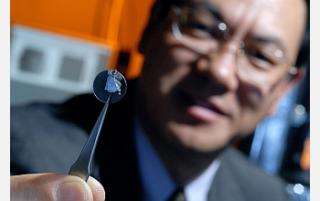
"There is a lot of mechanical energy available in our environment," said Zhong Lin Wang, a Regents Professor in the School of Materials Science and Engineering at the Georgia Institute of Technology. "Our nanogenerators can convert this mechanical energy to electrical energy. This could potentially open up a lot of possibilities for the future of nanotechnology."
Nanotechnology researchers have proposed and developed a broad range of nanoscale devices, but their use has been limited by the sources of energy available to power them. Conventional batteries make the nanoscale systems too large, and the toxic contents of batteries limit their use in the body. Other potential power sources also suffer from significant drawbacks.
"We can build nanodevices that are very small, but if the complete integrated system must include a large power source, that defeats the purpose," added Wang, who also holds affiliated faculty positions at Peking University and the National Center for Nanoscience and Technology of China.
The nanogenerators developed by Wang and graduate student Jinhui Song use the very small piezoelectric discharges created when zinc oxide nanowires are bent and then released. By building interconnected arrays containing millions of such wires, Wang believes he can produce enough current to power nanoscale devices.
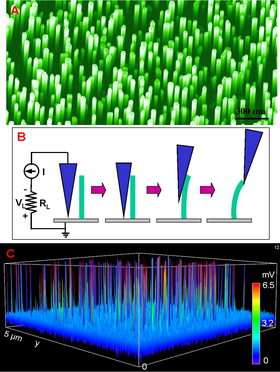
To study the effect, the researchers grew arrays of zinc oxide nanowires, then used an atomic-force microscope tip to deflect individual wires. As a wire was contacted and deflected by the tip, stretching on one side of the structure and compression on the other side created a charge separation – positive on the stretched side and negative on the compressed side – due to the piezoelectric effect.
The charges were preserved in the nanowire because a Schottky barrier was formed between the AFM tip and the nanowire. The coupling between semiconducting and piezoelectric properties resulted in the charging and discharging process when the tip scanned across the nanowire, Wang explained.
When the tip lost contact with the wire, the strain was released – and the researchers measured an electrical current. After the strain release, the nanowire vibrated through many cycles, but the electrical discharge was measured only at the instant when the strain was released.
To rule out other potential sources of the current, the researchers conducted similar tests using structures that were not piezoelectric or semiconducting. "After a variety of tests, we are confident that what we are seeing is a piezoelectric-induced discharge process," Wang said.
The researchers grew the nanowire arrays using a standard vapor-liquid-solid process in a small tube furnace. First, gold nanoparticles were deposited onto a sapphire substrate placed in one end of the furnace. An argon carrier gas was then flowed into the furnace as zinc oxide powder was heated. The nanowires grew beneath the gold nanoparticles, which serve as catalysts.
The resulting arrays contained vertically-aligned nanowires that ranged from 200 to 500 nanometers in length and 20 to 40 nanometers in diameter. The wires grew approximately 100 nanometers apart, as determined by the placement of the gold nanoparticles.
A film of zinc oxide also grew between the wires on the substrate surface, creating an electrical connection between the wires. To that conductive substrate, the researchers attached an electrode for measuring current flow.
Though attractive for use inside the body because zinc oxide is non-toxic, the nanogenerators could also be used wherever mechanical energy – hydraulic motion of seawater, wind or the motion of a foot inside a shoe – is available. The nanowires can be grown not only on crystal substrates, but also on polymer-based films. Use of flexible polymer substrates could one day allow portable devices to be powered by the movement of their users.
"You could envision having these nanogenerators in your shoes to produce electricity as you walk," Wang said. "This could be beneficial to soldiers in the field, who now depend on batteries to power their electrical equipment. As long as the soldiers were moving, they could generate electricity."
Current could also be produced by placing the nanowire arrays into fields of acoustic or ultrasonic energy. Though they are ceramic materials, the nanowires can bend as much as 50 degrees without breaking.
The next step in the research will be to maximize the power produced by an array of the new nanogenerators. Wang estimates that they can convert as much as 30 percent of the input mechanical energy into electrical energy for a single cycle of vibration. That could allow a nanowire array just 10 microns square to power a single nanoscale device – if all the power generated by the nanowire array can be successfully collected.
"Our bodies are good at converting chemical energy from glucose into the mechanical energy of our muscles," Wang noted. "These nanogenerators can take that mechanical energy and convert it to electrical energy for powering devices inside the body. This could open up tremendous possibilities for self-powered implantable medical devices."
Source: Georgia Institute of Technology


