Study: How to avoid becoming a fossil
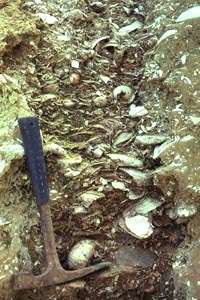
The best way to avoid becoming a fossil is to be small and live in deep, tropical waters. So say four paleontologists who have published a detailed, global study of clam preservation. Their work is intended to enhance evolutionary studies by determining what’s missing from the fossil record and why.
“Everyone talks about how imperfect the fossil record is, but not many people do anything about it,” said David Jablonski, the William Kenan Jr. Professor in Geophysical Sciences at the University of Chicago. “We’re not doing this for the sake of knowing more about clams, but for knowing more about how to answer biological questions in the fossil record more rigorously.”
Jablonski co-authored the study along with James Valentine, University of California, Berkeley; Susan Kidwell, University of Chicago; and Kaustuv Roy, University of California, San Diego. Their study, funded by the National Science Foundation and the National Aeronautics and Space Administration, appears in the April 10-14 Online Early Edition of the Proceedings of the National Academy of Sciences.
The findings will help scientists link the recent fossil record with modern biodiversity to better understand the role of humans in bringing about change in patterns of life on Earth, said Kidwell, the William Rainey Harper Professor in Geophysical Sciences. “This gives us some strategies for how to zero in on the most reliable data,” she said.
The PNAS co-authors focused on bivalves (clams, scallops, oysters, cockles and their kin), because they serve paleontologists the way geneticists use mice or fruit flies as model systems. Jablonski called the clam “a real bellweather” for understanding many long-term changes in biodiversity.
Said Kidwell: “This group is hughly important out there in the modern seas, constituting a big fraction of animal diversity.” Some clams are tiny while others are giants. They pursue lifestyles ranging from parasitic to predatory, and they live everywhere from deep-sea trenches and intertidal zones to freshwater lakes and streams. But do they all have the same chance of becoming fossils?
Jablonski, Kidwell and their colleagues based their study on an examination of museum specimens, combing the scientific literature and conducting statistical analyses. They determined the fossil occurrence of all 1,282 major types living today, then assessed why 24 percent of them failed to become fossils. In some cases, key factors were inextricably linked. “For example, deep-water species tend to have small bodies because there’s so little food down there,” Jablonski said. “Small body size turns out to be bad news for preservation in general, and thus deep-sea species are undercaptured.”
Surprisingly, they found that burrowing clams living within sediments were no more likely to become fossils than similarly sized varieties that lived out in the open.
Perhaps fittingly, parasitic clams fared the worst. “They live inside the burrow of another animal, like a shrimp, or they live parasitically upon the soft tissues of another organism. These guys have a lousy fossil record,” Kidwell said. “If you’re living inside the tissues, or directly attached to the tissues of another organism and it dies, then you’re attached to a corpse of decaying organic matter, which is not favorable to shell preservation.”
The team also found that shell composition played virtually no role in distorting the bivalve fossil record, echoing the findings of a related study that Kidwell published in the Feb. 11, 2005, issue of the journal Science. That study showed, contrary to longstanding expectations, that clams with durable shells were not better represented in the fossil record than those more prone to dissolving.
The PNAS co-authors suggest three remedies for dealing with the weaknesses they’ve documented in the fossil record. First, leave out the poorly documented groups. “Set some kind of cutoff on the quality of the record you’re going to include in your analysis,” Jablonski said. “Sometimes focusing on the most reliable fraction of the record will be the best way to go.”
Second, use all available data, but check to see if the evolutionary patterns they detect are consistent with the distortion of the fossil record. If the patterns run counter to the distortion, then they have probably identified a biological trend so strong that it has overwhelmed the flaws of the fossil record.
Lastly, “we can actually think about ways to correct the record numerically,” Jablonski said, adding back the missing varieties in their expected proportions.
The fossil record of other organisms could be assessed in much the same way, Jablonski said, producing a clearer picture of the biological dynamics of the past.
“The gauntlet is down: look at other groups. Look at sea urchins. Look at birds. Look at mammals. Look at flowering plants,” he said. “I’d like to think that we’ve produced a template for analyzing other groups. And of course as those analyses begin to accumulate, we’ll have a much clearer picture of what’s missing from the fossil record and how to make corrections, producing a clearer picture of the biological dynamics of the past.”
Source: University of Chicago


