Purdue creates simpler alternative for mass spectrometers
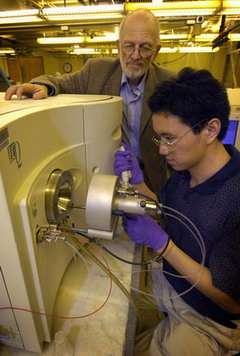
Purdue University researchers have developed a relatively simple alternative to sophisticated techniques now used to ionize materials, a critical step needed for chemical analyses involving instruments called mass spectrometers.
Unlike current techniques, the method works at ordinary atmospheric pressure instead of inside a mass spectrometer's vacuum chamber, and it does not require exotic technologies such as electron beams and lasers, said R. Graham Cooks, the Henry Bohn Hass Distinguished Professor of Analytical Chemistry in Purdue's College of Science.
Researchers have used the new method, called atmospheric-pressure thermal desorption ionization, to ionize various materials, including "organic salts," which play vital roles in biological processes.
"This is the first time researchers have done this at atmospheric pressure," said doctoral student Hao Chen.
Examples of organic salts include molecules such as proteins and lipids, which are critical for cell function. Scientists use mass spectrometry to learn about the composition of tissues and cells and in the field of proteomics, which requires identifying specific proteins and their proportions in biological samples such as blood.
Research findings regarding the new ionization technique are detailed in a paper now posted online and to appear in an upcoming issue of the European journal Angewandte Chemie. The paper was written by Chen, associate research scientist Zheng Ouyang and Cooks.
Mass spectrometry works by first turning molecules into ions — electrically charged versions of themselves — so that they can be detected and their masses can be measured. Conventional mass spectrometers analyze samples that are specially prepared and placed in a vacuum chamber.
The new "thermal ionization system" has been proven to be surprisingly accurate in revealing the masses of molecules in the materials being analyzed, Cooks said.
"We have shown that the spectrum is pretty clean and that there are almost no fragment ions, which was unexpected," Cooks said.
The researchers also used the method to ionize a material called an ionic liquid, which is like a "molten salt" at room temperature, Cooks said.
The ionic liquids are promising "green" alternatives to current solvents for industry and research because they are more environmentally friendly for making chemical compounds and can be easily recycled. Solvents are crucial for carrying out chemical reactions in research and to make pharmaceuticals and compounds vital for various industries.
The Purdue researchers placed the materials to be analyzed in a metal or ceramic tube that was heated to as hot as 300 degrees Celsius, separating the positively and negatively charged ions of the material and producing positively charged ions. Then, the ions in vapor form were mixed with nitrogen as a "carrier gas" and sucked by vacuum into the mass spectrometer.
"The two most important aspects are that this can be done at atmospheric pressure and just by heating a sample, a procedure which is much simpler than existing ionization methods using a laser or high-energy beam," Cooks said. "The method does not require a high-voltage power source."
The method shows promise for widespread applications because it could be used to ionize "non-volatile compounds" besides organic salts and ionic liquid, Cooks said. Examples of non-volatile compounds are amino acids and peptides, the building blocks of proteins.
The Purdue researchers also showed how to make the technique at least 10 times more sensitive by mixing the material being ionized with a solid or gas "matrix."
Using a matrix enabled the researchers to detect the amino acid lysine in a quantity of 200 picograms — the equivalent of ten-millionths the mass of a grain of sand.
Cooks' research group also has developed a method called desorption electrospray ionization, or DESI, which has been used to rapidly detect everything from cancer in the liver to explosives residues on luggage and "biomarkers" in urine that provide an early warning for diseases. While DESI performs the ionization step in the air or directly on surfaces outside of the mass spectrometer's vacuum chamber, the technique requires a high-voltage source, Cooks said.
"DESI is great for certain applications, but atmospheric-pressure thermal desorption ionization is even easier to use," he said. "However, this new technique is not able to perform some things that DESI can, including the biological imaging for disease detection."
The research has been funded by the National Science Foundation. Cooks' team is associated with several research centers at, or affiliated with, Purdue, including the Bindley Bioscience Center at the university's Discovery Park, the Indiana Instrumentation Institute, Inproteo LLC (formerly the Indiana Proteomics Consortium) and the Center for Sensing Science and Technology.
Future research using the new technique could involve proteomics.
Source: by Emil Venere


