Argonne researchers find 217 new targets for anti-cancer drugs
By identifying novel genes critical to cancer progression, biologists at the U.S. Department of Energy's Argonne National Laboratory have expanded the number of drug targets researchers have available for study to find ways to stop tumors in their tracks. The report is published today in Cancer Research.
The study centers on capillary formation, or angiogenesis, a process shown to be essential to tumor progression as tumors attract capillaries to provide oxygen essential for growth and frequently use those same vessels to send out metastatic cells. By zeroing in on these capillary-forming proteins, drug researchers may be able to treat a tumor by directly cutting off its blood supply.
Drug researchers, using tools available since the human genome was sequenced, seek specific targets to develop more precise cancer drugs with fewer side effects. "Once you have a unique target," explained biologist Diane Rodi, "you don't have the side effects of the drugs – most cancer drugs are anti-growth drugs that kill all the growing cells in the body. Most cancer therapies are not very specific and that is why they are so toxic."
The Argonne biologists identified 217 proteins involved only in capillary formation -- morphogenesis -- by finding all the gene products turned on during capillary formation and subtracting out those related only to growth, or proliferation, in a novel process called subtractive transcriptomics.
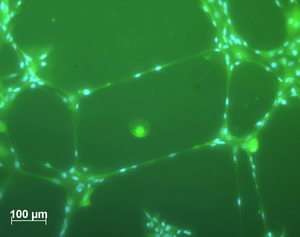
Argonne biologists grew human endothelial cells – the cells involved in blood vessel formation – on a tumor tissue-mimicking plate. As the capillaries grew over an 8-hour period, researchers isolated RNA samples at intervals – at 30 minutes, 1 hour, 2 hours, 4 hours and 8 hours. To determine which genes do not contribute specifically to blood vessel formation, endothelial cells were grown on gelatin-coated plastic. RNA was isolated at the same intervals as on the tumor tissue-mimicking plate.
Each RNA sample was tested using microarray analysis at the University of Chicago. The microarrays hold 44,000 samples of known RNA coded by the human genome. A reaction reveals the RNA that is being produced at each stage of the biological process. RNA codes for proteins.
"We wanted to find the proteins that are only made when the endothelial cells are making a capillary, not when they are just growing," Rodi said. "We took all of the genes that were made on the tissue plate and subtracted out those from the plastic plate. And we were left with 217."
The researchers sought the proteins in the capillaries using commercially available antibodies. Of the 16 morphogenesis-specific proteins tested, all were found in the capillaries after they were completely formed.
The capillary research revealed a bonus insight into a still mysterious nature of cells – their polarity. Cells are not the same all over their surface – different sections perform different tasks like acting as environmental sensors or making little “feet” to mediate cell movement. But researchers do not yet know all of the genes which are involved in polarity.
The majority of the 217 proteins identified by the Argonne group manage movement within the cell, long distance migration, cytoskeletal reorganization and cellular stickiness – all processes involved in cell polarity. The Argonne study revealed that more angiogenic genes are involved in polarity than previously believed, and identified a large number of novel proteins which may be rate-limiting for the angiogenic process.
"This information will help with developing new drugs," Rodi said. "Once you know a gene product helps out in a process, then it automatically becomes a possible drug target."
The next step is to find antibodies to the rest of the 217 genes – only about 50 are commercially available – and determine if they all are present in the capillaries. They are relying on a novel approach to express human proteins high throughput in bacteria that other Argonne biologists are in the process of developing. Long-term research could lead to new medications for cancer as well as for eczema, macular degeneration and rheumatoid arthritis – other diseases involving pathological capillary formation.
Source: Argonne National Laboratory


