Quantum dots self-tune their color for ultra-efficient nano lasers
April 14, 2006 Quantum dots self-tune their color for ultra-efficient nano lasers

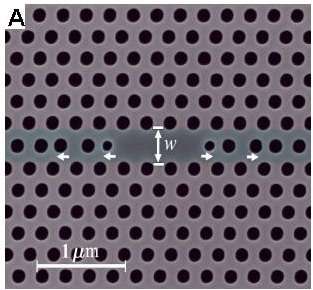
Fig. A. In this design of the ultra-efficient photonic crystal nano laser, a top-view electron microscope image shows the drilled hole pattern in a GaAs membrane. The three missing holes in a row at the center define the nano cavity, which confines the light. To finely tune the electromagnetic field, a waveguide (w) has been inserted and neighboring holes have been resized and shifted. Photo Credit: Stefan Strauf.

The laser, one of the most valuable scientific instruments, is getting smaller and more efficient. Scientists have designed a miniature laser, whose nanoscale dimensions and low optical losses will be instrumental in future developments of integrated photonic circuits.

Compared with a regular flashlight, a laser emits a very intense and strongly collimated beam of monochromatic light. These properties arise from an interaction between the gain medium and an optical cavity. In order for a laser to generate its tiny colored spot, the active gain medium, which amplifies the beam, must provide photons that are all emitted at the same wavelength in a process called “stimulated emission.”

While generating sufficient stimulated emission usually requires a great deal of gain material, scientists have discovered a method to create a nano laser with only a few tiny objects called “quantum dots.” Physicists from UC Santa Barbara and the University of Pavia in Italy have designed a new nano-device that works with only two to four quantum dots. The design, which provides ultra-efficient lasing performance, is published in a recent Physical Review Letters.

“While conventional quantum dot lasers require many layers with thousands of dots, this new design takes advantage of a quantum dot property that effectively self-tunes the dots’ photon emission wavelength into resonance with the cavity,” explained co-author Stefan Strauf to PhysOrg.com. When the gain medium resonates with the cavity, a laser can be created.”

Individual quantum dots have very sharp transition energy, and a large number of dots will display a broad emission bandwidth due to their natural size variations. While this broad emission makes them an ideal gain material for large volume lasers, device miniaturization presents a challenge since the sharp transitions of a few quantum dots no longer resonate with the laser cavity.

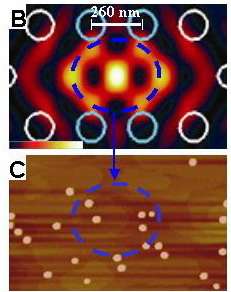
The team of scientists found a way out of this dilemma by embedding the dots in a photonic crystal nano cavity, which enables light to be confined in a very small volume. A photonic crystal can be made by drilling many holes within a thin membrane of a semiconductor material such as GaAs (see figure). This particular design provides a finely tuned distribution of the electromagnetic field inside the nanocavity, which optimizes the overlap of the embedded quantum dots with the field profile and increases the quality of the cavity.

“This optimization process is a lot like the skillful fine-tuning of a violin producing resonance tones, but for light instead of sound,” said Strauf.
Quantum dots self-tune their color for ultra-efficient nano lasers

Fig. B and C. (B) This image shows a close-up of the resulting field profile around the tuned nano cavity region, where the yellow-white color is the highest field strength. (C) This atomic-force microscope image shows a typical layer of the low-density quantum dot gain material that is embedded underneath the surface of the membrane. The bright spots are individual InAs quantum dots, about 20 nm in size. The dashed blue circles indicate that there are on average only a few dots spatially positioned within the field profile of the nano cavity. Photo Credit: Stefan Strauf.

This design drastically inhibits the emission of the dots at their natural sharp energies and forces them to interact with electronic carriers in their immediate surroundings. Because this interaction provides additional energy, the dots can self-tune their emission color into resonance with the cavity. Since this is a very pronounced interaction, the nano lasers display a hundredfold improvement of their lasing threshold values compared with any other semiconductor laser.

In addition to the record low lasing threshold produced with a couple of quantum dots, the scientists found a much higher optical efficiency than exhibited in high density quantum dot devices. Measuring the optical efficiency with the spontaneous emission coupling factor (which has a theoretical limit of 1.0), the team found that the new method exhibited a value of 0.85, while multi-layer quantum dot lasers have a factor ranging from 0.1-0.2.

“The record low lasing thresholds combined with the high efficiencies make these nano lasers useful for future applications in integrated photonic circuits on a chip and for bio sensing of individual molecules,” said Strauf. “Such nano lasers may now be formed with only a few or even a single quantum dot.”

Citation: Strauf, S. et al. Self-Tuned Quantum Dot Gain in Photonic Crystal Lasers. Physical Review Letters 96, 127404 (2006).

By Lisa Zyga, Copyright 2006 PhysOrg.com


print this article email this article download pdf blog this article bookmark this article     Stumble it Digg this share on Facebook retweet share on Reddit add to delicious
Rate this story - 4.3 /5 (129 votes)


April 14, 2006 all stories

Comments: 0

4.3 /5 (129 votes)
  • Stumble this up

  • Digg this

  • share this

  • hide
  • Related Stories

  • JQI researchers create entangled photons from quantum dots
    created Nov 18, 2009 | popularity not rated yet | comments 0
  • Atoms don't dance the 'Bose Nova'
    created Sep 03, 2009 | popularity not rated yet | comments 0
  • Confined electrons live longer
    created Aug 18, 2009 | popularity not rated yet | comments 0
  • New DNA test uses nanotechnology to find early signs of cancer
    created Aug 17, 2009 | popularity not rated yet | comments 0
  • Scientists develop novel ion trap for sensing force and light
    created Jul 01, 2009 | popularity not rated yet | comments 0


Other News

Peptides control crystal growth with 'switches, throttles and brakes'

Peptides control crystal growth with 'switches, throttles and brakes'

Nanotechnology / Bio & Medicine

created 9 minutes ago | popularity not rated yet | comments 0

(PhysOrg.com) -- By producing some of the highest resolution images of peptides attaching to mineral surfaces, scientists have a deeper understanding how biomolecules manipulate the growth crystals. This research ...


Nanoparticles used in common household items caused genetic damage in mice

Nanotechnology / Bio & Medicine

created Nov 16, 2009 | popularity 4.8 / 5 (24) | comments 11

Titanium dioxide (TiO2) nanoparticles, found in everything from cosmetics to sunscreen to paint to vitamins, caused systemic genetic damage in mice, according to a comprehensive study conducted by researchers at UCLA's Jonsson ...


Nanotube defects equal better energy and storage systems

Nanotube defects equal better energy and storage systems

Nanotechnology / Nanomaterials

created Nov 19, 2009 | popularity 4.4 / 5 (10) | comments 2

(PhysOrg.com) -- Most people would like to be able to charge their cell phones and other personal electronics quickly and not too often. A recent discovery made by UC San Diego engineers could lead to carbon ...


Using superconducting probes to get a picture of what it's like inside CNTs

Nanotechnology / Nanophysics

created Nov 20, 2009 | popularity 4.9 / 5 (8) | comments 0

(PhysOrg.com) -- "Carbon nanotubes are exciting for fundamental physics, and for potential technological applications," Nadya Mason tells PhysOrg.com. "However, we are generally limited in the way that we can study them. ...


New study confirms exotic electric properties of graphene

New study confirms exotic electric properties of graphene

Nanotechnology / Nanomaterials

created Nov 17, 2009 | popularity 4.8 / 5 (23) | comments 1

(PhysOrg.com) -- First, it was the soccer-ball-shaped molecules dubbed buckyballs. Then it was the cylindrically shaped nanotubes. Now, the hottest new material in physics and nanotechnology is graphene: ...