Paint-on laser could rescue computer chip industry from 'interconnect bottleneck'
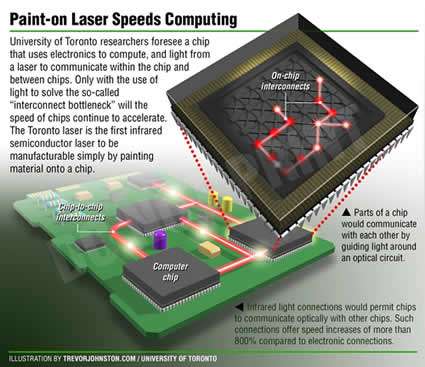
Researchers at the University of Toronto have created a laser that could help save the $200-billion dollar computer chip industry from a looming crisis dubbed the "interconnect bottleneck." But this isn't a laser in the stereotypical sense -- no corded, clunky boxes projecting different coloured lights. In fact, Professor Ted Sargent, of the Edward S. Rogers Sr. Department of Electrical and Computer Engineering, carries a small vial of the paint used to make this laser in his briefcase -- it looks like diluted ink.
Lasers that can produce coherent infrared light in the one to two micrometre wavelength range are essential in telecommunications, biomedical diagnosis and optical sensing. The speed and density of computer chips has risen exponentially over the years, and within 15 to 20 years the industry is expected to reach a point where components can't get any faster. But the interconnect bottleneck -- the point where microchips reach their capacity -- is expected sometime around 2010.
To tackle this problem, Sargent, a Canada Research Chair in Nanotechnology, created the new laser using colloidal quantum dots -- nanometre-sized particles of semiconductor that are suspended in a solvent like the particles in paint. "We've made a laser that can be smeared onto another material," says Sargent. "This is the first paint-on semiconductor laser to produce the invisible colours of light needed to carry information through fiber-optics. The infrared light could, in the future, be used to connect microprocessors on a silicon computer chip." A study describing the laser was published in the April 17 issue of the journal Optics Express.
According to Sjoerd Hoogland, a post-doctoral fellow and the first author of the paper, "this laser could help us to keep feeding the information-hungry Internet generation." The laser's most remarkable feature was its simplicity. "I made the laser by dipping a miniature glass tube in the paint and then drying it with a hairdryer," he said. "Once the right nanoparticles are made, the procedure takes about five minutes."
The microchip industry is looking for components that exist on the scale of transistors and are made of semiconductors, which would produce light when exposed to electrical current. With this development, it could be possible to use the electronics already found on microchips to power a laser that communicates within the chip itself.
"We crystallized precisely the size of the nanoparticles that would tune the colour of light coming from the laser. We chose nanoparticle size, and thus colour, the way a guitarist chooses frets to select the pitch of the instrument," Hoogland said. "Optical data transfer relies on light in the infrared--beams of light 1.5 micrometers in wavelength travel farthest in glass. We made our particles just the right size to generate laser light at exactly this wavelength."
Lionel C. Kimerling, Thomas Lord Professor of Materials Science and director of the Microphotonics Center at the Massachusetts Institute of Technology, reviewed the work. "The wavelength and the thermal budget of the Toronto laser are very appealing for applications in optical interconnects," Kimerling says. "The performance is excellent, particularly the temperature insensitivity of the output wavelength."
Source: University of Toronto


