Hubble Captures Magellanic Gemstones In The Southern Sky
April 18, 2006 Magellanic gemstones in the southern sky

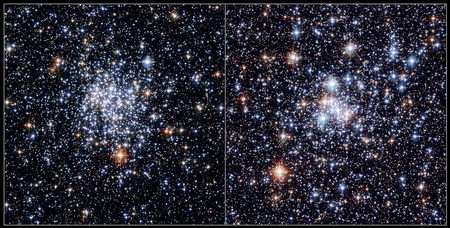
Hubble has captured the most detailed images to date of the open star clusters NGC 265 and NGC 290 in the Small Magellanic Cloud - two sparkling sets of gemstones in the southern sky. Two new composite images taken with the Advanced Camera for Surveys onboard the NASA/ESA Hubble Space Telescope show a myriad of stars in crystal clear detail. The brilliant open star clusters, NGC 265 and NGC 290, are located about 200,000 light-years away and are roughly 65 light-years across. Credit: European Space Agency & NASA

NASA's Hubble Space Telescope has captured the most detailed images to date of the open star clusters NGC 265 and NGC 290 in the Small Magellanic Cloud.

Hubble has captured the most detailed images to date of the open star clusters NGC 265 and NGC 290 in the Small Magellanic Cloud - two sparkling sets of gemstones in the southern sky.

Two new composite images taken with the Advanced Camera for Surveys onboard the NASA/ESA Hubble Space Telescope show a myriad of stars in crystal clear detail. The brilliant open star clusters, NGC 265 and NGC 290, are located about 200,000 light-years away and are roughly 65 light-years across.

Star clusters can be held together tightly by gravity, as is the case with densely packed crowds of hundreds of thousands of stars, called globular clusters. Or, they can be more loosely bound, irregularly shaped groupings of up to several thousands of stars, like the open clusters shown in this image.

The stars in these open clusters are all relatively young and were born from the same cloud of interstellar gas. Just as old school-friends drift apart after graduation, the stars in an open cluster will only remain together for a limited time and gradually disperse into space, pulled away by the gravitational tugs of other passing clusters and clouds of gas. Most open clusters dissolve within a few hundred million years, whereas the more tightly bound globular clusters can exist for many billions of years.

Open star clusters make excellent astronomical laboratories. The stars may have different masses, but all are at about the same distance, move in the same general direction, and have approximately the same age and chemical composition. They can be studied and compared to find out more about stellar evolution, the ages of such clusters, and much more.

The Small Magellanic Cloud, which hosts the two star clusters, is the smaller of the two companion dwarf galaxies of the Milky Way named after the Portuguese seafarer Ferdinand Magellan (1480-1521). It can be seen with the unaided eye as a hazy patch in the constellation Tucana (the Toucan) in the Southern Hemisphere. Both the Small and the Large Magellanic Clouds are rich in gas nebulae and star clusters. It is most likely that these irregular galaxies have been disrupted through repeated interactions with the Milky Way, resulting in the vigorous star-forming activity seen throughout the clouds. NGC 265 and NGC 290 may very well owe their existence to these close encounters with the Milky Way.

Source: Hubble Information Centre


print this article email this article download pdf blog this article bookmark this article     Stumble it Digg this share on Facebook retweet share on Reddit add to delicious
Rate this story - 4 /5 (7 votes)


April 18, 2006 all stories

Comments: 0

4 /5 (7 votes)
  • Stumble this up

  • Digg this

  • share this

  • hide
  • Related Stories

  • Opening up a colorful cosmic jewel box
    created Oct 29, 2009 | popularity not rated yet | comments 0
  • Sky merger yields sparkling dividends
    created Oct 13, 2009 | popularity not rated yet | comments 0
  • Stripped down: Hubble highlights two galaxies that are losing it
    created Sep 30, 2009 | popularity not rated yet | comments 0
  • An Eagle of Cosmic Proportions
    created Jul 16, 2009 | popularity not rated yet | comments 0
  • Starbursts in Dwarf Galaxies are a Global Affair
    created Apr 30, 2009 | popularity not rated yet | comments 0


Other News

Deep creep means milder, more frequent earthquakes along Southern California's San Jacinto fault

Deep creep means milder, more frequent earthquakes along Southern California's San Jacinto fault

Space & Earth / Earth Sciences

created 6 hours ago | popularity 4.7 / 5 (3) | comments 0

With an average of four mini-earthquakes per day, Southern California's San Jacinto fault constantly adjusts to make it a less likely candidate for a major earthquake than its quiet neighbor to the east, the ...


Success in 'space elevator' competition (AP)

Success in 'space elevator' competition (Update 3)

Space & Earth / Space Exploration

created Nov 05, 2009 | popularity 4.3 / 5 (33) | comments 50

(AP) -- A robot powered by a ground-based laser beam climbed a long cable dangling from a helicopter on Wednesday to qualify for prize money in a $2 million competition to test the potential reality of the ...


In a Galaxy Far, Far Away...

In a Galaxy Far, Far Away...

Space & Earth / Astronomy

created Nov 06, 2009 | popularity 4.8 / 5 (5) | comments 14

(PhysOrg.com) -- Astronomers have published the discovery of the farthest known object in the cosmos: a star that exploded when the universe was only 630 million years old -- only 4.6% of its current age. ...


'Dropouts' pinpoint earliest galaxies

'Dropouts' pinpoint earliest galaxies

Space & Earth / Astronomy

created Nov 06, 2009 | popularity 4.2 / 5 (10) | comments 12

Astronomers, conducting the broadest survey to date of galaxies from about 800 million years after the Big Bang, have found 22 early galaxies and confirmed the age of one by its characteristic hydrogen signature ...


Space hotel taking bookings for 2012 opening

Space hotel taking bookings for 2012 opening

Space & Earth / Space Exploration

created Nov 05, 2009 | popularity 4.4 / 5 (20) | comments 11

(PhysOrg.com) -- The first orbiting space hotel is on track to open for its first customers in 2012, but hurry, as bookings are filling fast.