Gold 'Nanostars' Could Be Ultra-Sensitive Chemical Sensors
April 18th, 2006 'Nanostars' could be ultra-sensitive chemical sensors

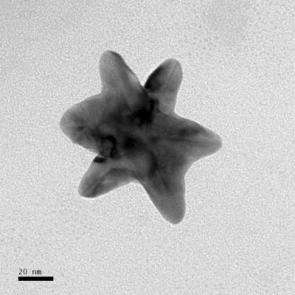
The nanostar's 3-D spikes are visible in this image from a transmission electron microscope. Credit: Jason Hafner/Rice University

New optics research from Rice University's Laboratory for Nanophotonics suggests that tiny gold particles called nanostars could become powerful chemical sensors.

The findings are available online and due to appear in an upcoming issue of the journal Nano Letters. Nanophotonics is a rapidly growing field of study that looks at ways to generate and manipulate light using ultrasmall, engineered structures. The virus-sized nanostars, so named because of their spiky surface, are one of a growing number of intricately shaped particles that are increasingly drawing the attention of experts at LANP and other leading photonics labs.

"Just a few years ago, everyone's attention was on the size of nanoparticles because altering size was a straightforward way to change the wavelength of light that the particle reacted with," said lead researcher Jason Hafner, associate director of LANP and assistant professor of physics and astronomy and of chemistry. "Today, researchers are increasingly interested in intricate shapes and the specific ways that those shapes affect a particle's interaction with light."

Most nanophotonic research at LANP involves the study of plasmons, waves of electrons that flow like a fluid across metal surfaces. Light can be used to amplify plasmon waves on metal nanoparticles. Like a child in a bathtub, rhythmically building waves until they slosh out of the tub, the plasmons on the particles dramatically amplified with wavelengths of light that correspond to the rhythm of the electron waves. The study of plasmonics is one of the fastest growing fields in optics because it could prove useful for a wide range of applications in biological sensing, microelectronics, chemical detection, medical technology and others.

"LANP is building a broad-based plasmonics research program at Rice, and our recent cutting-edge work on novel structures like nanostars and nanorice is a clear indication of leadership we're building in this field," said LANP Director Naomi Halas, the Stanley C. Moore Professor of Electrical and Computer Engineering and professor of chemistry.

Nanostars incorporate some of the best properties of oft-studied photonic particles like nanorods and quantum dots. For example, they deliver strong spectral peaks that are easy to distinguish with relatively low-cost detectors. But Hafner's team found unique properties too. A painstaking analysis revealed that each spike on a nanostar has a unique spectral signature, and preliminary tests show that these signatures can be used to discern the three-dimensional orientation of the nanostar, which could open up new possibilities for 3-D molecular sensing.

"We are just getting started with our follow-up work, but nanostars clearly offer some exciting possibilities," said Hafner, assistant professor of physics and astronomy and of chemistry. "Their extreme sensitivity to the local dielectric environment is a particularly attractive quality for molecular sensing."

Source: Rice University


print this article email this article download pdf blog this article bookmark this article     Digg this Stumble it share on Facebook share on Reddit add to delicious save to Yahoo! bookmarks
4.3/5 after 15 votes


April 18th, 2006 all stories
Nanotechnology /

Comments: 0
Rank: 4.3/5 after 15 votes

  • Stumble this up

  • Digg this

  • Share it:
  • share on Facebook
  • share on MySpace
  • share on Slashdot
  • rss-newsfeed
  • share on Google
  • share on Reddit
  • add to delicious
  • save to Yahoo! bookmarks
  • share on Windows Live
  • Add to Mixx!
Rating: 4.3/5 after 15 votes

  • Related Stories

  • Rice scientists unveil 'nanoegg'
    created Jul 20, 2006 | popularity not rated yet | comments 0
  • Rice University researchers create 'nanorice'
    created Mar 14, 2006 | popularity not rated yet | comments 0
  • Rice researchers gain new insight into nanoscale optics
    created Sep 14, 2005 | popularity not rated yet | comments 0
  • VLBA locates superenergetic bursts near giant black hole
    created Jul 02, 2009 | popularity not rated yet | comments 0
  • Fermi Telescope reveals a population of radio-quiet gamma-ray pulsars
    created Jul 02, 2009 | popularity not rated yet | comments 0

Tags


  • Physicists Demonstrate Quantum Memory with Matter Qubits
    Physicists Demonstrate Quantum Memory with Matter Qubits
    Physics / General Physics
    created Jul 03, 2009 | popularity 4.4 / 5 (17) | comments 1
  • 'Holey' Nanosheets for Wastewater Dye Removal
    Nanotechnology / Nanomaterials
    created Jul 01, 2009 | popularity 5 / 5 (5) | comments 1
  • Jellyfish Robot Swims Like its Biological Counterpart
    Jellyfish Robot Swims Like its Biological Counterpart
    Electronics / Robotics
    created Jun 26, 2009 | popularity 4.4 / 5 (8) | comments 1
  • Could Maxwell's Demon Exist in Nanoscale Systems?
    Could Maxwell's Demon Exist in Nanoscale Systems?
    Physics / General Physics
    created Jun 24, 2009 | popularity 4.4 / 5 (18) | comments 29
  • Living Safely with Robots, Beyond Asimov's Laws
    Living Safely with Robots, Beyond Asimov's Laws
    Electronics / Robotics
    created Jun 22, 2009 | popularity 4.6 / 5 (52) | comments 40
  • Other News

    A 'quantum of sol' -- how nanotechnology could hold the key to a solar-powered future

    A 'quantum of sol' -- how nanotechnology could hold the key to a solar-powered future

    Nanotechnology / Nanomaterials

    created Jun 30, 2009 | popularity 3.9 / 5 (14) | comments 16

    (PhysOrg.com) -- A new generation of 'nano-structured' millimetre-sized solar cells that could convert the sun's energy to electricity more than twice as efficiently as current technology, is the subject of ...


    Australian researchers are set to begin human trials of a tiny nano-cell that acts as a "Trojan horse" against cancer

    Hi-tech 'Trojan horse' can kill cancer cells: researchers

    Nanotechnology / Bio & Medicine

    created Jun 29, 2009 | popularity 4.6 / 5 (11) | comments 7

    Australian researchers are set to begin human trials of a tiny nano-cell that acts as a "Trojan horse" against cancer cells, a breakthrough they say may curb the need for debilitating chemotherapy.


    'Holey' Nanosheets for Wastewater Dye Removal

    Nanotechnology / Nanomaterials

    created Jul 01, 2009 | popularity 5 / 5 (5) | comments 1

    (PhysOrg.com) -- Researchers have discovered that extremely thin sheets of nickel oxide with hexagonally shaped holes can absorb hazardous dyes from wastewater nearly as well as the best traditional methods, but are recyclable. ...


    Harnessing Nanoparticles To Track Cancer Cell Changes

    Nanotechnology / Bio & Medicine

    created Jul 03, 2009 | popularity not rated yet | comments 1

    The more dots there are, the more accurate a picture you get when you connect them. Cancer researchers adopting that philosophy have developed a new imaging technology that could give scientists the ability to simultaneously ...


    Computer-Guided Nanoparticle Therapy Destroys Tumors

    Nanotechnology / Bio & Medicine

    created Jun 29, 2009 | popularity 5 / 5 (11) | comments 0

    Gold nanoshells are among the most promising new nanoscale therapeutics being developed to kill tumors, acting as antennas that turn light energy into heat that cooks cancer to death. Now, a multi-institutional research team ...