'Word-vision' brain area confirmed
April 19, 2006 Brain

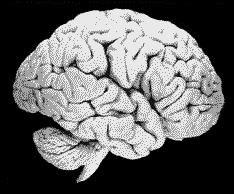
French neuroscientists have ended a long controversy, confirming a specific area of the human brain plays a causal role in our ability to recognize words.

Humans have an uncanny ability to skim through text, instantly recognizing words by their shape -- even though writing developed only about 6000 years ago, long after humans evolved. Thus, scientists have hotly debated whether an area of the cortex called the Visual Word Form Area, or VWFA, is a specific and necessary area for recognizing words.

Functional MRI scans have shown the area activates when people read, as opposed to recognizing other objects, such as faces or houses. And people with lesions in that region lose the ability to recognize whole words, reduced to letter-by-letter reading. But fMRI studies have not demonstrated a causal role for the VWFA, and lesions involving the VWFA invariably involved other regions as well.

Now, a patient whose surgery to relieve epilepsy specifically disrupted the VWFA has given researchers -- led by Laurent Cohen of the Hospital of Salpetriere in Paris -- an opportunity to demonstrate the region does indeed play a causal role in our ability to recognize words.

The research appears in the journal Neuron.

Copyright 2006 by United Press International


Rate this story - 3.6 /5 (5 votes)


April 19, 2006 all stories

Comments: 0

3.6 /5 (5 votes)

  • hide
  • Related Stories

  • Virtual USA
    created Jan 29, 2010 | popularity not rated yet | comments 0
  • Face recognition ability inherited separately from IQ
    created Jan 19, 2010 | popularity not rated yet | comments 0
  • Researchers say vaccine appears to 'mop up' leukemia cells Gleevec leaves behind
    created Jan 07, 2010 | popularity not rated yet | comments 0
  • Next generation lens promises more control
    created Dec 20, 2009 | popularity not rated yet | comments 0
  • Scientists decode memory-forming brain cell conversations
    created Dec 16, 2009 | popularity not rated yet | comments 0


Other News

Study challenges bird-from-dinosaur theory of evolution - was it the other way around?

Study challenges bird-from-dinosaur theory of evolution - was it the other way around?

Other Sciences / Archaeology & Fossils

created 5 hours ago | popularity 4.2 / 5 (6) | comments 2 | with audio podcast

(PhysOrg.com) -- A new study just published in the Proceedings of the National Academy of Sciences provides yet more evidence that birds did not descend from ground-dwelling theropod dinosaurs, experts say, a ...


'Counterfactual' thinkers are more motivated and analytical, study suggests

Other Sciences / Social Sciences

created 8 hours ago | popularity 4.3 / 5 (3) | comments 3 | with audio podcast

(PhysOrg.com) -- "If only I had..." Almost everyone has said those four words at some time. Rather than intensifying regret, '"what if" reflection about pivotal moments in the past helps people to weave a coherent life story, ...


Women on board: Does forced diversity hurt firm performance?

Other Sciences / Social Sciences

created 6 hours ago | popularity not rated yet | comments 1

(PhysOrg.com) -- New SEC rules will require public firms to disclose what role, if any, diversity plays in appointing members to their corporate boards, but University of Michigan researchers say any forced restructuring ...


Office romance? Not a problem most of time: study

Office romance? Not a problem most of time: study

Other Sciences / Social Sciences

created 6 hours ago | popularity not rated yet | comments 1

(PhysOrg.com) -- Pam and Jim on The Office. Meredith and McDreamy on Grey's Anatomy. Television shows depict many workplace romances, but in the real world how do co-workers view love on the job? According ...


Study: Cell-phone bans while driving have more impact in dense, urban areas

Study: Cell-phone bans while driving have more impact in dense, urban areas

Other Sciences / Social Sciences

created 8 hours ago | popularity not rated yet | comments 1

A new study analyzing the impact of hand-held cell phone legislation on driving safety concludes that usage-ban laws had more of an impact in densely populated urban areas with a higher number of licensed ...