Galaxies cluster near dark matter, study finds
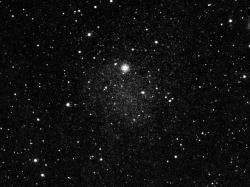
Try mixing caramel into vanilla ice cream -- you will always end up with globs and swirls of caramel. Scientists are finding that galaxies may distribute themselves in similar ways throughout the universe and in places where there is lots of so-called dark matter.
"Our findings suggest that unseen dark matter -- which emits no light but has mass -- has had a major effect on the formation and evolution of galaxies, and that bright active galaxies are only born within dark matter clumps of a certain size in the young universe," said Cornell University research associate Duncan Farrah, the lead author of a paper on spatial clustering that appeared in the April 10 issue of Astrophysical Journal Letters.
To investigate the spatial distribution of galaxies, Farrah used data that recently became available from the Spitzer Wide-area InfraRed Extragalactic (SWIRE) survey, one of the largest such surveys performed by the Spitzer Space Telescope, which was launched in 2003.
A galaxy is typically made up of hundreds of billions of stars grouped tightly together. But galaxies themselves often group together into what astronomers call "large-scale structures." And, just as galaxies themselves can take on such shapes as ellipticals and spirals, so, too, can the large-scale structures, ranging from galaxy clusters to long filaments of galaxies to large, empty voids.
"You might think that galaxies are just distributed randomly across the sky, like throwing a handful of sand onto the floor," said Farrar. "But the problem is they are not, and this has been a great puzzle."
Farrah is interested in how large-scale structures form. To measure the amount of clustering in the early universe, he looked at light that had traveled for several billion years from extremely distant galaxies. From this he was able to calculate the amount of bunching in candidate galaxy clusters in the early universe.
"We wanted to find the beacons of the first stages of the formation of a galaxy cluster because, at that time, the clusters themselves had not formed yet," said Farrah.
In particular, he was interested in objects that emit strongly in the infrared and are surrounded by dense gas and dust. These objects, known as ultraluminous infrared galaxies (ULIRGs), were thought to be precursors of galaxy clusters. Farrah confirmed this by showing that ULIRGs do, indeed, tend to cluster in their early phases. The ability to pinpoint the locations of nascent galaxy clusters will enable researchers to investigate early cluster formations and when they occurred.
Farrah's finding that distant ULIRGs are linked with large clumps of dark matter was surprising for another reason. As its name suggests, dark matter doesn't emit light so no conventional telescope can see it. However, because dark matter has mass, its existence can be inferred by the way stars are drawn to regions where this mysterious mass is concentrated.
Unexpectedly, Farrah found that ULIRGs at different points in the history of the universe coincide with clumps of dark matter haloes of very similar masses. This observation suggests that a minimum amount of dark matter is necessary for galaxies to form and to coalesce into clusters. Farrah believes his study also provides valuable insights into understanding how dark matter helped mold the evolution of the universe.
Carol Lonsdale of NASA's Jet Propulsion Laboratory, which manages the Spitzer Space Telescope, is the principal investigator for the SWIRE project.
Source: Cornell University, by Alex Kwan


