Infrared Space Observatory provides the first view of monstrous stars being born
April 20, 2006 Infrared Space Observatory provides the first view of monstrous stars being born

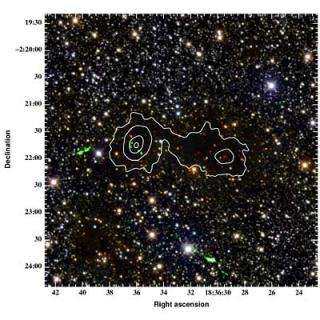
The ISOSS J18364--0221 region contains two dense cores, each containing enough matter to become at least one massive star. The background image was taken by the Calar Altar 3.5 metre telescope during October 2003 and June 2004. The white contours show cold dust and were taken by the James Clerk Maxwell Telescope during May 2003. The diffuse and elongated emission displayed in green is due to shocked molecular hydrogen (was also observed at Calar Alto) and this traces the outflow of the obscured central source. Credits: Birkmann/Krause/Lemke (Max-Planck-Insitut für Astronomie)

Scientists have secured their first look at the birth of monstrous stars that shine 100 000 times more brightly than the Sun, thanks to ESA’s Infrared Space Observatory (ISO). The discovery allows astronomers to begin investigating why only some regions of space promote the growth of these massive stars.

Space is littered with giant clouds of gas. Occasionally, regions within these clouds collapse to form stars. “One of the major questions in the field of study is why do some clouds produce high- and low-mass stars, whilst others form only low-mass stars?” asks Oliver Krause, Max-Planck-Institut für Astronomie, Heidelberg and Steward Observatory, Arizona.
Infrared Space Observatory provides the first view of monstrous stars being born

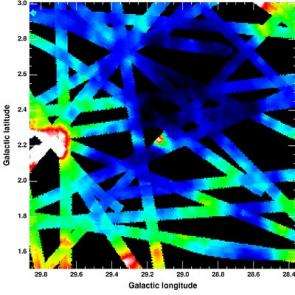
The massive star-forming region ISOSS J18364--0221 is in the centre of the image. The data was collected by the Infrared Space Observatory's ISOPHOT's far-infrared camera at 170 micrometres. ISO produced a web of data as it turned from one celestial object to another during its mission. Credits: ESA/Birkmann/Krause/Lemke (Max-Planck-Insitut für Astronomie)

The conditions necessary to form high-mass stars are difficult to deduce because such stellar monsters form far away and are shrouded behind curtains of dust. Only long wavelengths of infrared radiation can escape from these obscuring cocoons and reveal the low temperature dust cores that mark the sites of star formation. This radiation is exactly what ISO’s ISOPHOT far-infrared camera has collected.

Stephan Birkmann, Oliver Krause and Dietrich Lemke, all of the Max-Planck-Institut für Astronomie, Heidelberg, used ISOPHOT’s data to zero-in on two intensely cold and dense cores, each containing enough matter to form at least one massive star. “This opens up a new era for the observations of the early details of high-mass star formation,” says Krause.

The data was collected in the ISOPHOT Serendipity Survey (ISOSS), a clever study pioneered by Lemke. He realised that when ISO was turning from one celestial object to another, valuable observing time was being lost. He organised for ISOPHOT’s far-infrared camera to continuously record during such slews and beam this data to Earth.

During the ISO mission, which lasted for two and a half years during 1995–98, the spacecraft made around 10 000 slews, providing a web of data across the sky for the previously unexplored window of infrared emission at 170 micrometres. This wavelength is 310 times longer than optical radiation and reveals cold dust down to just 10K (–263° Celsius). A catalogue was produced of the cold sites in the survey.

Birkmann and his colleagues investigated this catalogue and found fifty potential places of high-mass stellar birth. A campaign of follow-up observations using ground-based telescopes revealed that object ISOSS J18364-0221 was in fact two cold dense cores that looked suspiciously like those associated with the birth of low-mass stars, but containing much more mass.

The first core is at 16.5 Kelvin (–256.5° Celsius). It contains seventy-five times the mass of the Sun and shows signs of gravitational collapse. The second one is around 12K (–261° Celsius) and contains 280 solar masses. The team are currently studying the other potential sites.

Source: ESA


print this article email this article download pdf blog this article bookmark this article     Stumble it Digg this share on Facebook retweet share on Reddit add to delicious
Rate this story - 3.8 /5 (16 votes)


April 20, 2006 all stories

Comments: 0

3.8 /5 (16 votes)
  • Stumble this up

  • Digg this

  • share this

  • hide
  • Related Stories

  • Hunting for Planets in the Dark
    created Nov 19, 2009 | popularity not rated yet | comments 0
  • SOFIA Seeks Secrets of Planetary Birth
    created Nov 19, 2009 | popularity not rated yet | comments 0
  • The Ring Nebula
    created Nov 02, 2009 | popularity not rated yet | comments 0
  • Astronomers explore 'last blank space' on map of the Universe
    created Oct 28, 2009 | popularity not rated yet | comments 0
  • Fermi Telescope Caps First Year With Glimpse of Space-Time (w/ Video)
    created Oct 28, 2009 | popularity not rated yet | comments 0


Other News

Astronauts finish another spacewalk, still no baby (AP)

Astronauts finish another spacewalk, still no baby

Space & Earth / Space Exploration

created 5 hours ago | popularity 3 / 5 (2) | comments 0

(AP) -- A spacewalking astronaut put aside the impending birth of his daughter and blazed through his first-ever venture outside the International Space Station on Saturday.


Unseasonably hot and dry weather combined with strong winds to fan scores of blazes in the country's southeastern states

Australia issues 'catastrophic' alerts as fires rage

Space & Earth / Environment

created 11 hours ago | popularity 4.5 / 5 (2) | comments 0

Australia has issued "catastrophic" alerts after record-breaking temperatures and wild lightning storms sparked more than 100 fires across the country, officials said Saturday.


Commuters wait on the platform shrouded by fog in London

Climate change not man-made, say majority of Britons: poll

Space & Earth / Environment

created Nov 15, 2009 | popularity 3.3 / 5 (15) | comments 45

Less than half of Britons believes that human activity is to blame for global warming, according to a poll carried out for The Times newspaper and published on Saturday.


Mysteriously warm times in Antarctica

Mysteriously warm times in Antarctica

Space & Earth / Earth Sciences

created Nov 18, 2009 | popularity 4.2 / 5 (21) | comments 28

(PhysOrg.com) -- A new study of Antarctica's past climate reveals that temperatures during the warm periods between ice ages (interglacials) may have been higher than previously thought. The latest analysis ...


UN: Fight climate change with free condoms (AP)

UN: Fight climate change with free condoms

Space & Earth / Environment

created Nov 18, 2009 | popularity 3.1 / 5 (11) | comments 22

(AP) -- The battle against global warming could be helped if the world slowed population growth by making free condoms and family planning advice more widely available, the U.N. Population Fund said Wednesday.