Scientists penetrate fossil magma chamber beneath intact ocean crust
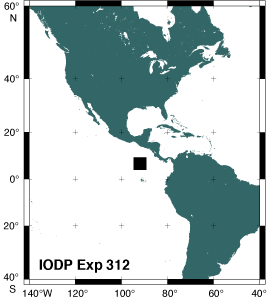
Pacific Ocean, approximately 800 km west of Costa Rica—An international team of scientists aboard the research drilling ship JOIDES Resolution has—for the first time—recovered black rocks known as gabbros from intact ocean crust. Supported by the Integrated Ocean Drilling Program (IODP), the scientists drilled through the volcanic rock that forms the Earth’s crust to reach a fossil magma chamber lying 1.4 kilometers beneath the seafloor.
“By sampling a complete section of the upper oceanic crust, we’ve achieved a goal scientists have pursued for over 40 years, since the days of Project MoHole,” says Damon Teagle, National Oceanography Centre, University of Southampton, UK, and co-chief scientist of the drilling expedition. “Our accomplishment will ultimately help science answer the important question, ‘how is new ocean crust formed?’”
Formation of ocean crust is a key process in the cycle of plate tectonics; it constantly ‘repaves’ the Earth’s surface, builds mountains, and leads to earthquakes and volcanoes. Project MoHole, begun in the 1950s, aimed to drill all the way through the ocean crust, into the Earth’s mantle.
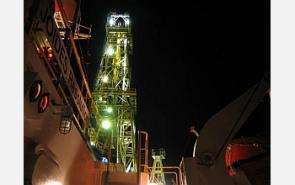
Jeffrey Alt of the University of Michigan, Expedition and co-chief scientist of an earlier leg of this mission, explains that “having this sample from the deep fossil magma chamber allows us to compare its composition to the overlying lavas. It will help explain,” he says, “whether ocean crust, which is about six- to seven- kilometers thick, is formed from one high-level magma chamber, or from a series of stacked magma lenses.” He emphasizes that “the size and geometry of the melt lens affects not only the composition and thermal structure of the ocean crust, but also the vigor of hydrothermal circulation of seawater through the crust.” Alt states that such systems lead to spectacular black-smoker vents—modern analogs of ancient copper deposits and deep-ocean oases that support exotic life.
IODP Program Director James Allan at the U.S. National Science Foundation, which co-funds IODP research with Japan, further clarifies what the expedition’s discovery represents. "These results,” he says, “coming from the structural heart of Pacific crust, confirm ideas from seismologic interpretation about how fast-spreading oceanic crust is built. They refine our understanding of the relationship between seismic velocity and crustal rock composition, and open new vistas for investigating the origin of lower oceanic crust, best addressed by deeper drilling." NSF and Japan each provide a scientific drilling vessel to IODP for research teams.
Geophysical theories have long projected that oceanic magma chambers freeze to form coarse-grained, black rocks known as gabbros, commonly used for facing stones on buildings and kitchen countertops. Although gabbros have been sampled elsewhere in the oceans, where faulting and tectonic movement have brought them closer to the seafloor, this is the first time that gabbros have been recovered from intact ocean crust.
“Drilling this deep hole in the eastern Pacific is a rare opportunity to calibrate remote geophysical measurements such as seismic travel time or magnetic field with direct observations of real rocks,” says geophysicist Doug Wilson, University of California, Santa Barbara. Co-chief scientist on an earlier expedition to the same drilling site, Wilson was instrumental in helping to select the site drilled. His contribution to the research mission was thorough study of the ocean crust’s magnetic properties.
“Finding the right place to drill was probably key to our success,” Wilson asserts. The research team identified a 15-million-year-old region of the Pacific Ocean that formed when the East Pacific Rise was spreading at a “superfast” rate (more than 200 millimeters per year), faster than any mid-ocean ridge on Earth today. “We planned to exploit a partially tested geophysical observation that magma chambers should be closest to the Earth’s surface, in crust formed at the fastest spreading rate. If that theory were to be correct,” reasoned Wilson, “then we should only need to drill a relatively shallow hole–compared to anywhere elseto reach gabbros.” Wilson and his colleagues proved the theory correct.
Following three years of research and multiple trips to the site in question, the borehole that rendered the magma chamber is now more than 1,500 meters deep; it took nearly five months at sea to drill. Twenty-five hardened steel and tungsten carbide drill bits were used before the scientists’ work was complete. The rocks directly above the frozen magma chamber were extremely hard because they had been baked by the underlying magmas, much like tempered steel.
IODP scientists want to return to the site of the unearthed magma chamber to explore deeper, in hopes of finding more secrets hidden deep within the ocean’s crust.
The Integrated Ocean Drilling Program (IODP) is an international marine research program dedicated to advancing scientific understanding of the Earth, the deep biosphere, climate change, and Earth processes by sampling and monitoring sub-seafloor environments. IODP is supported by two lead agencies: the U.S. National Science Foundation, and Japan’s Ministry of Education, Culture, Sports, Science, and Technology, with support from a European consortium of 17 countries, and the People’s Republic of China. IODP’s U.S.-sponsored drilling operations are conducted by the JOI Alliance; comprised of the Joint Oceanographic Institutions, Texas A & M University Research Foundation, and Lamont-Doherty Earth Observatory of Columbia University.
Source: Integrated Ocean Drilling Program Management International


