Ancient and Modern Evidence Suggests Limits to Future Global Warming
Duke-led research team ran some 1,000 computer simulations, covering 1,000 years, to get a longer-range assessment of the highest likely readings.
Instrumental readings made during the past century offer ample evidence that carbon dioxide and other "greenhouse gases" in the atmosphere are warming Earth's climate, a team led by Duke University scientists has reported. But by analyzing indirect evidence of temperature fluctuations over six previous centuries, the team also found that the magnitude of future global warming will likely fall well short of current highest predictions.
In making their deductions, the researchers ran some 1,000 computer simulations, covering 1,000 years, that took into account a range of modern and ancient climate records. Modern records are based on thermometer readings, while measurements derived from such sources as tree rings and ice cores served as markers of warm and cold spells over prior centuries.
The investigators evaluated the data using an "energy balance model" that they describe as a slimmed-down version of the heavy-duty computer models typically used to analyze climate trends. It is the model's streamlined nature that enabled the researchers to perform such large numbers of simulations over such a long period in such detail, they said.
The group used thousands of different versions of this model, each version varying in some of its properties, in order to determine which variants best matched actual observations. One key property that varied was what the researchers termed "sensitivity" -- that is, how much the simulations' temperatures would change in response to increasing greenhouse gas levels.
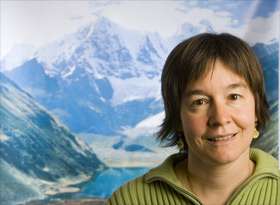
"What I can say very confidently is that the present-day sensitivity is not zero, meaning that there is a positive, warming response to greenhouse gases," said climate analyst Gabriele Hegerl, an associate research professor at Duke's NicholasSchool of the Environment and Earth Sciences. "Our work also substantially reduces the probability of very high climate sensitivities."
Hegerl is lead author of the study, published April 20, 2006, in the journal Nature. Her co-authors are Thomas Crowley, Duke's Nicholas Professor of Earth Systems Science; William Hyde, a former NicholasSchool research scientist now at the University of Toronto; and David Frame, a researcher at the University of Oxford.
Many scientists expect that the level of carbon dioxide in the atmosphere will sometime this century reach double the levels that were present during preindustrial times. Because carbon dioxide traps outgoing heat energy similarly to the glass in a greenhouse, the additional human-created outputs of the gas -- mostly from fossil-fuel burning -- are expected to warm Earth's climate. The key question is: by how much?
The commonly accepted range for how much average global temperatures will rise in response to a doubling of atmospheric carbon dioxide is between 1.5 and 4.5 degrees centigrade, according to the researchers. But some observational studies, they noted, suggest the possibility that average temperatures might rise more than 9 degrees.
However, the new study -- using "reconstructions" of Northern Hemisphere temperatures since the year 1270 -- indicates a 90 percent probability that a doubling of carbon dioxide levels will result in temperature increases of between 1.5 and 6.2 degrees, the team reported.
In turn, the study showed a reduced likelihood that the actual maximum increase will exceed 4.5 degrees -- "from 36 percent to 15 percent or less," the researchers said. A 4.5 degree increase is the highest maximum currently predicted by the international Intergovernmental Panel on Climate Change.
Hegerl said her group confined its study largely to the Northern Hemisphere because only there have scientists collected enough data to reconstruct temperature variations over the entire past millennium.
According to Hegerl, some studies claim that preindustrial temperatures fluctuated very little until the past century, and have risen sharply since.
"But our reconstruction supports a lot of variability in the past, as well as an upward trend in the 20th century," she said. And a record with plenty of ups and downs before the modern era "shows a climate reacting then and now to a variety of 'external forcing,'" she said.
The term "external forcing" refers to all those outside influences that can perturb the climate. Understanding how temperatures responded to such forcings in the premodern era -- when the impact of carbon dioxide and other heat-trapping gases varied relatively little -- helps scientists predict future forcings by greenhouse gases, Hegerl said.
"Looking back longer in time makes it possible to more confidently rule out responses that are very high or very low," she said.
The researchers consulted instrumental records of the various forcings that have occurred in modern times, with the aim of comparing those to actual recorded temperatures.
In order to reconstruct temperatures from the centuries before 1850, the team used various lines of indirect evidence. They looked, for example, at particulates trapped in ice cores as measures of past volcanic eruptions. Such eruptions eject clouds of particles high into the atmosphere. By reducing the amount of sunlight that can pass through the atmosphere, the particles tend to cool the climate for a time, Hegerl said.
They also consulted a number of tree ring studies that reveal hot and cold spells in ancient growth variations, as well as studies that can estimate temperatures as far back as the 1600s based on readings obtained from holes bored deep into the ground.
Although the researchers collected data spanning a full millennium, because of some technical limitations they actually simulated temperature variations over a roughly 700-year period beginning in 1270.
All in all, the researchers considered four different detailed reconstructions of past climates, including a new reconstruction done by Crowley and Hegerl, to deduce probable temperatures before reliable instruments were available.
According to Hegerl, past volcanic eruptions provided the strongest tie between past climate forcings and temperatures. "You can see downturns in temperature exactly where you see volcanic eruptions," she said.
Source: Duke University


