Study details honeybee coalition building
April 20, 2006 Study details honeybee coalition building

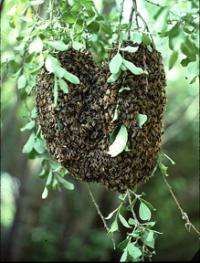
A honeybee swarm bivouacs on a tree branch, waiting for scout bees to select candidate sites for a new home, deliberate among the choices and then reach a verdict -- a process "complicated enough to rival the dealings of any department committee," says Cornell biologist Thomas Seeley. Courtesy of Thomas Seeley

U.S. scientists have found honeybees employ an unusual method of deciding which site to select as a new home -- a method that involves coalition building.

Cornell University biologist Thomas Seeley, lead author of the study, said when thousands of honeybees begin to hunt for a new home, usually a tree cavity, scouts are dispatched to find candidate sites.

When the scout bees return and communicate their choices through a "waggle dance," the rest of the colony considers the choices and reaches a verdict -- a process Seeley says is "complicated enough to rival the dealings of any department committee."

To study whether honeybees always choose the best site, the researchers offered swarms four small and one superior site in size. Although the superior site was never the first one found, it was almost always chosen.

The bees' group decision-making methods, which include an open forum of ideas, frank "discussions" and friendly competition, just might help human committees "achieve collective intelligence and thus avoid collective folly," conclude the researchers.

Seeley and colleagues report their study in the May-June issue of the journal American Scientist.

Copyright 2006 by United Press International


print this article email this article download pdf blog this article bookmark this article     Stumble it Digg this share on Facebook retweet share on Reddit add to delicious
Rate this story - 4.1 /5 (7 votes)


April 20, 2006 all stories

Comments: 0

4.1 /5 (7 votes)
  • Stumble this up

  • Digg this

  • share this

  • hide
  • Related Stories

  • Google, other Silicon Valley firms nurture app developers
    created Dec 03, 2009 | popularity not rated yet | comments 0
  • Asian carp may have breached barrier protecting Lake Michigan
    created Nov 24, 2009 | popularity not rated yet | comments 0
  • Study finds bees can learn differences in food's temperature
    created Nov 17, 2009 | popularity not rated yet | comments 0
  • 15,000 reasons to worry about invasive species
    created Nov 09, 2009 | popularity not rated yet | comments 0
  • Organic weed control options for highbush blueberry
    created Nov 04, 2009 | popularity not rated yet | comments 0


Other News

Coin tosses can be easily rigged: study

Other Sciences / Other

created 17 hours ago | popularity 3.4 / 5 (5) | comments 7

The ubiquitous coin toss is not so random after all, and can easily be manipulated to turn up heads, or tails, a Canadian study has found.


Creativity in mathematics

Other Sciences / Mathematics

created 5 hours ago | popularity not rated yet | comments 0

"Mathematics links Art and Science in one great enterprise, the human attempt to make sense of the universe." So writes Abel Prizewinner and Fields Medalist Sir Michael F. Atiyah in the January 2010 Notices of the American Ma ...


Emotions an overlooked key to whistle-blowing, study says

Other Sciences / Economics

created 17 hours ago | popularity not rated yet | comments 1

A gut-level connection with workers may be the key to encouraging whistle-blowing that could chip away at an estimated $652 billion lost to fraud annually by U.S. businesses, an ongoing University of Illinois study suggests.


Playing favorites: Parents still involved after children are grown

Other Sciences / Social Sciences

created 21 hours ago | popularity not rated yet | comments 0

(PhysOrg.com) -- Middle-aged parents are more involved in their grown children's lives than ever, according to new research from Purdue University.


New technology helps scientists understand ancient fossils

Other Sciences / Archaeology & Fossils

created 14 hours ago | popularity 5 / 5 (1) | comments 1

Some of the world's oldest human bones and other ancient relics are studied here using some of the world's newest technologies.