Like fireflies and pendulum clocks, nano-oscillators synchronize their behavior
Like the flashing of fireflies and ticking of pendulum clocks, the signals emitted by multiple nanoscale oscillators can naturally synchronize under certain conditions, greatly amplifying their output power and stabilizing their signal pattern, according to scientists at the Commerce Department's National Institute of Standards and Technology.
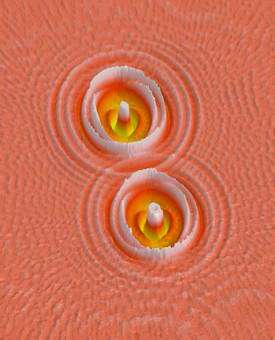
Image: A simulation made with NIST micromagnetic software shows the interaction of "spin waves" emitted by two nano-oscillators that generate microwave signals. The ability of these tiny spintronic devices to spontaneously synchronize their emissions may lead to smaller, cheaper wireless communications components. Image credit: National Institute of Standards and Technology
In the Sept. 15 issue of Nature,* NIST scientists describe "locking" the dynamic magnetic properties of two nanoscale oscillators located 500 nanometers apart, boosting the power of the microwave signals given off by the devices. While an individual oscillator has signal power of just 10 nanowatts, the output from multiple devices increases as the square of the number of devices involved. The NIST work suggests that small arrays of 10 nano-oscillators could produce signals of 1 microwatt or more, sufficient for practical use as reference oscillators or directional microwave transmitters and receivers in devices such as cell phones, radar systems and computer chips.
"These nanoscale oscillators could potentially replace much bulkier and expensive components in microwave circuits," says Matthew Pufall, one of the NIST researchers. "This is a significant advance in demonstrating the potential utility of these devices."
The NIST-designed oscillators consist of a sandwich of two magnetic films separated by a non-magnetic layer of copper. Passing an electrical current through the device causes the direction of its magnetization to switch back and forth rapidly, producing a microwave signal. The circular devices are 50 nanometers in diameter, about one-thousandth of the width of a human hair and hundreds of times smaller than the typical microwave generators in commercial use today. The devices are compatible with conventional semiconductor technology, which is expected to make them inexpensive to manufacture.
The type of signal locking observed at NIST was first described by the 17th-century Dutch scientist Christiaan Huygens, who found that two pendulum clocks mounted on the same wall synchronized their ticking, thanks to weak coupling of acoustic signals through the wall. This phenomenon also occurs in many biological systems, such as the synchronized flashing of fireflies, the singing of certain crickets, circadian rhythms in which biological cycles are locked to the sun, and heartbeat patterns linked to breathing speed. There are also examples in the physical sciences, such as the synchronization of the moon's rotation with respect to its orbit about the Earth.
Locking is already exploited in many technologies, such as wireless communications and certain types of antenna networks. For instance, in many telecommunications schemes, a receiver oscillator must lock to a signal transmitted by a sender.
The work described in Nature is an advance in the field of "spintronics," which takes advantage of the fact that the individual electrons in an electric current behave like minuscule bar magnets, each having a "spin" along a particular direction, analogous to a magnet's north or south pole. Conventional electronics, by contrast, relies on the electrons' charge. Spintronics is already exploited in read heads for computer hard-disk drives and may provide new functionalities in a variety of other electronic devices.
When an electric current passes through the NIST oscillators, the electrons in the current align their spins to match the orientation of the first magnetic layer in the device. When the now-aligned electrons flow through the second magnetic layer, the spin of the electrons is transferred to the film. The result is that the magnetization of the film oscillates much like a spinning top. The oscillation generates a microwave signal, which can be tuned from less than 5 gigahertz (5 billion oscillations a second) to more than 35 gigahertz by manipulating the current or an external magnetic field. In contrast, most cell phones transmit and receive signals at frequencies between 1 and 2 gigahertz.
Scientists long have known that an oscillator can be forced to sympathetically synchronize to an applied signal that is close to its own frequency. That is, if small, periodic "nudges" are applied to an oscillator, eventually it will synchronize to those nudges. In the latest NIST experiments, certain combinations of currents applied to both oscillators cause their respective frequencies to approach each other and eventually lock together.
In a related paper published Aug. 5 in Physical Review Letters,** the NIST research group demonstrated that nano-oscillators can be locked to an externally applied signal. This work also showed how to vary the phase of the oscillation (the positions of the peaks and troughs of the wave pattern), a technique used in radar and directional transmissions. "This work suggests the interesting possibility of using the oscillators for 'nano-wireless' communications within or between chips on a circuit board," says William Rippard, a member of the NIST group.
NIST scientists are still studying exactly why locking occurs between nano-oscillators. One possible mechanism is the emission of "spin waves," the magnetic analog of waves in the ocean. In magnetic systems these waves are alternating variations in the direction of the magnetization. The waves created by the two oscillators may overlap and synchronize. Alternatively, each oscillator can be thought of as a bar magnet spinning around its midpoint or end over end. Attractive and repulsive forces between the devices' poles may cause them to spin in a complementary pattern, thereby synchronizing the oscillations.
* S.F. Kaka, M.R. Pufall, W.H. Rippard, T.J. Silva, and S.E. Russek. 2005. Mutual Phase-Locking of Microwave Spin Torque Nano-Oscillators. Nature. Sept. 15.
** W.H. Rippard, M.R. Pufall, S.F. Kaka, T.J. Silva, S.E. Russek, and J.A. Katine. 2005. Injection Locking and Phase Control of Spin Transfer Nano-Oscillators. Physical Review Letters. Aug. 5.
Source: NIST


