Swan study shows reproductive success in early life leads to faster ageing
April 21, 2006
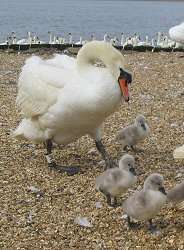
Birds from mute swan colony at Abbotsbury, Dorset. Credit: Dr Anne Charmantier
Why do we stop reproducing after a certain age, and how is this age determined? A study by Oxford University researchers has shed light on this question by studying data from Dorset swans.
A theory which says that reproductive success in early life will lead to faster ageing later has been supported by the study of mute swans (Cygnus olor) which shows that those swans which reproduce early in life also stopped breeding early, and vice versa. Which pattern a swan adopts appears to be genetically inherited.
The team, from the Edward Grey Institute in Oxford’s Department of Zoology, investigated data on swans that bred as youngsters and those that started to reproduce at a much later age. They discovered the age at which swans started to reproduce varied considerably – from two to twelve years old – and the age at which swans stopped breeding also showed huge variation – from two to twenty years old. The main finding, however, was that the birds that started breeding at an early age stopped reproducing earlier than the late-starters.
The study, to be published in the science journal PNAS this week, supports the ‘antagonistic pleiotropy’ theory for the evolution of ageing, that says that you ‘pay’ in later life for your success in reproducing when young. It is thought the study is the first to show this pattern in a wild animal population.
The researchers studied data dating back to the late 1960s of individually identifiable birds from the mute swan colony at Abbotsbury, in Dorset. As soon as swans started pairing up, the researchers visited the nesting area to identify all breeding parents, and they collected data on their breeding site, breeding dates and clutch sizes. They were able to monitor up to six generations of the same family and discovered the age at which the birds reproduced was found to have a heritable component – if the mother reproduced later in life, it was more likely that her cygnets would too when they were adults.
Lead author, Dr Anne Charmantier, said: ‘Ageing is about losing your capacity for reproduction, or having a higher probability of dying. At first sight, it is difficult to explain in the natural selection framework, because it shouldn’t be selected for. One theory that tries to elucidate whether ageing can be explained by selection is the “antagonistic pleiotropy” theory – that is, you cannot win on all levels: the more you invest early in life, the earlier you are going to senesce (age) in reproductive terms. We show this in the swan study.
‘The important thing about this study is it shows that this link between the age at which you start reproducing and the age at which you stop is actually genetic. If you carry genes which will make you start reproducing early, you also carry genes which will make you stop early. It’s what we call an “evolutionary trade-off”. It explains why birds and other animals, like humans, age – because we invest in early life.’
Source: University of Oxford
-
Juvenile predation preventing Steller sea lion recovery
Jan 18, 2012 |
5 / 5 (1) |
1
-
Largest bird alters its foraging due to climate change
Jan 12, 2012 |
2.5 / 5 (6) |
2
-
Complex sex life of goats could have implications for wildlife management
Dec 14, 2011 |
not rated yet |
0
-
World's first captive breeding of Ozark hellbenders at Saint Louis Zoo
Dec 01, 2011 |
not rated yet |
0
-
Ancient DNA provides new insights into cave paintings of horses
Nov 07, 2011 |
4.8 / 5 (8) |
2
-
Engineers build first sub-10-nm carbon nanotube transistor
Feb 01, 2012 |
4.9 / 5 (31) |
30
-
Something old, something new: Evolution and the structural divergence of duplicate genes
Jan 31, 2012 |
4.6 / 5 (7) |
1
-
The hidden nanoworld of ice crystals: Revealing the dynamic behavior of quasi-liquid layers
Jan 30, 2012 |
5 / 5 (3) |
1
-
Stock market network reveals investor clustering
Jan 27, 2012 |
3.9 / 5 (23) |
8
-
Of microchemistry and molecules: Electronic microfluidic device synthesizes biocompatible probes
Jan 26, 2012 |
5 / 5 (1) |
0
More news stories
Employers feel no love for unscrupulous practice of 'service sweethearting'
A new study led by two Florida State University marketing professors finds that some frontline service employees who are rewarded for hikes in customer loyalty and satisfaction also may engage in "service ...
Other Sciences / Economics & Business
21 minutes ago |
not rated yet |
0
A frank discussion of the power law and linking correlation to causation
(PhysOrg.com) -- Michael Stumpf a mathematics professor at Imperial College in London, and Mason Porter a lecturer at Oxford have teamed together to write and publish a perspective piece in Science regarding the in ...
Sonic Cradle lands spot in TED exhibition
A Simon Fraser University graduate student project that melds music, meditation and modern technology has landed a rare spot as an exhibit at TEDActive 2012 in Palm Springs, California this month.
2 hours ago |
not rated yet |
0
The question of life in the ancient world
Theres a general feeling that we dont get the Greeks ancient or modern. Many, including heads of state like Angela Merkel, visibly shake their head in exasperation, rightly or wrongly, at ...
Other Sciences / Archaeology & Fossils
5 hours ago |
1 / 5 (1) |
2
US workers are 'giving away the store,' costing firms billions
Nearly 70 percent of the nation's service employees give away free goods and services from hamburgers to cable TV costing companies billions of dollars a year, according to a groundbreaking study.
Other Sciences / Economics & Business
23 hours ago |
4.5 / 5 (2) |
10
Putting the squeeze on planets outside our solar system
(PhysOrg.com) -- Using high-powered lasers, scientists at Lawrence Livermore National Laboratory and collaborators discovered that molten magnesium silicate undergoes a phase change in the liquid state, abruptly ...
India probes Google over 'forex transactions'
Indian authorities are probing whether online giant Google broke domestic foreign-exchange transactions rules while shifting funds abroad, the Press Trust of India reported on Friday.
Germany freezes signing of disputed Internet pact
Germany on Friday halted the signing of a controversial international accord billed as a way to beat online piracy that has sparked angry protests, saying it needed more time to consider it.
Health experts, scientists to discuss bird flu studies
The World Health Organization said Friday it will meet next week to determine whether scientists can publish research on a bird flu virus that may be easily passed among humans.
Obama forges compromise birth control plan
US President Barack Obama Friday announced a compromise to defuse a row over access to birth control which prompted election-year Republican critics to claim he was waging a war on religion.
US issues guidelines to avoid heparin contamination
Four years after US drug-maker Baxter International's blood thinner heparin was contaminated in China, causing dozens of deaths, US regulators on Friday issued draft guidelines for safe production.