Kennewick Man Skeletal Find May Revolutionalize Continent's History
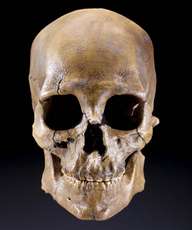
A forensic anthropologist at Middle Tennessee State University is one of a select number of scientists to participate in the examination of a skeleton that could force historians to rewrite the story of the entire North American continent.
Dr. Hugh Berryman, research professor, was one of only 11 experts from across the United States to scrutinize the bones of Kennewick Man, a 9,300-year-old skeleton found 10 years ago along the Columbia River at Kennewick, Wash.
“It’s one of the oldest skeletons, one of the earliest individuals that populated this continent,” Berryman says. “And we have a chance to look at those remains and learn from them what they tell us about the past and who these people were.”
The 380 bones are being preserved at the University of Washington’s Burke Museum under an agreement with the U.S. Army Corps of Engineers, which controls the land on which Kennewick was discovered. Berryman says he was between two and three feet deep in the ground. The burial miraculously saved the bones from the elements, the animals, machinery and man for centuries, and ancient deposits of calcium carbonate on the bones allowed the researchers to determine the positioning of the bones in the ground.
“We have evidence that the bones were still in anatomic order,” Berryman says. “He was still articulated, and he appears to have been a burial. So once something is buried, that moves it at a depth that perhaps the coyotes, the wolves, scavengers could not get to it.”
The July 2005 research was very nearly derailed when the Corps initially decided to turn Kennewick over to a coalition of Native American tribes. Eight scientists filed a federal lawsuit to gain permission to study the skeleton. A federal judge, whose ruling later was upheld by the Ninth U.S. Circuit Court of Appeals, decided in favor of the scientists after determining that the tribes could not prove a direct cultural affiliation with Kennewick.
Berryman says the information that can be gleaned from Kennewick came close to being lost forever.
“Since 1990, we’ve lost most of the skeletal remains from groups,” Berryman says. “It’s a shame that a lot of these groups are already gone. We have no way of knowing what kind of movements there were in prehistoric times, where these people came from, who they were related to, what other tribal groups they might be related to.”
What the experts were able to ascertain from their brief encounter with Kennewick is that he did not look like a Native American. In fact, Berryman says Kennewick’s facial features are most similar to those of a Japanese group called the Ainu, who have a different physical makeup and cultural background from the ethnic Japanese.
Some Ainu’s facial features appear European. Their eyes may lack the Asian almond-shaped appearance, and their hair may be light and curly in color. However, this does not mean that Kennewick Man necessarily was European in origin. His features more closely resemble those of the natives of the Pacific Rim than those of Native Americans.
Berryman, a fracture expert who was trained in the fine art of picking apart dead people at the University of Tennessee’s “Body Farm,” also documented three types of bone breaks in Kennewick—fractures that were suffered in his lifetime and then healed, fractures that happened after his burial, and fractures that occurred when the skeleton was eroded from the riverbank.
Part of a spear had remained lodged in Kennewick’s right hip bone at a 77-degree angle, but, remarkably, the spear did not cause his death. The cause of his demise remains a mystery. What is known is that this athletic, rugged hunter suffered many physical traumas before finally expiring in his mid-to-late 30s.
“The muscle markings are pretty pronounced,” Berryman says.“He was probably a well-built individual. The bones of the right arm were larger than the left.”
The bigger right arm can be explained by the 18-to-24-inch-long atlatl, or spear thrower, that gave him and his contemporaries the ability to propel a spear up to the length of a football field in order to kill their food. Kennewick died long before the invention of the bow and arrow.
Berryman says Kennewick has only begun to reveal the story of his life and times, and it would be tremendous to have other scientists examine his bones.
“It was a lot slower process than we thought,” Berryman says. “The first day, all day, we looked at one bone, one femur. And then we realized at the end of the day that we were going to be lucky to be able to cover this the way that it should be in a week-and-a-half.”
Age, ancestry, sex, height, pathologies, types of trauma, even whether a woman has given birth—all can be determined just from examining a skeleton, says Berryman, who often is called upon to give expert testimony on bones in criminal trials.
“Bone is great at recording its own history,” he says.“Throughout your life, there are different things that you do, and they may leave little signs in the bone. If you can read those signs, it’s almost like interviewing a person.”'
Source: Middle Tennessee State University


