Drilling on Mars to find evidence of ancient organisms: a second genesis of life?

September 15, 2005 feature
Drilling on Mars to find evidence of ancient organisms: a second genesis of life?
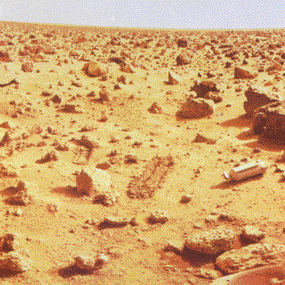
Was there ever life on Mars? The answer to this question would do more than just satisfy curiosity. Researchers from NASA announce a plan to drill on Mars in search of ancient Martian organisms for comparison between life on Mars and life on Earth.

It is already theorized that life on Earth shares a common ancestor with life on Mars brought about by an exchange of material from meteorites. Evidence of life on Mars would strengthen this theory and give insight to origins of life on Earth.

Current research has focused on attaining fossils of Martian life which would only prove that life once existed on the planet. However, scientists from NASA and the SETI Institute believe that they can find out more information from Martian permafrost.

If researchers could discover dead, but intact organisms from Mars, biochemical and genetic analysis could be performed. These methods would provide a way for direct comparison between the life once found on Mars and the life currently found on Earth.

The best place to look for preserved Martian organisms is in the permafrost found on the Southern hemisphere of Mars. Heavily cratered, this terrain dates back to early Martian history when water was abundant and existence of life more likely.

Scientists at NASA have several obstacles to overcome as they plan this study. Mars is under strict planetary protection laws set forth by the Committee on Space Research (COSPAR). Any robotic drilling missions would need to utilize sterile equipment to avoid introducing biological material into the Martian environment.

Also, contamination of samples must be avoided to ensure that biological material taken from the permafrost was of Martian origin.

Before a drilling mission to Mars is underway, more research is needed to develop automated drilling systems or systems for human operation.

In the near future though, NASA hopes to find evidence of life on Mars. Could this evidence represent a second genesis of life, separate from that on Earth? The answers may be in the permafrost.

Reference:

Smith HD and McKay CP.
Planetary and Space Science Journal. 2005. Article in Press.

by Gina M. Buss, Copyright 2005 PhysOrg.com

4.5 /5 (4 votes)  

Rank 4.5 /5 (4 votes)
Tags

Relevant PhysicsForums posts

More news stories

Europe stakes billion-dollar bet on new rocket

A pencil-slim rocket is scheduled to lift into space from South America on Monday, carrying a billion-dollar bet that Europe can grab a juicy slice of the market to place satellites in low orbit.

Space & Earth / Space Exploration

created 24 minutes ago | popularity not rated yet | comments 0

NASA sees wide-eyed cyclone Jasmine

Cyclone Jasmine's eye has opened wider on NASA satellite imagery, as it moves through the Southern Pacific Ocean.

Space & Earth / Earth Sciences

created 16 hours ago | popularity 3.5 / 5 (2) | comments 2

NASA sees Giovanna reach cyclone strength, threaten Madagascar

Tropical Storm 12S built up steam and became a cyclone on February 10, 2012 as NASA's Terra satellite passed overhead. Residents of east-central Madagascar should prepare for this cyclone to make landfall ...

Space & Earth / Earth Sciences

created 16 hours ago | popularity not rated yet | comments 0

Humans may have helped the decline of African rainforests 3000 years ago

(PhysOrg.com) -- Large areas of rainforests in Central Africa mysteriously disappeared over three thousand years ago, to be replaced by savannas. The prevailing theory has been that the cause was a change ...

Space & Earth / Environment

created Feb 10, 2012 | popularity 4.3 / 5 (13) | comments 13 | with audio podcast report

Political leaders play key role in how worried Americans are by climate change: study

More than extreme weather events and the work of scientists, it is national political leaders who influence how much Americans worry about the threat of climate change, new research finds.

Space & Earth / Environment

created Feb 06, 2012 | popularity 5 / 5 (6) | comments 68


GPS court ruling leaves US phone tracking unclear

A US Supreme Court decision requiring a warrant to place a GPS device on the car of a criminal suspect leaves unresolved the bigger issue of police tracking using mobile phones, legal experts say.

Netflix settlement trims 14 pct off 4Q earnings

(AP) -- Netflix pressed the rewind button on its fourth-quarter earnings after settling allegations that the video subscription service violated a consumer-privacy law.

Study finds that anti-diabetic medication can prevent the long-term effects of maternal obesity

In a study to be presented today at the Society for Maternal-Fetal Medicine's annual meeting, The Pregnancy Meeting, in Dallas, Texas, researchers will report findings that show that short therapy with the anti-diabetic medication ...

Elbow position not a predictor of injury

Elbow position alone appeared to not affect injury rates and performance in college-level, male pitchers say researchers presenting at the American Orthopaedic Society for Sports Medicine's Specialty Day in San Francisco, ...

New data provides direction for ACL injured knee treatments

Primary Anterior Cruciate Ligament (ACL) reconstruction improves quality of life and sports functionality for athletes, according to research presented today at the American Orthopaedic Society for Sports Medicine's Specialty ...

Treatment for hip conditions should not rest solely on MRI scans

When it comes to treating people with hip pain, physicians should not replace clinical observation with the use of magnetic resonance images (MRI), according to research being presented today at the American Orthopaedic Society ...