The world's deepest dinosaur finding
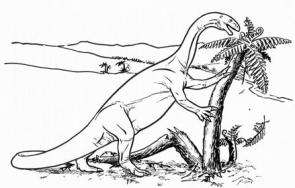
April 24, 2006 Norway’s first dinosaur fossil is a Plateosaurus

Norway’s first dinosaur fossil is a Plateosaurus, a species that could be up to nine metres long and weigh up to four tons. It lived in Europe and on Greenland 210 to 195 million years ago, at the end of the Triassic Period.

While most nations excavate their skeletons using a toothbrush, the Norwegians found one using a drill. The somewhat rough uncovering of Norway’s first dinosaur happened in the North Sea, at an entire 2256 metres below the seabed. It had been there for nearly 200 million years, ever since the time the North Sea wasn’t a sea at all, but an enormous alluvial plane.

It is merely a coincidence that the remains of the old dinosaur now see the light of day again, or more precisely, parts of the dinosaur.

The fossil is in fact just a crushed knucklebone in a drilling core – a long cylinder of rock drilled out from an exploration well at the Snorre offshore field.

Norway’s first dinosaur fossil is a Plateosaurus, a species that could be up to nine metres long and weigh up to four tons.

It lived in Europe and on Greenland 210 to 195 million years ago, at the end of the Triassic Period.

The Plateosaurus at the Snorre offshore field had a hollow grave.

The fossil, which was found 2256 metres below the seabed, represents the world’s deepest dinosaur finding. But it is by no means certain that the record-breaking knucklebone is a rarity down there in the abyss.
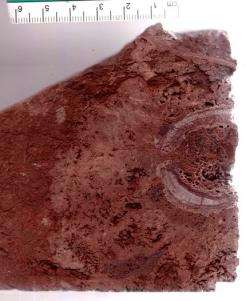
The fossil is just a crushed knucklebone in a drilling core

The fossil is just a crushed knucklebone in a drilling core – a long cylinder of rock drilled out from an exploration well at the Snorre offshore field.

In fact, the old North Sea land was once a huge area where big rivers meandered through dry plains. Now the landscape has been compressed to form a pattern of fossil alluvial sand between banks of red shale.


Source: Research Council of Norway


print this article email this article download pdf blog this article bookmark this article     Stumble it Digg this share on Facebook retweet share on Reddit add to delicious
Rate this story - 4.8 /5 (13 votes)


April 24, 2006 all stories

Comments: 0

4.8 /5 (13 votes)
  • Stumble this up

  • Digg this

  • share this

  • hide
  • Related Stories

  • Portable 3-D laser technology preserves Texas dinosaur's rare footprint
    created Nov 04, 2009 | popularity not rated yet | comments 0
  • Oldest known spider's web found in amber
    created Nov 02, 2009 | popularity not rated yet | comments 0
  • Dinosaur-Killer was Soft on Algae
    created Oct 02, 2009 | popularity not rated yet | comments 0
  • When palm trees gave way to spruce trees
    created Jun 17, 2009 | popularity not rated yet | comments 0
  • Fossil bone bed helps reconstruct life along California's ancient coastline
    created Jun 08, 2009 | popularity not rated yet | comments 0


Other News

Climate change could boost incidence of civil war in Africa

Other Sciences / Social Sciences

created 12 hours ago | popularity 1.7 / 5 (11) | comments 5

Climate change could increase the likelihood of civil war in sub-Saharan Africa by over 50 percent within the next two decades, according to a new study led by a team of researchers at University of California, Berkeley, ...


As robots become more common, Stanford experts consider the legal challenges

Other Sciences / Social Sciences

created 10 hours ago | popularity 4.5 / 5 (2) | comments 0

(PhysOrg.com) -- They already detect and defuse bombs, control traffic patterns and do some basic household chores. And scientists predict that pretty soon, robots will be using artificial intelligence to play a larger role ...


The cause behind the characteristic shape of a long leaf revealed

The cause behind the characteristic shape of a long leaf revealed

Other Sciences / Mathematics

created 12 hours ago | popularity 5 / 5 (2) | comments 0

Applied mathematicians dissected the morphology of the plantain lily (Hosta lancifolia), a characteristic long leaf with a saddle-like arc midsection and closely packed ripples along the edges. The simple ...


Do kids benefit from homework?

Do kids benefit from homework?

Other Sciences / Social Sciences

created 8 hours ago | popularity not rated yet | comments 1

(PhysOrg.com) -- Homework is as old as school itself. Yet the practice is controversial as people debate the benefits or consider the shortcomings and hassles. Research into the topic is often contradictory ...


5-day delivery no sure cure for postal woes, economist says

Other Sciences / Economics

created 9 hours ago | popularity 2 / 5 (1) | comments 0

Scaling back mail delivery from six days a week to five may be the best bet to stem mounting U.S. Postal Service losses, but could still be a gamble, says a University of Illinois economist who has studied the agency's persistent ...