Chandra finds black holes are 'green'
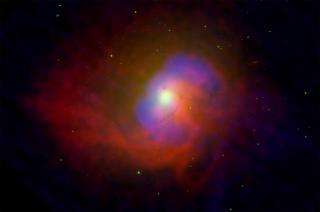
April 24, 2006 Chandra finds black holes are 'green'

Credit: X-ray: NASA/CXC/KIPAC/S.Allen et al; Radio: NRAO/VLA/G.Taylor; Infrared: NASA/ESA/McMaster Univ./W.Harris

Black holes are the most fuel efficient engines in the Universe, according to a new study using NASA's Chandra X-ray Observatory. By making the first direct estimate of how efficient or "green" black holes are, this work gives insight into how black holes generate energy and affect their environment.

The new Chandra finding shows that most of the energy released by matter falling toward a supermassive black hole is in the form of high-energy jets traveling at near the speed of light away from the black hole. This is an important step in understanding how such jets can be launched from magnetized disks of gas near the event horizon of a black hole.

"Just as with cars, it's critical to know the fuel efficiency of black holes," said lead author Steve Allen of the Kavli Institute for Particle Astrophysics and Cosmology at Stanford University, and the Stanford Linear Accelerator Center. "Without this information, we cannot figure out what is going on under the hood, so to speak, or what the engine can do."

Allen and his team used Chandra to study nine supermassive black holes at the centers of elliptical galaxies. These black holes are relatively old and generate much less radiation than quasars, rapidly growing supermassive black holes seen in the early Universe. The surprise came when the Chandra results showed that these "quiet" black holes are all producing much more energy in jets of high-energy particles than in visible light or X-rays. These jets create huge bubbles, or cavities, in the hot gas in the galaxies.

The efficiency of the black hole energy-production was calculated in two steps: first Chandra images of the inner regions of the galaxies were used to estimate how much fuel is available for the black hole; then Chandra images were used to estimate the power required to produce the cavities.

"If a car was as fuel-efficient as these black holes, it could theoretically travel over a billion miles on a gallon of gas," said coauthor Christopher Reynolds of the University of Maryland, College Park.

New details are given about how black hole engines achieve this extreme efficiency. Some of the gas first attracted to the black holes may be blown away by the energetic activity before it gets too near the black hole, but a significant fraction must eventually approach the event horizon where it is used with high efficiency to power the jets. The study also implies that matter flows towards the black holes at a steady rate for several million years.

"These black holes are very efficient, but it also takes a very long time to refuel them," said Steve Allen who receives funding from the Office of Science of the Department of Energy.

This new study shows that black holes are green in another important way. The energy transferred to the hot gas by the jets should keep hot gas from cooling, thereby preventing billions of new stars from forming. This will place limits on the growth of the largest galaxies, and prevent galactic sprawl from taking over the neighborhood.

Source: Chandra X-ray Center


print this article email this article download pdf blog this article bookmark this article     Stumble it Digg this share on Facebook retweet share on Reddit add to delicious
Rate this story - 4.6 /5 (23 votes)

Rank Filter

Move the slider to adjust rank threshold, so that you can hide some of the comments.


Display comments: newest first

  • jeffsaunders - May 29, 2009
    • Rank: not rated yet
    A confusing article. I get the impression though, in the end, that what they are saying is that most of the matter that falls towards the black hole is blasted back out again in high energy particles.


    At least that is what I think they are saying, in which case I would have labeled the black hole as very inefficient, as it hardly absorbs any of the matter it attracts.


    I guess, like most things, it depends on your point of view and motivation. Is a black hole more efficient if it grows faster or slower?

April 24, 2006 all stories

Comments: 1

4.6 /5 (23 votes)
  • Stumble this up

  • Digg this

  • share this

  • hide
  • Related Stories

  • X-Ray Jets from Galaxies
    created Oct 19, 2009 | popularity not rated yet | comments 0
  • Sky merger yields sparkling dividends
    created Oct 13, 2009 | popularity not rated yet | comments 0
  • Black Holes Go 'Mano a Mano'
    created Oct 06, 2009 | popularity not rated yet | comments 0
  • New Vista of Milky Way Center Unveiled
    created Sep 22, 2009 | popularity not rated yet | comments 0
  • Cygnus X-1: Still a 'Star' After All Those Years
    created Aug 28, 2009 | popularity not rated yet | comments 0


Other News

Deep creep means milder, more frequent earthquakes along Southern California's San Jacinto fault

Deep creep means milder, more frequent earthquakes along Southern California's San Jacinto fault

Space & Earth / Earth Sciences

created 7 hours ago | popularity 4.7 / 5 (3) | comments 0

With an average of four mini-earthquakes per day, Southern California's San Jacinto fault constantly adjusts to make it a less likely candidate for a major earthquake than its quiet neighbor to the east, the ...


Success in 'space elevator' competition (AP)

Success in 'space elevator' competition (Update 3)

Space & Earth / Space Exploration

created Nov 05, 2009 | popularity 4.3 / 5 (33) | comments 50

(AP) -- A robot powered by a ground-based laser beam climbed a long cable dangling from a helicopter on Wednesday to qualify for prize money in a $2 million competition to test the potential reality of the ...


In a Galaxy Far, Far Away...

In a Galaxy Far, Far Away...

Space & Earth / Astronomy

created Nov 06, 2009 | popularity 4.8 / 5 (5) | comments 15

(PhysOrg.com) -- Astronomers have published the discovery of the farthest known object in the cosmos: a star that exploded when the universe was only 630 million years old -- only 4.6% of its current age. ...


'Dropouts' pinpoint earliest galaxies

'Dropouts' pinpoint earliest galaxies

Space & Earth / Astronomy

created Nov 06, 2009 | popularity 4.2 / 5 (10) | comments 13

Astronomers, conducting the broadest survey to date of galaxies from about 800 million years after the Big Bang, have found 22 early galaxies and confirmed the age of one by its characteristic hydrogen signature ...


Space hotel taking bookings for 2012 opening

Space hotel taking bookings for 2012 opening

Space & Earth / Space Exploration

created Nov 05, 2009 | popularity 4.4 / 5 (20) | comments 11

(PhysOrg.com) -- The first orbiting space hotel is on track to open for its first customers in 2012, but hurry, as bookings are filling fast.