Seeking Answers to the Puzzle of Proton Spin
Thanks to a series of machine upgrades, researchers at the Relativistic Heavy Ion Collider (RHIC), the newest and largest particle accelerator at the U.S. Department of Energy's Brookhaven National Laboratory, are making progress in answering a fundamental question that has long puzzled physicists: Where do protons get their spin, a property of elementary particles as basic as mass and electrical charge?
Each year since 2002, RHIC has taken a short break from its primary mission -- slamming ions together in the quest for understanding the state of matter at the birth of the universe -- to explore this question. This year, however, the entire experimental run will be dedicated to understanding proton spin, as researchers collide beams of polarized protons (protons that are spinning in the same direction) at various collision energies. During the last week of the 20-week run, polarized protons will be accelerated to the highest energies ever recorded -- 250 billion electron volts (GeV), or two-and-a-half times the typical proton collision energies studied at RHIC.
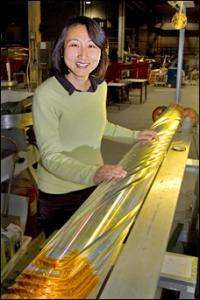
“We are able to achieve these high collision energies because of the improvements we have made to the accelerator complex over the past few years,” said Mei Bai, an accelerator physicist in Brookhaven’s Collider-Accelerator Department. “These improvements make it possible for the proton bunches to retain a high percentage of polarization at high energies, which is required for our physics measurements.”
Scientists know that protons are made of smaller particles called quarks, which are held together by emitting and absorbing particles called gluons. The physicists also know that all of these particles have an intrinsic property known as spin, somewhat analogous to Earth spinning on its axis. Physicists have long thought that the spin of a proton was simply the sum of the spins of its three component quarks. But experiments have shown that the quarks account for only about 20 percent of the proton’s spin. That has left the scientists with a puzzle: What accounts for the missing 80 percent?
Scientists believe that the gluons that hold the quarks together may contribute to the proton's spin, and the orbital motion of the quarks around each other, like the bodies in a solar system, can also add to the spin. RHIC is the world's only machine capable of colliding high-energy beams of polarized protons, and is a unique tool for separating these contributions and answering the question.
Bai explained that keeping the beams polarized as they make their way through the chain of five accelerators that make up the RHIC complex is incredibly difficult. Four of these accelerators are composed of magnets that can interfere with polarization, and there is no way to “re-polarize” the protons once their spin is disrupted. So, the goal is to minimize, as much as possible, polarization loss along the protons’ path.
Specialized sets of magnets called “Siberian snakes” make this possible. The magnets’ corkscrew-like design causes the direction of the magnetic field to spiral along the direction of the beam. As the beam moves through the two snakes in each of RHIC’s 2.4-mile-circumference rings, the magnetic field flips the polarization, or direction of spin, and simultaneously averages out many smaller effects of RHIC’s accelerator magnets, which otherwise would depolarize the proton beams. This allows the scientists to maintain stable polarization of the beam.
This setup has been in place since 2002, but since the snakes were all located at the “end of the line” in RHIC, they did not address polarization loss occurring in the Alternating Gradient Synchrotron (AGS), the accelerator that injects the beams into RHIC’s two rings. So, over the past two years, two additional partial snakes were installed in the AGS to minimize loss in that machine. “These two partial snakes work like a charm, and we’ve seen a big improvement in luminosity” said Bai. “The AGS is now much more stable than it used to be, and we are able to accelerate proton beams of much higher bunch intensity with much higher polarization transmission efficiency.”
In the last two proton runs at RHIC, researchers got their first exciting glimpses of results that depend on the contribution of gluons to the proton's spin. During this run they expect to obtain important data on this contribution and also begin looking at the contribution made by the proton’s orbital motion. The stage will also be set for running protons at much higher energies, so these studies can be carried much further in future runs.
“We have made great progress, but we still have room to improve,” said Bai. “In a perfect world, we would be able to correct for all the potential depolarization mechanisms. I’m very confident that within the next few years, we should be able to achieve our goals.”
Bai will discuss the RHIC complex improvements and the performance of RHIC as a polarized-proton collider at the American Physical Society April meeting in Dallas, Texas.
RHIC is funded primarily by the Office of Nuclear Physics within the U.S. Department of Energy’s Office of Science.
Source: Brookhaven National Laboratory


