Rensselaer researchers to study nano springs, rods, beams
September 15, 2005 Rensselaer researchers to study nano springs, rods, beams

Researchers at Rensselaer Polytechnic Institute are exploring the potential of nanomechanical systems by making and testing springs, rods, and beams on the nanoscale. They have been awarded a $1.15 million grant from the National Science Foundation for the research.

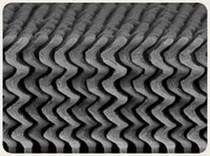
Image: An array of tiny silicon springs, each with a diameter of about 150 nanometers.

The past decade has seen an explosion of interest in electronic devices at the molecular level, but less attention has been paid to nanoscale mechanical systems, according to Toh-Ming Lu, the R.P. Baker Distinguished Professor of Physics at Rensselaer and principal investigator for the project. "Nanomechanical devices may have as important an impact as nanoelectronics, but a number of challenges need to be overcome before these systems can be practically realized," he says. "This represents a multi-billion-dollar high-technology industry that will save energy and improve the quality of lives."

Lu envisions a wide range of applications for these devices, including much more efficient light emitters and solar cells, extremely sensitive chemical and biological sensors, and super-high-density three-dimensional magnetic memory.

To achieve these advances, researchers need a better understanding of not only the growth and control of nanoscale structures, but also the way they respond to external forces such as heat, electric and magnetic fields, and mechanical stress, according to Lu. He has brought together a team of physicists, materials scientists, and mechanical engineers to address all of these issues.

"This is one more example of the wide array of interdisciplinary research being conducted at Rensselaer," says Omkaram "Om" Nalamasu, vice president for research at Rensselaer. "Collaborative work like this will help our society solve its most pressing problems in fields as diverse as energy security and information technology."

The $1.15 million, four-year grant is part of a National Science Foundation program to develop Nanoscale Interdisciplinary Research Teams (NIRT) to catalyze synergistic research and education in emerging areas of nanoscale science and technology.

Source: Rensselaer Polytechnic Institute


print this article email this article download pdf blog this article bookmark this article     Stumble it Digg this share on Facebook retweet share on Reddit add to delicious
Rate this story - not rated yet


September 15, 2005 all stories

Comments: 0

not rated yet
  • Stumble this up

  • Digg this

  • share this

  • hide
  • Related Stories


Other News

Engineers image nanostructure of a solid acid catalyst and boost its catalytic activity

Nanotechnology / Nanomaterials

created 13 hours ago | popularity 5 / 5 (1) | comments 2

The catalytic processes that facilitate the production of many chemicals and fuels could become much more environmentally friendly thanks to a breakthrough achieved by researchers from Lehigh and Rice Universities.


New transparent insulating film could enable energy-efficient displays

New transparent insulating film could enable energy-efficient displays

Nanotechnology / Nanomaterials

created 17 hours ago | popularity 4.9 / 5 (7) | comments 0

Johns Hopkins materials scientists have found a new use for a chemical compound that has traditionally been viewed as an electrical conductor, a substance that allows electricity to flow through it. By orienting ...


Ideal nanoparticle cancer therapies surf the bloodstream

Nanotechnology / Bio & Medicine

created 17 hours ago | popularity 5 / 5 (1) | comments 0

Eric Shaqfeh studies blood at Stanford University, using computer models that simulate how the fluid and the cells it contains move around. On November 11 at a meeting of the scientific society AVS, he will present his latest ...


New Digital 'Electronics' Concept May Continue Moore's Law

New Digital 'Electronics' Concept May Continue Moore's Law

Nanotechnology / Nanophysics

created Nov 05, 2009 | popularity 4.6 / 5 (57) | comments 9

(PhysOrg.com) -- Computers of the future could be operating not on electrons, but on tiny waves traveling through an electron "fluid," if a new proposal is successful. The new circuit design, recently introduced ...


Nanoparticles for gene therapy improve

Nanoparticles for gene therapy improve

Nanotechnology / Bio & Medicine

created Nov 06, 2009 | popularity 5 / 5 (5) | comments 3

(PhysOrg.com) -- About five years ago, Professor Janet Sawicki at the Lankenau Institute in Pennsylvania read an article about nanoparticles developed by MIT's Robert Langer for gene therapy, the insertion ...