Prototype for one-metre wide, eco-friendly car unveiled in Britain
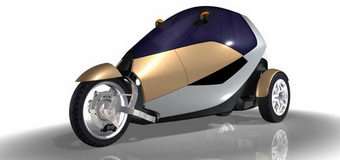
The prototype of a revolutionary new type of vehicle only one metre wide specially designed for cities has been developed by a team of European scientists. The vehicle combines the safety of a micro-car and the manoeuvrability of a motorbike, while being more fuel-efficient and less polluting than other vehicles.
The CLEVER (Compact Low Emission Vehicle for Urban Transport) vehicle is a £1.5 million collaborative project which has involved nine European partners from industry and research, including the University of Bath
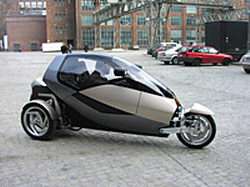
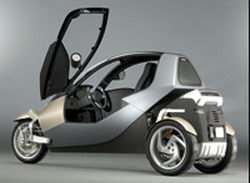
The three-year international project has produced a tilting three-wheeled vehicle that is fully enclosed and has seats for the driver and a passenger. Its strengthened frame protects the driver in a crash and the vehicle has a top speed of approximately 60 mph (about 100 kph) and an acceleration of 0-40 mph (60 kph) in seven seconds.
At just over three feet (1 metre) wide, it is 20 inches (0.5 metres) narrower than a micro-car, and three feet narrower than a medium sized conventional car. This reduced width means more efficient parking bays, and the possibility of narrower lanes for such vehicles.
The vehicle is different from previous attempts to create a small urban vehicle in that it is fully enclosed in a metal framework, is stylishly designed and is much safer. Its roof is as high as conventional cars, and it carries one passenger, who sits behind the driver.
German, French, British and Austrian organisations, including BMW, began work on the project in December 2002 completed it in March this year. It is funded by the European Union.
Matt Barker and Ben Drew, research officers at the University of Bath’s Centre for Power Transmission and Motion Control, developed a novel tilting chassis concept to keep the vehicle stable in corners. The vehicle controls the amount of tilt automatically, unlike on a motorcycle where the rider controls how far to tilt the vehicle.
The hydraulic active tilt system is electronically controlled to keep the vehicle balanced at all speeds while maintaining car-like steering throughout. The vehicle has an aluminium frame and plastic body work.
The work at Bath focused on the design and simulation of the vehicle chassis and control of the hydraulic tilting system. Cooper-Avon Tyres Ltd worked with the University of Bath to achieve these goals.
Running on compressed natural gas, the vehicle would not only help preserve stocks of oil but would emit about a third of the carbon dioxide than conventional family cars. Because it does not run on petrol or diesel, it would not be liable for the congestion charge in London, or any other city where the charge is likely to be adopted. Its fuel consumption is equivalent to 108 miles per gallon (or 2.6 litres per 100 kms) with petrol, a third of most cars.
"The CLEVER vehicle is a tremendous leap forward in the development of vehicles for the 21st century," said Dr Jos Darling, senior lecturer in Mechanical Engineering at the University of Bath, who is in charge of its part of the project, with Dr Geraint Owen.
"Making our vehicles smaller is a good solution to the relentless increase in traffic in our towns and cities. The advent of micro cars was a first step, but with its manoeuvrability and narrowness, the CLEVER vehicle is the ultimate in the search for a small vehicle to get around cities like Bath and London.
"The fact that it has a stylish design, can carry a passenger, is not open to the weather and is as high as a conventional car, will mean it will be much more popular with motorists than previous novel city vehicles.
"It costs less to run, is quieter and is less polluting, and this will make it popular with environmentalists. Its strengthened safety frame makes it very safe for the driver in accidents.
"We think the CLEVER vehicle is the way forward in city motoring and are proud that the University of Bath is at the heart of a European project to bring it about."
Source: University of Bath


