SMART-1 maps Humorum edge - where Highlands and Mare mix

April 26th, 2006

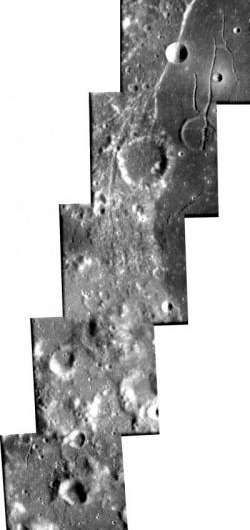
This sequence of images, taken by the advanced Moon Imaging Experiment (AMIE) on board ESA's SMART-1 spacecraft, shows on area on the near side of the Moon, on the edge of the Mare Humorum basin.
SMART-1 maps Humorum edge - where Highlands and Mare mix

Credit: ESA

AMIE obtained these raw images on 13 January 2006 from a distance ranging between 1031 and 1107 kilometres from the surface, with a ground resolution between 93 and 100 metres per pixel. The imaged area is located at longitude 45.7º West and latitude between 30.5º and 24.5º South. The field of view of each single image is about 50 kilometres.

The flat lava plain in the upper right image is the floor of Mare Humorum. The bowl-shaped crater on top, cut by a fracture, is called 'Liebig F' and has a diameter of nine kilometres.

The Mare Humorum impact basin is 825 kilometres across. Its precise age could not be determined yet by previous lunar programmes, but geologic mapping suggest it could be around 3.9 thousand million years old – an age comprised between those of the Imbrium and Nectaris Basins. The Humorum basin is filled with a layer of basalt, likely thicker than three kilometres at its centre.

The Humorum basin, like several other lunar basins, was formed in a period which ended around 4.1 billion years ago. It was filled with mare material - basaltic flood eruptions caused by very large meteoroid impacts - only during the later Eratosthenian era, in a period comprised between 3.9 and 3.2 billion years ago. The western edge of the sea is marked by a network of cracks and clefts following the Rupes Liebig.

The three northern images include part of the flat darker area corresponding to the mare basalt filling the inner ring of the basin impact. A fresh small crater is surrounded by brighter deposits.

The top north image also shows giant lava tubes or rilles in the Mare. Some graben-lineated structures (a graben is an elongated and relatively depressed crustal block that between two fault systems) indicate the stress structures created during the multi-ring collapse, and refreshed by additional load deformation from the weight of later basalt fill.

It is possible to notice the landscape transition towards the most southern image typical of an old cratered highland. In the middle image the small craters are not very clear because the terrain has been partly covered by material ejected from the impact basin.

Source: ESA


print this article email this article download pdf blog this article bookmark this article     Digg this Stumble it share on Facebook share on Reddit add to delicious save to Yahoo! bookmarks
4/5 after 7 votes


April 26th, 2006 all stories
Space & Earth /

Comments: 0
Rank: 4/5 after 7 votes

  • Stumble this up

  • Digg this

  • Share it:
  • share on Facebook
  • share on MySpace
  • share on Slashdot
  • rss-newsfeed
  • share on Google
  • share on Reddit
  • add to delicious
  • save to Yahoo! bookmarks
  • share on Windows Live
  • Add to Mixx!
Rating: 4/5 after 7 votes

  • Related Stories

  • Gassendi crater - clue on the thermal history of Mare Humorum
    created Jul 06, 2006 | popularity not rated yet | comments 0
  • Mercury's surface dominated by volcanism and iron-deficiency
    created Jul 03, 2008 | popularity not rated yet | comments 0
  • Mysterious Lunar Swirls
    created Jun 27, 2006 | popularity not rated yet | comments 0
  • Reiner Gamma swirl: magnetic effect of a cometary impact?
    created Apr 06, 2006 | popularity not rated yet | comments 0
  • Tectonic 'wrinkles' in Crater De Gasparis
    created Mar 22, 2006 | popularity not rated yet | comments 0

Tags


  • Transform a ball into a rock -- or make it invisible -- using transformation optics
    Transform a ball into a rock -- or make it invisible -- using transformation optics
    Physics / General Physics
    created 9 hours ago | popularity 3 / 5 (2) | comments 0
  • Could a quantum motor do work?
    Physics / General Physics
    created Jul 07, 2009 | popularity 4 / 5 (12) | comments 0
  • Physicists Demonstrate Quantum Memory with Matter Qubits
    Physicists Demonstrate Quantum Memory with Matter Qubits
    Physics / General Physics
    created Jul 03, 2009 | popularity 4.5 / 5 (20) | comments 1
  • 'Holey' Nanosheets for Wastewater Dye Removal
    Nanotechnology / Nanomaterials
    created Jul 01, 2009 | popularity 5 / 5 (5) | comments 1
  • Jellyfish Robot Swims Like its Biological Counterpart
    Jellyfish Robot Swims Like its Biological Counterpart
    Electronics / Robotics
    created Jun 26, 2009 | popularity 4.4 / 5 (9) | comments 1
  • Other News

    Living fossils hold record of 'supermassive' kick

    Living fossils hold record of 'supermassive' kick

    Space & Earth / Astronomy

    created 2 hours ago | popularity 4.5 / 5 (2) | comments 1

    The tight cluster of stars surrounding a supermassive black hole after it has been violently kicked out of a galaxy represents a new kind of astronomical object and a fossil record of the kick.


    Methane-eating microbes can use iron and manganese oxides to 'breathe'

    Methane-eating microbes can use iron and manganese oxides to 'breathe'

    Space & Earth / Earth Sciences

    created 5 hours ago | popularity 4.7 / 5 (3) | comments 0

    Iron and manganese compounds, in addition to sulfate, may play an important role in converting methane to carbon dioxide and eventually carbonates in the Earth's oceans, according to a team of researchers ...


    Tremors on southern San Andreas Fault may mean increased quake risk

    Tremors on southern San Andreas Fault may mean increased quake risk

    Space & Earth / Earth Sciences

    created 4 hours ago | popularity not rated yet | comments 0

    (PhysOrg.com) -- Increases in mysterious underground tremors observed in several active earthquake fault zones around the world could signal a build-up of stress at locked segments of the faults and presumably ...


    A Galaxy Collision in Action

    A Galaxy Collision in Action

    Space & Earth / Astronomy

    created 4 hours ago | popularity 4.8 / 5 (4) | comments 1

    This beautiful image gives a new look at Stephan's Quintet, a compact group of galaxies discovered about 130 years ago and located about 280 million light years from Earth. The curved, light blue ridge running ...


    NASA sails through countdown, weather outlook poor (AP)

    NASA sails through countdown, weather outlook poor

    Space & Earth / Space Exploration

    created 2 hours ago | popularity not rated yet | comments 0

    (AP) -- NASA is sailing through the countdown for Saturday's launch of space shuttle Endeavour, with weather the lone concern.