Researchers create a biologically-inspired artificial compound eye
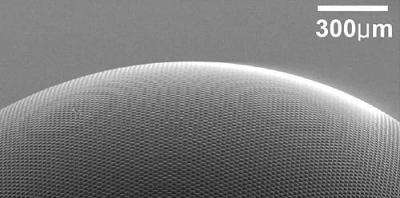
Using the eyes of insects such as dragonflies and houseflies as models, a team of bioengineers at University of California, Berkeley, has created a series of artificial compound eyes.
These eyes can eventually be used as cameras or sensory detectors to capture visual or chemical information from a wider field of vision than previously possible, even with the best fish-eye lens, said Luke P. Lee, the team's principal investigator. Potential applications include surveillance; high-speed motion detection; environmental sensing; medical procedures, such as endoscopies and image-guided surgeries, that require cameras; and a number of clinical treatments that can be controlled by implanted light delivery devices.
They are the first hemispherical, three-dimensional optical systems to integrate microlens arrays – thousands of tiny lenses packed side by side – with self-aligned, self-written waveguides, that is, light-conducting channels that themselves have been created by beams of light, said Lee, the Lloyd Distinguished Professor of Bioengineering at UC Berkeley.
The eyes are fully described for the first time in the April 28 issue of the journal Science.
"I've always wanted to create an advanced, three-dimensional optical system," Lee said, "but conventional microfabrication technology is two-dimensional. So, I started thinking about basing a fabrication system on the developmental stages of insect eyes that I'd learned about as a biophysicist and bioengineer."
What he and his team came up with is a low-cost, easy-to-replicate method of creating pinhead-sized polymer resin domes spiked with thousands of light-guiding channels, each topped with its own lens. Not only are these units packed together in the same hexagonal, honeycomb pattern as in an insect's compound eye, but each is also remarkably similar in size, design, shape and function to an ommatidium, the individual sensory unit of a compound eye.
Just like pins in a pincushion – or a dragonfly's 30,000 ommatidia – the team's artificial ommatidia are each oriented at a slightly different angle. Lee's team has shown that the lenses and waveguides of the artificial eyes focus and conduct light in the same way as an insect's eye.
While an insect's ommatidia each end in a photoreceptor cell that transmits a light signal to the creature's optic nerve, Lee plans to couple his team's ommatidia with CCD photodiodes, the light-capturing units used in digital cameras and camcorders. He also has plans to link them to spectroscopes for chemical detection and analysis.
"The lenses and waveguides are the most important part of the system," Lee said. "People have said that it would be totally impossible to create them with an angle, but now that we've done it, we're ready to integrate imaging or chemical sensing into the eyes."
While conventional microfabrication techniques are expensive and use high temperatures, Lee and his team borrowed from nature, using a low temperature system, photopolymerization, and self-aligning, self-writing technology.
To create the artificial eye, the team first needed to construct a hemispherical mold of the eye's outer layer, a structure consisting of thousands of microlenses. Using existing technology, they made a flat array of these tiny, domed lenses arranged in the hexagonal honeycomb pattern. On top of this, they applied a thin slab of an elastic polymer called polydimethylsiloxane, or PDMS, creating a concave pattern of the lenses in the polymer. By affixing the PDMS membrane over the opening of a vacuum chamber and applying negative air pressure, they pulled it into the dome shapes they needed, controlling its form by using different pressures.
They then had a hemisphere-shaped cup pocked with some 8,700 indentations: a compound-eye mold that could be used over and over again using soft lithography technology, a set of methods developed over the last decade to replicate nanoscale-sized structures.
The material they chose for the artificial eyes was an epoxy resin that cures into a hardened form when exposed to ultraviolet light. They poured the resin into the dimpled molds, baked it at a low temperature just long enough to slightly harden the material, then turned out the contents: little resin hemispheres with a surface packed with 8,700 raised mounds. When struck by a beam of light, each of these mounds acts as a lens, focusing the light and sending it into the material below. Like a welder's torch burning a hole into metal, over time the focused light beams etch holes in the resin creating the tiny channels called self-written waveguides.
Because these channels are formed at the angle of the light beams that strike them, Lee used a condenser lens to bend his light source into a spoke-like pattern of beams that converges on the eye's dome. The end result is that the waveguides pierce the resin at angles that head toward the center of the dome, just like the converging ommatidia of an insect eye.
Because the microlenses create the waveguides, each microlens is perfectly aligned with its waveguide. The self-alignment, self-writing processes are crucial to the creation of the artificial compound eye, said Lee, because these processes will also align the microlenses and waveguides with the pixels of CCDs and spectroscopes.
"Who knows? Maybe this is how insect eyes are created, too," said Lee. "First, there are the lenses, and then as light keeps coming in, they make their own optical paths and connect with the visual system."
Lee speculates that the artificial compound eyes will be put to use within a few years. Their first applications may be in ultra-thin camera phones. After that, he expects to see them used in camcorders for omnidirectional surveillance imaging and such uses as small, hidden, wearable cameras.
Source: University of California - Berkeley


