Probing Question: Why don't we have high-speed trains in the U.S.?
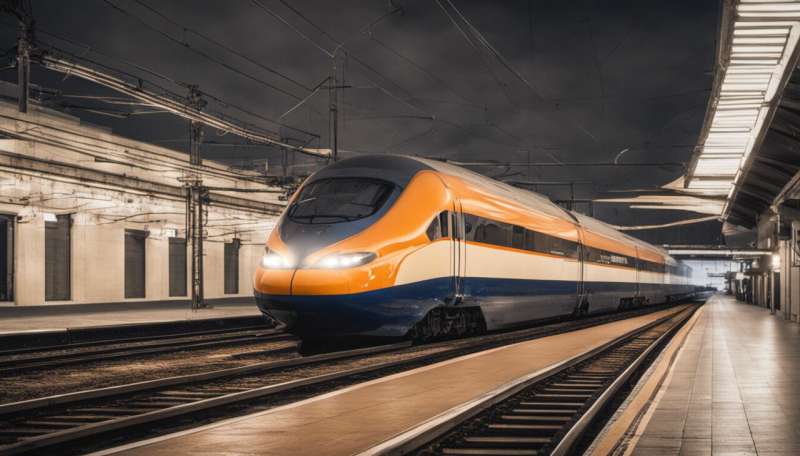
The next time you need to get to New York or Washington, D.C., think how much easier it would be if high-speed trains were as common here as they are in Europe. Such trains would leave every hour and get you to your destination -- even right to the airport -- on time and faster than driving.
Here in the United States, high-speed trains are fantasy, but not in Europe or Japan. Eurostar trains run on the hour, speeding London passengers at up to 186 mph to Paris in about two and a half hours, for about $266 round trip. Trains between Barcelona and Madrid soon will reach 210 mph.
Japan's high-speed trains, the world's first, have linked Tokyo, Nagoya, Kyoto and Osaka since 1964. The shinkansen, or "bullet" trains now reach speeds of more than 186 mph, shuttling riders from Tokyo to Osaka in two and a half hours, for about $120 each way.
Here, Amtrak's Acela Express makes the trip from Washington, D.C., to Boston in about six and a half hours for about $321 round trip. The Acela typically runs at speeds up to 120 to 130 mph and on one short stretch at 150 mph, speeds that make it the fastest train in America but are considered slow by global standards.
Why are we so far behind?
The answer is simple, said John Spychalski, professor of supply chain management in Penn State's Smeal College of Business. The U.S. government won't pay for high-speed trains.
"(High-speed train service) is not going to be built by private enterprise, no more than the interstate highway system was built by private enterprise," Spychalski explained. "The U.S. would not have the air-transport system developed to where it is today without public-sector involvement."
A lack of political support at the federal and state levels keeps Amtrak in an annual battle just to survive, ensuring that high-speed train service is not available in most of the country, said Spychalski.
This political vacuum has been consistent over many decades among both Republicans and Democrats, he noted, and has its roots in public attitudes.
"What does the average person know of high-speed rail? Very little," Spychalski said. "Their mindset is centered on two things they know: autos and airplanes." Where trains are seen as a quaint part of our history, Americans view their cars as status symbols, an extension of ego and class distinction.
Over the 20-year period from 1978 to 1999, federal spending on rail travel totaled $18.3 billion, about 3.6 percent of total transportation spending. In the same period, the nation spent $251.5 billion on highways (49.9 percent), and $114 billion on air (22.6 percent). During these two decades, spending on rail dropped 1.9 percent annually as spending on every other transportation mode increased annually up to 10 percent, according to a recent report from the Mineta Transportation Institute.
Last year, President Bush proposed zero funding for Amtrak, but then signed Congress' final budget with $1.3 billion for rail service. This year, Bush proposed cutting Amtrak's budget back to $900 million. Amtrak officials say they need $1.6 billion to operate at the current level and can't afford to make any progress.
"Funding of Amtrak is always hard-scrabble," said Spychalski. "Amtrak is always trying to catch up."
The benefits of high-speed train service, he explained, would include relieving pressure on the air traffic control system in crowded regions like New England, California and Chicago by getting passengers city-to-city faster than air flights.
Environmentally, rail uses the least land to move the most people, and high-speed trains promise better air quality, he added.
Traveling by rail is safer than traveling by car, Spychalski says. Plus, rail tends to be less vulnerable to severe weather and to terrorism.
The better-linked a rail system is to autos and air -- i.e. the rail stations at Amsterdam's Schiphol Airport and Frankfurt's Airport -- the more valuable it is, said Spychalski. "We need to look at the transport system from a total system perspective and look at how the air, rail and road relate to each other."
Despite the political barriers, there are some U.S. rail success stories, said Spychalski. They include restoration of rail service between Boston and Portland, Maine, and both inter-city and commuter rail passenger services serving key areas within California. Ridership is increasing in both places.
Here in Pennsylvania, the state and Amtrak are working on a $100 million project to make train service between Harrisburg and Philadelphia faster, safer and more convenient.
The many benefits of high-speed rail and these success stories keep Spychalski hopeful that someday U.S. trains will eventually climb that political mountain, just like the Little Engine that Could.
Source: Research/Penn State, By Lisa Duchene


