Toshiba develops fuel cell prototypes for portable music players
September 16, 2005
Toshiba develops fuel cell prototypes for portable music players

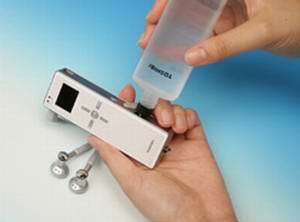
Toshiba said Friday it has developed two small direct methanol fuel cell prototypes that can dramatically increase the playing time for mobile music players. A fuel cell unit the size of a pack of chewing gum can power a flash-memory-based player for about 35 hours on a single charge.

The new fuel cell units have an output power of 100mW and 300mW and have been applied to a flash-memory-based digital audio player and an HDD-based digital audio player, respectively

The 100mW unit, similar in shape and size to a pack of gum at a compact W23mm x L75mm x D10mm, can power the flash-based player for approximately 35 hours on a single 3.5ml charge of highly concentrated methanol, the fuel that drives the electricity producing chemical reaction in the fuel cell. The 300mW unit is W60mm x L75mm x D10mm and delivers enough power to keep an HDD-based audio player running for approximately 60 hours on a single 10ml charge.

Both prototype players include components related to the testing and are W35mm x L110mm x D20mm (flash memory) and W65mm x L125mm x D27mm (HDD) with the fuel cell units. These sizes can be reduced substantially by removing the extra components and applying optimal design for commercial products.

The design of the fuel cell units reflects current moves toward international standardization of micro fuel cells and meets the International Electrotechnical Commission's draft safety standards now under review.

Toshiba's DMFC features a passive fuel supply system that is suited to smaller fuel cells and use with a highly concentrated methanol solution. Fuel cells usually mix methane with water in a concentration of less than 30%, a dilution that supports generating efficiency but which requires a fuel tank that is much too big for portable equipment. Through durability and reliability tests with the new units, Toshiba will accelerate technology enhancements, including development of production technology, to support integration of DMFC into commercial products expected to appear in and after 2007.

The two prototype players and their methanol cartridges will be exhibited at the CEATEC JAPAN 2005 which will be held at Makuhari Messe, Chiba Prefecture, from October 4 to 8, 2005.

3.9 /5 (13 votes)  

Rank 3.9 /5 (13 votes)
Tags

Related Stories
Relevant PhysicsForums posts

More news stories

Japan scientist makes 'Avatar' robot

A Japanese-developed robot that mimics the movements of its human controller is bringing the Hollywood blockbuster "Avatar" one step closer to reality.

Electronics / Robotics

created 23 hours ago | popularity 5 / 5 (7) | comments 9

Intel packs performance and reliability into its latest SSD 520 series

Intel Corporation announced today its fastest, most robust client/consumer solid-state drive (SSD) to date, the Intel Solid-State Drive 520 Series (Intel SSD 520), a 6 gigabit-per-second (gbps) SATA III SSD ...

Electronics / Hardware

created Feb 07, 2012 | popularity 5 / 5 (1) | comments 4

Google rumored to have built Heads-Up-Display glasses prototype

(PhysOrg.com) -- 9to5Google is reporting that they have received a tip from someone they believe to be a reliable source saying that Google is working on a Heads-Up-Display (HUD) pair of eye-glasses. The per ...

Electronics / Consumer & Gadgets

created Feb 08, 2012 | popularity 4.3 / 5 (8) | comments 2 | with audio podcast weblog

Apple to debut 'iPad 3' in March: report

Apple will unveil a new version of its market-ruling iPad table computer in March, according to a report in Dow Jones-owned technology blog All Things D.

Electronics / Consumer & Gadgets

created Feb 09, 2012 | popularity 1.9 / 5 (21) | comments 0

New Kindle Touch is an impressive e-reader

When it comes to reading digital books, tablets are all the rage. But there's a lot to like about simple e-readers, which over the past year have become both a lot cheaper and a lot less clunky.

Electronics / Consumer & Gadgets

created Feb 09, 2012 | popularity 5 / 5 (4) | comments 1


Anonymous knocks CIA website offline (Update)

The website of the Central Intelligence Agency was inaccessible on Friday after the hacker group Anonymous claimed to have knocked it offline.

New error-correcting codes guarantee the fastest possible rate of data transmission

Error-correcting codes are one of the triumphs of the digital age. They’re a way of encoding information so that it can be transmitted across a communication channel — such as an optical fiber o ...

Humans may have helped the decline of African rainforests 3000 years ago

(PhysOrg.com) -- Large areas of rainforests in Central Africa mysteriously disappeared over three thousand years ago, to be replaced by savannas. The prevailing theory has been that the cause was a change ...

New power source discovered

(PhysOrg.com) -- Researchers at the Massachusetts Institute of Technology (MIT) and RMIT University have made a breakthrough in energy storage and power generation.

Small modular reactor design could be a 'SUPERSTAR'

(PhysOrg.com) -- Though most of today's nuclear reactors are cooled by water, we've long known that there are alternatives; in fact, the world's first nuclear-powered electricity in 1951 came from a reactor ...

Google users warned of threat to smartphone wallets

Users of Google smartphone wallets were being warned on Friday that there is a way to crack pass codes intended to thwart thieves from going on illicit shopping sprees.