Space Shuttle Replacement
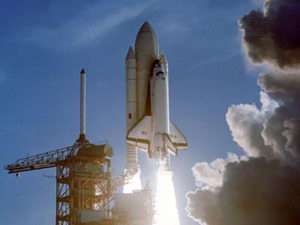
It’s no secret that NASA needs a replacement for the aging STS – Space Transport System – or more commonly, the Space Shuttle. In fact, many scientists – including some of the most prestigious organizations like the Federation of Scientists – have been against the shuttle from the beginning. Maybe NASA should have listened to them.
The shuttle program has been the most costly space program in history. Despite huge investments in improvements and upgrades for safety, it has proven to be dangerous and ineffective for its intended missions – namely space science and construction of the Space Station – now on hold.
It has had its successes – the Hubble repairs in 1993, 1997 and 1999 and dozens of successful placements of important military and communications satellites. Right now, selling tickets to ride the space shuttle – even for satellites – is tough proposition. Nobody wants to pay more and risk their multimillion dollar mission on a vehicle considered an antique – it’s more than 25 years old. Even NASA has stopped defending the shuttle.
First Challenger and then Columbia accidents have placed a dark shadow on the whole program. The last launch showed the safety fixes inadequate. The shuttle still has serious problems with the ceramic tiles that form the reentry heat shield, i.e. they come unglued and fall off and are susceptible to damage from falling debris during launch.
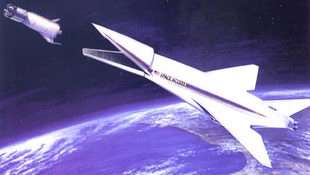
Replacements for the shuttle have not been scarce. In fact, ideas for better ways to place mass into orbit have been on the drawing boards since even before the first launch of the space shuttle and many remain interesting to this day. Indeed, due to advances in materials science and engineering, some look even more attractive than when they were first proposed. It’s worth a look to see where we might be headed in the future.
What have replaced the Space Shuttle missions recently are multistage rockets – smaller versions of the same Saturn 5s that got us to the moon. The Russian Soyuz program is a the longest running example, but the European Airane rockets, the Japanese and now, even the Chinese and Indians, have all been putting satellites into orbit with rocket based systems. The US has relied principally on the Titan and Delta programs. Except for the Soyuz, all are unmanned – not for technical reasons, but for lack of a real reason to spend the huge amounts necessary to put a person into orbit. Advances in computers, communications and robotics have all but banished the need for crewed missions.
This new emphasis on non-crewed missions also helps to change the picture substantially for putting payloads into orbit. While the shuttle can barely make into low Earth orbit, multistage rockets without heavy life support systems can be launched at just a fraction of the cost and take payloads as far as interstellar space.
In the near term the new Atlas 5 from Lockeed Martin and Boeing’s Delta 4 series rockets will be the mainstay of US efforts to place satellites in orbit.
Still, rockets leave much to be desired. They also have unacceptable failure rates and, because of the need to carry all their reaction mass – rocket fuel – with them, they must be huge to put even a small payload into orbit. They are not exactly cheap either – the last Titan launch cost $441 million dollars.
The space plane concept has been studied for twenty years and probably will be the next shuttle replacement – especially for low earth orbits and passengers. Scientists will probably continue to use un-crewed probes making probable space plane passengers tourists – a very small but growing business.
The big advantage of the space plane is its abilities to “fly” into space. Rather than having to lift all its reaction mass with it, it uses the surrounding air as part of its fuel. Although the motors would be akin to jet engines, they would have to operate at the much higher speeds needed to make orbit. These special engines would be a combination of jet, ramjet, and super sonic ram jet or scram jet. Problems include motor design, low orbital altitude and the same deadly high-speed reentry the shuttle uses.
To add altitude to the space plane concept, the Space Access plan uses a combination of space plane and rocket driven payload to put objects into any orbit desired. This plan has since been put on hold due to high development costs.
A more futuristic method relies on powerful lasers to “push” objects into space. Proof of concept studies have shown a small cone-like disk being pushed up a pole by a laser. The laser super heats the air in the cone causing a small explosion which forces the disk upward. In practice, the laser targeting would have to be exact – a multi-gigawatt laser could do real damage to any unprotected object. Also, either the laser would have to be very powerful or the target disk very light.
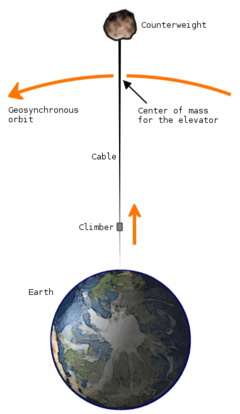
The tether concept has also been studied and offers real promise. Basically, a very strong tether would be stretched from the earth into space. The mass at the space bound end – traveling at orbital velocity – would counteract the Earth’s gravity making an “elevator” to the stars. One of the problems encountered during testing of this idea was the strong electrical currents generated by the tether. These currents heated the tether causing it to snap in at least one experiment. However, this “flaw” could turn into a benefit if a way were found to capture the generated electricity without endangering the structural integrity of the tether itself.
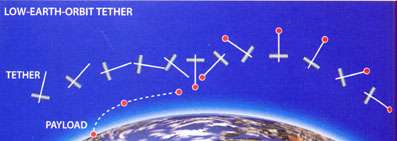
A more complicated scenario involves several rotating tethers at stacked at different orbits. This “elevator” system would work by passing off loads to the next higher rotating tether to move them into a final orbit. The complicated dynamics of this system demand a carefully choreographed dance, but the payoff is a free ride into orbit and beyond – discounting the cost of building such a system, of course.
Less probable, but more efficient, is the atomic rocket. Using a nuclear reactor for thrust has several advantages, most importantly a high lift to mass ratio. The motor would deliver substantial amounts of energy for a given weight. The fear of atomic rocket crashes and the resulting radioactive fallout, however, will probably keep this idea on the back burner.
Whatever the means used, it won’t be for lack of bright ideas. The biggest hurdle facing the space program is the need for direction in crewed space flight. While scientists opt for less expensive robotics missions, the general public’s representatives approve the budget – and they want to see humans in space, not just rovers and satellites.
The International Space Station – also marginally effective for space science - is on hold due to problems with the shuttle and low payload capacities of the Soyuz rockets. Many scientists are backing un-crewed missions as being more cost effective and less risky and talk of a Mars mission is still just that: talk.
The truth is humans are ill suited to explore space which is far more hostile than any frontier we have faced in the past. We can see the wonders of our solar systems from the comfort of our living rooms via robotic probes instead of risking a fiery death riding a controlled explosion. Until leaving the earth becomes cheaper and safer, only a few wealthy space adventures will experience leaving the earth first hand – much like the first airplane users did. But one day, we will reach again for the stars. Maybe some of the technologies in this article will be the one to get us there.
By Philip Dunn, Copyright 2006 PhysOrg.com
Images from Scientific American Space Exploration Quarterly Vol. 10 Num. 1


