Hurricanes Are Getting Stronger, Study Says
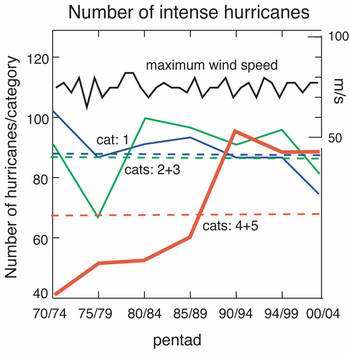
The number of Category 4 and 5 hurricanes worldwide has nearly doubled over the past 35 years, even though the total number of hurricanes has dropped since the 1990s, according to a study by researchers at the Georgia Institute of Technology and the National Center for Atmospheric Research. The shift occurred as global sea surface temperatures have increased over the same period. The research will appear in the September 16 issue of the journal Science.
Image: The number of Category 4 and 5 hurricanes worldwide has nearly doubled over the past 35 years.
Peter Webster, professor at Georgia Tech’s School of Earth and Atmospheric Sciences, along with NCAR’s Greg Holland and Tech’s Judith Curry and Hai-Ru Chang, studied the number, duration and intensity of hurricanes (also known as typhoons or tropical cyclones) that have occurred worldwide from 1970 to 2004.
“What we found was rather astonishing,” said Webster. “In the 1970's, there was an average of about 10 Category 4 and 5 hurricanes per year globally. Since 1990, the number of Category 4 and 5 hurricanes has almost doubled, averaging 18 per year globally.”
Category 4 hurricanes have sustained winds from 131 to 155 miles per hour; Category 5 systems, such as Hurricane Katrina at its peak over the Gulf of Mexico, feature winds of 156 mph or more.
“Category 4 and 5 storms are also making up a larger share of the total number of hurricanes,” said Curry, chair of the School of Earth and Atmospheric Sciences at Georgia Tech and co-author of the study. “Category 4 and 5 hurricanes made up about 20 percent of all hurricanes in the 1970's, but over the last decade they account for about 35 percent of these storms.”
The largest increases in the number of intense hurricanes occurred in the North Pacific, Southwest Pacific and the North and South Indian Oceans, with slightly smaller increases in the North Atlantic Ocean.
All this is happening as sea-surface temperatures are rising across the globe-anywhere from around one-half to one degree Fahrenheit, depending on the region, for hurricane seasons since the 1970’s.
“Our work is consistent with the concept that there is a relationship between increasing sea surface temperature and hurricane intensity,” said Webster. “However, it’s not a simple relationship. In fact, it’s difficult to explain why the total number of hurricanes and their longevity has decreased during the last decade, when sea surface temperatures have risen the most.”
The only region that is experiencing more hurricanes overall is the North Atlantic, where they have become more numerous and longer-lasting, especially since 1995. The North Atlantic has averaged eight to nine hurricanes per year in the last decade, compared to the six to seven per year before the increase. Category 4 and 5 hurricanes in the North Atlantic have increased at an even faster clip: from 16 in the period of 1975-89 to 25 in the period of 1990-2004, a rise of 56 percent.
A study published in July in the journal Nature came to a similar conclusion. Focusing on North Atlantic and North Pacific hurricanes, Kerry Emanuel (Massachusetts Institute of Technology) found an increase in their duration and power, although it used a different measurement to determine a storm’s power.
But whether all of this is due to human-induced global warming is still uncertain, said Webster. “We need a longer data record of hurricane statistics, and we need to understand more about the role hurricanes play in regulating the heat balance and circulation in the atmosphere and oceans.”
"Basic physical reasoning and climate model simulations and projections motivated this study,” said Jay Fein, director of NSF’s climate and large scale dynamics program, which funded the research. “These results will stimulate further research into the complex natural and anthropogenic processes influencing these tropical cyclone trends and characteristics.”
Webster is currently attempting to determine the basic role of hurricanes in the climate of the planet. “The thing they do more than anything is cool the oceans by evaporating the water and then redistributing the oceans’ tropical heat to higher latitudes,” he said.
“But we don’t know a lot about how evaporation from the oceans’ surface works when the winds get up to around 100 miles per hour, as they do in hurricanes,” said Webster, who adds that this physical understanding will be crucial to connecting trends in hurricane intensity to overall climate change.
“If we can understand why the world sees about 85 named storms a year and not, for example, 200 or 25, then we might be able to say that what we’re seeing is consistent with what we'd expect in a global warming scenario. Without this understanding, a forecast of the number and intensity of tropical storms in a future warmer world would be merely statistical extrapolation.”
Source: Georgia Institute of Technology


