Dual Properties of Carbon Nanotubes Revealed
April 28, 2006
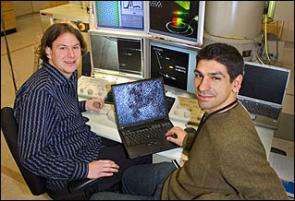
Tobias Beetz (left) and Matt Sfeir review data in the electron microscopy lab at Brookhaven.
For the first time, researchers have directly measured the electronic structure of individual carbon nanotubes whose physical properties had already been determined. This new study, pioneered by researchers at the U.S. Department of Energy’s Brookhaven National Laboratory working with their colleagues at Columbia University, may help scientists determine the usefulness of carbon nanotubes in various applications, from microelectronics to mechanical, thermal, and photovoltaic devices.
The researchers report on their work in the April 28 issue of Science.
“This combined study technique allows us -- for the first time -- to test some fundamental predictions about nanotube behavior,” said Matt Sfeir, a physicist in Brookhaven’s Condensed Matter Physics and Materials Sciences Division and lead author of the study. “Understanding how these materials function on a basic level is key to controlling and manipulating them for future successful commercial applications.”
Carbon nanotubes are capsule-shaped molecules only a few billionths of a meter (nanometers) in width. In nanotube form, many materials take on useful, unique properties, such as physical strength and excellent conductivity. Single-walled carbon nanotubes are the most widely investigated variety, but what makes them so interesting also makes them very difficult to study -- several hundred distinct species exist, and each has dramatically different electronic properties thought to be linked to their unique individual structure.
Sfeir and his colleagues sought to look at both the structure of carbon nanotubes and their corresponding electronic properties using two existing techniques. The twist is that the two techniques would be used on each of the nanotubes studied, giving the researchers a complete picture of their unique structure and behavior as well as greater knowledge about how they “transition” from semi-conducting to metallic in terms of their electronic properties.
The work started at Columbia, where the single-walled carbon nanotubes were grown freely suspended over a slit etched into a silicon substrate. The researchers then identified usable individual nanotubes, labeled them, and studied them with a technique known as resonance Rayleigh scattering. This method allows researchers to detect the optical spectrum of light scattered from the nanotubes and use that scattered light to determine their electronic structure.
“The optical spectra alone, however, does not give us sufficient information to absolutely assign electronic transitions to the nanotubes’ physical structure,” said Sfeir. “We needed a technique that could provide independent structural verification. Fortunately, our colleagues in the electron microscopy group at Brookhaven were interested in this problem as well and were able to provide a solution - electron diffraction.”
The labeled nanotubes were brought to Brookhaven, where physicist Tobias Beetz subjected them to electron diffraction studies using an electron microscope. This gave the researchers complementary data on the nanotubes’ physical structure.
“Electron diffraction is an ideal tool for determining the exact structure of metallic and semiconducting nanotubes,” said Beetz. “We can use this tool to easily see if we are dealing with single-walled or double-walled nanotubes, and we are not limited to studying a certain nanotube diameter range as we would be using other methods.”
After collecting these two sets of information from many different nanotube structures, researchers were then able, for the first time, to test theories of nanotube electronic transitions and confirm several assumptions made in previous models.
“One aspect we have verified is how small changes in the pitch of the hexagons on the nanotube sidewall, determined by how the nanotube grows, lead to systematic deviations in the electronic behavior in both semi-conducting and metallic structures,” said Sfeir. “This predicted behavior, known as the “family pattern,” had never before been directly tested, and our experimental results place it on a solid foundation that was previously lacking.”
Source: BNL
-
Researchers devise new means for creating elastic conductors
Jan 24, 2012 |
5 / 5 (2) |
0
-
Scientists solve mystery of colorful armchair nanotubes
Jan 09, 2012 |
5 / 5 (2) |
2
-
Graphene rips follow rules: Simulations show carbon sheets tear along energetically favorable lines
Jan 05, 2012 |
5 / 5 (3) |
0
-
NIST releases first certified reference material for single-wall carbon nanotubes
Dec 21, 2011 |
5 / 5 (2) |
0
-
New method for enhancing thermal conductivity could cool computer chips, lasers and other devices
Dec 14, 2011 |
4.6 / 5 (11) |
3
-
Engineers build first sub-10-nm carbon nanotube transistor
Feb 01, 2012 |
4.9 / 5 (31) |
30
-
Something old, something new: Evolution and the structural divergence of duplicate genes
Jan 31, 2012 |
4.6 / 5 (7) |
1
-
The hidden nanoworld of ice crystals: Revealing the dynamic behavior of quasi-liquid layers
Jan 30, 2012 |
5 / 5 (3) |
1
-
Stock market network reveals investor clustering
Jan 27, 2012 |
3.9 / 5 (23) |
8
-
Of microchemistry and molecules: Electronic microfluidic device synthesizes biocompatible probes
Jan 26, 2012 |
5 / 5 (1) |
0
-
Universe as a cellular automaton
1 hour ago
-
Question about Newton's laws
1 hour ago
-
Gravity Question (I think) with mass and speed
4 hours ago
-
Can you manipulate any formula in Physics?
4 hours ago
-
I have a quiz -_-
6 hours ago
-
Understanding Antennas based on GPS
7 hours ago
- More from Physics Forums - General Physics
More news stories
New kind of solar cell could capture significantly more energy than current cells
New solar cells could increase the maximum efficiency of solar panels by over 25%, according to scientists from the University of Cambridge.
Feb 08, 2012 |
4.5 / 5 (12) |
14
|
Nanoshell whispering galleries improve thin solar panels
Visitors to Statuary Hall in the U.S. Capitol Building may have experienced a curious acoustic feature that allows a person to whisper softly at one side of the cavernous, half-domed room and for another on ...
Nanotechnology / Nanomaterials
Feb 07, 2012 |
4.3 / 5 (6) |
6
|
'Dark plasmons' transmit energy
Microscopic channels of gold nanoparticles have the ability to transmit electromagnetic energy that starts as light and propagates via "dark plasmons," according to researchers at Rice University.
Feb 09, 2012 |
4.8 / 5 (9) |
1
|
Revealing how a battery material works
Since its discovery 15 years ago, lithium iron phosphate (LiFePO4) has become one of the most promising materials for rechargeable batteries because of its stability, durability, safety and ability to deliver ...
Nanotechnology / Nanomaterials
Feb 08, 2012 |
5 / 5 (5) |
0
|
Nanotube therapy takes aim at breast cancer stem cells
Wake Forest Baptist Medical Center researchers have again proven that injecting multiwalled carbon nanotubes (MWCNTs) into tumors and heating them with a quick, 30-second laser treatment can kill them.
Nanotechnology / Bio & Medicine
Feb 09, 2012 |
5 / 5 (1) |
0
|
Walney offshore wind farm is world's biggest (for now)
(PhysOrg.com) -- The Walney wind farm on the Irish Sea--characterized by high tides, waves and windy weather--officially opened this week. The farm is treated in the press as a very big deal as the Walney ...
Europeans protest controversial Internet pact
Tens of thousands of people marched in protests in more than a dozen European cities Saturday against a controversial anti-online piracy pact that critics say could curtail Internet freedom.
GPS court ruling leaves US phone tracking unclear
A US Supreme Court decision requiring a warrant to place a GPS device on the car of a criminal suspect leaves unresolved the bigger issue of police tracking using mobile phones, legal experts say.
Europe stakes billion-dollar bet on new rocket
A pencil-slim rocket is scheduled to lift into space from South America on Monday, carrying a billion-dollar bet that Europe can grab a juicy slice of the market to place satellites in low orbit.
Study finds that anti-diabetic medication can prevent the long-term effects of maternal obesity
In a study to be presented today at the Society for Maternal-Fetal Medicine's annual meeting, The Pregnancy Meeting, in Dallas, Texas, researchers will report findings that show that short therapy with the anti-diabetic medication ...
Netflix settlement trims 14 pct off 4Q earnings
(AP) -- Netflix pressed the rewind button on its fourth-quarter earnings after settling allegations that the video subscription service violated a consumer-privacy law.