A biosensor layered like lasagna
April 28, 2006
A biosensor layered like lasagna

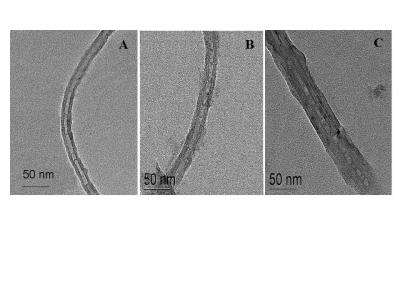
Electron-microscopic images show enzyme-coated carbon nanotubes of varying thicknesses. The sensitivity of a biosensor increases with thickness, to about six layers (right). Credit: Pacific Northwest National Laboratory

In a mixing of pasta metaphors, Pacific Northwest National Laboratory scientists have used electrostatic attraction to layer reactive biological molecules lasagna-like around spaghetti-like carbon nanotubes.

This configuration can accommodate a wide range of applications, from ultra-precise blood-sugar monitoring to infectious-agent detection, said Yuehe Lin, who led the research at the Department of Energy campus' W.R. Wiley Environmental Molecular Sciences Laboratory.

The technique, described in the current (April) Journal of Nanoscience and Nanotechnology, enables enzymes, with the help of a long, noodle-like polymer molecule, to self-assemble layer-by-layer on a single carbon nanotube.
A biosensor layered like lasagna

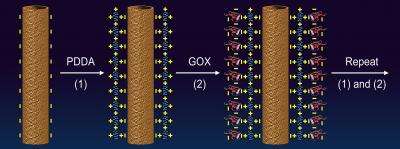
A polymer, here labeled PDDA, clings to a carbon nanotube of opposite charge, and an enzyme, GOX, does the same with the polymer. The steps can be repeated to build up a biosensor's layers, enzyme count and sensitivity. Credit: Pacific Northwest National Laboratory

Lin and co-author Guodong Liu, a postdoctoral fellow in Lin's group, coaxed electrostatic clinginess in a polymer and an oppositely charged protein-enzyme, in this case glucose oxidase, which reacts in the presence of blood sugar. The catalyzed products from the reaction ping the carbon nanotube; if the tube is connected to an electrode, the tube will carry a signal that corresponds precisely with the amount of glucose detected. The first polymer binds to the carbon nanotube. Enzymes are attracted to the polymer, leaving an outer layer for the next polymer of opposite charge to cling to, and so on.

An individual strand coated with one to six layers ranges from 30 nanometers to about 50 nanometers thick. "Each polymer layer is porous," Lin said. "This allows the glucose to diffuse in and come into contact with the enzymes."

"The polymers trap the enzymes in place," Liu said. "You can go up to five or six layers to improve the sensitivity of the detector, but after that, the more enzyme layers" inhibit diffusion of the glucose.

Now that the glucose enzyme biosensor has passed the test, Lin said, it should be possible to build a similar sensor using other enzymes that react specifically with other biological chemicals, environmental agents or even microbes and their toxic byproducts. Lin and colleagues also reported, in February issue of Analytical Chemistry, having used a similar technique to construct sensors for nerve agents.

Source: Pacific Northwest National Laboratory

4.2 /5 (10 votes)  

Rank 4.2 /5 (10 votes)
Tags

Relevant PhysicsForums posts
  • Does magnetic generators work ?
    created1 hour ago
  • Gravity Question (I think) with mass and speed
    created2 hours ago
  • Can you manipulate any formula in Physics?
    created3 hours ago
  • I have a quiz -_-
    created5 hours ago
  • Understanding Antennas based on GPS
    created5 hours ago
  • Parallel plate capacitor's charge
    created6 hours ago
  • More from Physics Forums - General Physics

More news stories

New kind of solar cell could capture significantly more energy than current cells

New solar cells could increase the maximum efficiency of solar panels by over 25%, according to scientists from the University of Cambridge.

Nanotechnology / Nanophysics

created Feb 08, 2012 | popularity 4.5 / 5 (12) | comments 14 | with audio podcast

Nanoshell whispering galleries improve thin solar panels

Visitors to Statuary Hall in the U.S. Capitol Building may have experienced a curious acoustic feature that allows a person to whisper softly at one side of the cavernous, half-domed room and for another on ...

Nanotechnology / Nanomaterials

created Feb 07, 2012 | popularity 4.3 / 5 (6) | comments 6 | with audio podcast

'Dark plasmons' transmit energy

Microscopic channels of gold nanoparticles have the ability to transmit electromagnetic energy that starts as light and propagates via "dark plasmons," according to researchers at Rice University.

Nanotechnology / Nanophysics

created Feb 09, 2012 | popularity 4.8 / 5 (9) | comments 1 | with audio podcast

Revealing how a battery material works

Since its discovery 15 years ago, lithium iron phosphate (LiFePO4) has become one of the most promising materials for rechargeable batteries because of its stability, durability, safety and ability to deliver ...

Nanotechnology / Nanomaterials

created Feb 08, 2012 | popularity 5 / 5 (5) | comments 0 | with audio podcast

Nanotube therapy takes aim at breast cancer stem cells

Wake Forest Baptist Medical Center researchers have again proven that injecting multiwalled carbon nanotubes (MWCNTs) into tumors and heating them with a quick, 30-second laser treatment can kill them.

Nanotechnology / Bio & Medicine

created Feb 09, 2012 | popularity 5 / 5 (1) | comments 0 | with audio podcast


Walney offshore wind farm is world's biggest (for now)

(PhysOrg.com) -- The Walney wind farm on the Irish Sea--characterized by high tides, waves and windy weather--officially opened this week. The farm is treated in the press as a very big deal as the Walney ...

GPS court ruling leaves US phone tracking unclear

A US Supreme Court decision requiring a warrant to place a GPS device on the car of a criminal suspect leaves unresolved the bigger issue of police tracking using mobile phones, legal experts say.

Study finds that anti-diabetic medication can prevent the long-term effects of maternal obesity

In a study to be presented today at the Society for Maternal-Fetal Medicine's annual meeting, The Pregnancy Meeting, in Dallas, Texas, researchers will report findings that show that short therapy with the anti-diabetic medication ...

Europe stakes billion-dollar bet on new rocket

A pencil-slim rocket is scheduled to lift into space from South America on Monday, carrying a billion-dollar bet that Europe can grab a juicy slice of the market to place satellites in low orbit.

Netflix settlement trims 14 pct off 4Q earnings

(AP) -- Netflix pressed the rewind button on its fourth-quarter earnings after settling allegations that the video subscription service violated a consumer-privacy law.

Europeans protest controversial Internet pact

Tens of thousands of people marched in protests in more than a dozen European cities Saturday against a controversial anti-online piracy pact that critics say could curtail Internet freedom.