Existing Technologies Combine to Make Automated Home
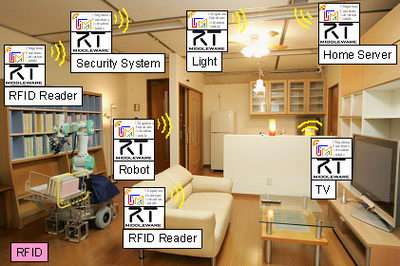
The National Institute of Advanced Industrial Science and Technology (Japan), Ymatic Ltd., and Biometrica Systems Asia Co. Ltd. have jointly developed a novel automated home – not with new technology, but with a clever combining of existing solutions. The home combines robots guided by IC tags, a biometric face authentication system, and a wireless network using a software solution called RT middleware.
RT middleware – the key technology – is a set of software libraries that allow a computer to talk to common appliances like TVs, security systems and even the not-so-common household robot. With this software, automated home developers can link products that required proprietary solutions in the past. They still have some work to do to standardize household appliances, but if the concept catches on, soon it may be common.
The showcase system features a biometric face identification system to secure the front door, a robot that can deliver IC tagged books using an RFID reader, remote controlled light and climate controls connected to a on a small server with a plasma screen monitor/TV.
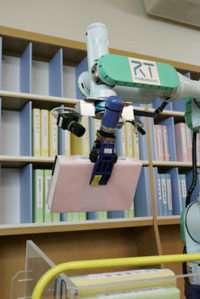
IC tags in the floor and the books guide the robot and identify each individual book. The user selects the book from the library on the screen using the remote control and the robot locates and delivers it.
IC – Integrated Circuit – tags are tiny chips – about the size of a sesame seed and the thickness of common paper. Each chip can store a number that can be read by a standard RFID – Raid Frequency Identification – reader. The big advantage to IC chips as opposed to bar codes is the size of the number they can store - 38 septillion (38 digits) vs. 10 trillion (13 digits) for a standard bar code. And, as opposed to bar codes which must be read one at a time, RFID readers can scan 80 IC tags at the same time. Imagine, your checkout time at the store would be just a few seconds if all products came IC tagged. Unfortunately, each IC tag costs about .91 cents (US$) each making them too expensive, but mass production could reduce this to just a few cents in coming years.
While the robot in the picture is retrieving printed books – possibly an anachronism when this technology comes into use – it could just as easily be bringing a tasty beverage from the fridge – cold beer anyone? The robot gets around using over 400 IC tags embedded in the floor to “fix” its position exactly in the room.
The book shelving system was developed to be used in libraries. The shelves also contain RFID readers to detect which books are present by scanning the IC tags in the books themselves.
The biometric door lock works by scanning your face – with a digital camera - and comparing it to a library of known faces – a match opens the door. Its backup is an IC tag system that scans for a particular tag that could be embedded in a ring or wristwatch. With current face recognition technology, a secondary system is definitely necessary as biometric face scanners can produce false positives.
A server – a networked computer – stores important data about the home adding flexibility, functionality and possibilities for expansion. The possibilities are endless for adding appliances: RFID scanners in the refrigerator and larder to identify food past its expiration date and automatically order items that have run out. Home inventory could be just a few seconds away with instant notification of missing objects. Just place IC tags on everything and capture their codes – an RFID scanner could then just scan the rooms and match items to the list.
As with any RFID technology, privacy concerns are worth mentioning. If your neighbor, for example, has a similar system, he could easily read the contents of your library using his scanner – possibly amplified - to “see” the titles of all your books. Concerns about wireless network security are also worth mentioning, although the introduction of WEP – Wireless Encryption Protocol – has given users fairly decent privacy.
In all, it’s a pretty neat setup. The tech-loving Japanese will be sure to want these automated living spaces as soon as they are available – the rest of us will probably wait for it to be affordable, as well. The tasty beverage serving robot, on the other hand - now that’s a technology worth having now.
By Philip Dunn, Copyright 2006 PhysOrg.com


