Study suggests new way of making super-hard nanomaterials
September 16th, 2005 Study suggests new way of making super-hard nanomaterials

Research conducted by a team of scientists led by Lawrence Livermore National Laboratory suggests a new way of making super-hard materials under high-pressure conditions. The research offers a glimpse at harder materials that could one day be used in fusion energy production, spacecraft shielding and safer automobile frames, as well as other applications.

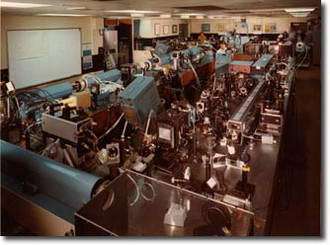
Image: Livermore’s Janus laser was used to generate shock waves in nanocrystalline nickel and copper nearly one million times greater than atmospheric pressure.

The findings, under the title “Ultrahigh Strength in Nanocrystalline Materials Under Shock Loading,” are reported in the Sept. 16 edition of the journal Science.

“This marks the first time anyone has been able to do actual shock experiments on nanocrystal metals and, at the same time, carry out numerical simulations in supercomputers to interpret the results,” said Eduardo M. Bringa, a materials scientist at LLNL and the principal investigator on the team.

Until now, understanding of how nanocrystalline metals deformed at high strain rates had been limited to computer simulations. For their research, Lab scientists introduced shock waves via the Laboratory’s Janus laser.

Their findings point the way to making materials harder than anything previously achieved.

In general, metallic materials used in everyday applications are made of small “grains” joined by grain boundaries. When the grain size is reduced to less than 100 nanometers, the material is considered “nanocrystalline.” (As a reference point, human hair has a thickness of 1-10 microns; 1 micron equals 1,000 nanometers.)

Nanocrystalline materials have extraordinary properties, such as enhanced hardness. However, when the grain size becomes extremely small, the grains slide over each other as the material deforms, causing the material to become softer.

“It’s sort of like stepping into sand,” said Bruce Remington, a laser physicist at the Lab and a participant in the research. “The material is solid but you still sink into it.”
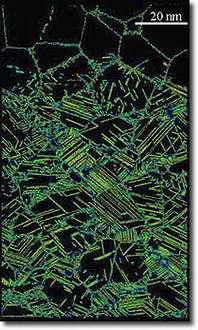
Computer simulation of a shock wave traveling through a thin slab of nanocrystalline copper

Computer simulation of a shock wave traveling through a thin slab of nanocrystalline copper

The Lab-led team studied what happened when a shock wave was passed through samples of nanocrystalline nickel and copper. In addition to the experiments, they carried out simulations using up to 4,000 processors in LLNL computers. These are the largest simulations of nanocrystals to date. The shock waves produced by the high-intensity laser move faster than the speed of sound and generate pressures nearly one million times greater than atmospheric pressure.

“This high pressure increases the friction among grains and decreases the sliding,” Bringa said. “By turning off the mechanism that softens the grains, we create a material that, being hard to begin with, is even harder during and following the shock wave application.”

Remington cautioned that the research remains in early phases, but said such research could point the way to harder materials that could be used in shielding military vehicles, protecting spacecraft from damage caused by interplanetary dust particles, or fashioning safer bumpers and automobile frames. The materials also could have applications in inertial confinement fusion experiments.

In addition to Bringa and Remington, LLNL team members include Alfredo Caro, Yinmin (Morris) Wang, Maximo Victoria and James McNaney, of the Materials Science and Technologies Division within the Chemistry and Materials Science Directorate; and Raymond Smith of the Physics and Advanced Technologies Directorate. The Paul Scherrer Institute in Switzerland also contributed.

Bringa said the team has not yet been able to measure what happens during the shock wave transit, which lasts only nanoseconds, “but we have studied how the material changes after shock loading.” As part of this ongoing project, Bringa said the team will continue collaborating with worldwide experts in order “to improve our understanding of the interesting nanocrystalline materials.”

Plans are in place to do the first time-resolved measurements at the Janus laser, to refine the understanding of the shocked nanocrystalline samples.

Source: Lawrence Livermore National Laboratory


print this article email this article download pdf blog this article bookmark this article     Digg this Stumble it share on Facebook share on Reddit add to delicious save to Yahoo! bookmarks
4/5 after 2 votes


September 16th, 2005 all stories
Nanotechnology /

Comments: 0
Rank: 4/5 after 2 votes

  • Stumble this up

  • Digg this

  • Share it:
  • share on Facebook
  • share on MySpace
  • share on Slashdot
  • rss-newsfeed
  • share on Google
  • share on Reddit
  • add to delicious
  • save to Yahoo! bookmarks
  • share on Windows Live
  • Add to Mixx!
Rating: 4/5 after 2 votes

  • Related Stories

  • Scientists replace chrome coatings with safer metal alloys
    created May 20, 2009 | popularity not rated yet | comments 0
  • Nano this, Nano that, what the...
    created Feb 01, 2006 | popularity not rated yet | comments 0
  • Blast mitigation expert helps create materials resistant to explosions
    created Apr 23, 2009 | popularity not rated yet | comments 0
  • New RFID technology tracks and monitors nuclear materials
    created Mar 24, 2009 | popularity not rated yet | comments 0
  • Shifting sound to light may lead to better computer chips
    created Mar 16, 2009 | popularity not rated yet | comments 0

Tags


  • Physicists Demonstrate Quantum Memory with Matter Qubits
    Physicists Demonstrate Quantum Memory with Matter Qubits
    Physics / General Physics
    created Jul 03, 2009 | popularity 4.4 / 5 (17) | comments 1
  • 'Holey' Nanosheets for Wastewater Dye Removal
    Nanotechnology / Nanomaterials
    created Jul 01, 2009 | popularity 5 / 5 (5) | comments 1
  • Jellyfish Robot Swims Like its Biological Counterpart
    Jellyfish Robot Swims Like its Biological Counterpart
    Electronics / Robotics
    created Jun 26, 2009 | popularity 4.4 / 5 (8) | comments 1
  • Could Maxwell's Demon Exist in Nanoscale Systems?
    Could Maxwell's Demon Exist in Nanoscale Systems?
    Physics / General Physics
    created Jun 24, 2009 | popularity 4.4 / 5 (18) | comments 29
  • Living Safely with Robots, Beyond Asimov's Laws
    Living Safely with Robots, Beyond Asimov's Laws
    Electronics / Robotics
    created Jun 22, 2009 | popularity 4.6 / 5 (53) | comments 40
  • Other News

    Nano Measurement in the 3rd Dimension

    Nano Measurement in the 3rd Dimension

    Nanotechnology / Nanophysics

    created 50 minutes ago | popularity 3 / 5 (1) | comments 0

    From the motion sensor to the computer chip - in many products of daily life components are used whose functioning is based on smallest structures of the size of thousandths - or even millionths - of millimetres. ...


    A 'quantum of sol' -- how nanotechnology could hold the key to a solar-powered future

    A 'quantum of sol' -- how nanotechnology could hold the key to a solar-powered future

    Nanotechnology / Nanomaterials

    created Jun 30, 2009 | popularity 3.9 / 5 (16) | comments 17

    (PhysOrg.com) -- A new generation of 'nano-structured' millimetre-sized solar cells that could convert the sun's energy to electricity more than twice as efficiently as current technology, is the subject of ...


    Australian researchers are set to begin human trials of a tiny nano-cell that acts as a "Trojan horse" against cancer

    Hi-tech 'Trojan horse' can kill cancer cells: researchers

    Nanotechnology / Bio & Medicine

    created Jun 29, 2009 | popularity 4.7 / 5 (12) | comments 7

    Australian researchers are set to begin human trials of a tiny nano-cell that acts as a "Trojan horse" against cancer cells, a breakthrough they say may curb the need for debilitating chemotherapy.


    'Holey' Nanosheets for Wastewater Dye Removal

    Nanotechnology / Nanomaterials

    created Jul 01, 2009 | popularity 5 / 5 (5) | comments 1

    (PhysOrg.com) -- Researchers have discovered that extremely thin sheets of nickel oxide with hexagonally shaped holes can absorb hazardous dyes from wastewater nearly as well as the best traditional methods, but are recyclable. ...


    Harnessing Nanoparticles To Track Cancer Cell Changes

    Nanotechnology / Bio & Medicine

    created Jul 03, 2009 | popularity not rated yet | comments 1

    The more dots there are, the more accurate a picture you get when you connect them. Cancer researchers adopting that philosophy have developed a new imaging technology that could give scientists the ability to simultaneously ...