Titan's Seas Are Sand
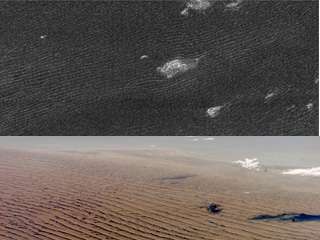
Until a couple of years ago, scientists thought the dark equatorial regions of Titan might be liquid oceans. New radar evidence shows they are seas -- but seas of sand dunes like those in the Arabian or Namibian Deserts, a University of Arizona member of the Cassini radar team and colleagues report in Science (May 5).
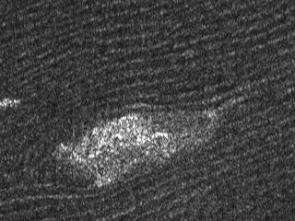
Radar images taken when the Cassini spacecraft flew by Titan last October show dunes 330 feet (100 meters) high that run parallel to each other for hundreds of miles at Titan's equator. One dune field runs more than 930 miles (1500 km) long, said Ralph Lorenz of UA's Lunar and Planetary Laboratory.
"It's bizarre," Lorenz said. "These images from a moon of Saturn look just like radar images of Namibia or Arabia. Titan's atmosphere is thicker than Earth's, its gravity is lower, its sand is certainly different -- everything is different except for the physical process that forms the dunes and resulting landscape."
Ten years ago, scientists believed that Saturn's moon Titan is too far from the sun to have solar-driven surface winds powerful enough to sculpt sand dunes. They also theorized that the dark regions at Titan's equator might be liquid ethane oceans that would trap sand.
But researchers have since learned that Saturn's powerful gravity creates significant tides in Titan's atmosphere. Saturn's tidal effect on Titan is roughly 400 times greater than our moon's tidal pull on Earth.
As first seen in circulation models a couple of years ago, Lorenz said, "Tides apparently dominate the near-surface winds because they're so strong throughout the atmosphere, top to bottom. Solar-driven winds are strong only high up."
The dunes seen by Cassini radar are a particular linear or longitudinal type that is characteristic of dunes formed by winds blowing from different directions. The tides cause wind to change direction as they drive winds toward the equator, Lorenz said.
And when the tidal wind combines with Titan's west-to-east zonal wind, as the radar images show, it creates dunes aligned nearly west-east except near mountains that influence local wind direction.
"When we saw these dunes in radar it started to make sense," he said. "If you look at the dunes, you see tidal winds might be blowing sand around the moon several times and working it into dunes at the equator. It's possible that tidal winds are carrying dark sediments from higher latitudes to the equator, forming Titan's dark belt."
The researchers' model of Titan suggests tides can create surface winds that reach about one mile per hour (a half-meter per second). "Even though this is a very gentle wind, this is enough to blow grains along the ground in Titan's thick atmosphere and low gravity," Lorenz said. Titan's sand is a little coarser but less dense than typical sand on Earth or Mars. "These grains might resemble coffee grounds."
The variable tidal wind combines with Titan's west-to-east zonal wind to create surface winds that average about one mile per hour (a half meter per second). Average wind speed is a bit deceptive, because sand dunes wouldn't form on Earth or Mars at their average wind speeds.
Whether the grains are made of organic solids, water ice, or a mixture of both is a mystery. Cassini's Visual and Infrared Mapping Spectrometer, led by UA's Robert Brown, may get results on sand dune composition.
How the sand formed is another peculiar story.
Sand may have formed when liquid methane rain eroded particles from ice bedrock. Researchers previously thought that it doesn't rain enough on Titan to erode much bedrock, but they thought in terms of average rainfall.
Observations and models of Titan show that clouds and rain are rare. That means that individual storms could be large and still yield a low average rainfall, Lorenz explained.
When the UA-led Descent Imager/Spectral Radiometer (DISR) team produced images taken during the Huygens probe landing on Titan in January 2005, the world saw gullies, streambeds and canyons in the landscape. These same features on Titan have been seen with radar.
These features show that when it does rain on Titan, it rains in very energetic events, just as it does in the Arizona desert, Lorenz said.
Energetic rain that triggers flash floods may be a mechanism for making sand, he added.
Alternatively, the sand may come from organic solids produced by photochemical reactions in Titan's atmosphere.
"It's exciting that the radar, which is mainly to study the surface of Titan, is telling us so much about how winds on Titan work," Lorenz said. "This will be important information for when we return to Titan in the future, perhaps with a balloon."
An international group of scientists are co-authors on the Science article, "The Sand Seas of Titan: Cassini Observations of Longitudinal Dunes." They are from the Jet Propulsion Laboratory, California Institute of Technology, U.S. Geological Survey - Flagstaff, Planetary Science Institute, Wheeling Jesuit College, Proxemy Research of Bowie, Md., Stanford University, Goddard Institute for Space Studies, Observatoire de Paris, International Research School of Planetary Sciences, Universita' d'Annunzio, Facolt di Ingegneria, Universit La Sapienza, Politecnico di Bari and Agenzia Spaziale Italiana. Jani Radebaugh and Jonathan Lunine of UA's Lunar and Planetary Laboratory are among the co-authors.
Source: University of Arizona


