New Evidence of Early Glacial Development, History of Antarctic Ice Sheet Revised
May 5th, 2006 New Evidence of Early Glacial Development, History of Antarctic Ice Sheet Revised

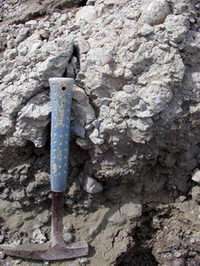
Sediments characteristic of deposition by glacial ice near the Eocene-Oligocene boundary on Seymour Island. Credit: Linda C. Ivany

Syracuse University Professors Linda C. Ivany and Scott D. Samson along with colleagues at the University of Leuven in Belgium and Hamilton College have found evidence that expands our understanding about how the ice sheet covering most of Antarctica really began. Their findings were published in the article “Evidence for an Earliest Oligocene Ice Sheet on the Antarctic Penninsula,” in the May 2006 issue of the journal, Geology. The research was supported by funding from the National Science Foundation’s Office of Polar Programs.

“One of the most fundamental climate shifts that this planet has undergone since the events that precipitated the extinction of the dinosaurs is the so-called
‘greenhouse to icehouse transition’—the time when Earth went from having virtually no ice on it at all to one with a more or less permanent ice sheet covering Antarctica,” says Ivany, professor of earth science in The College of Arts and Sciences at SU and principal investigator on the project. “This happened about 34 million years ago, and is marked by dramatic changes in the chemistry of the oceans and the appearance of ‘ice rafted debris’ in ocean sediments around Antarctica, carried there by icebergs from land that floated out and melted far from the continent, releasing the sand and rock that had been frozen into them.”

Though scientists are quite sure that glaciers grew on Antarctica at this time, it is not clear where that ice was, nor how much of it there was initially. This is because most of the continent is now under the ice, and it is difficult to find places where sediments are exposed that record this interval of time.

Until now, the assumption has been that glaciers were confined to the eastern part of Antarctica, where the biggest ice sheet is today. Ivany’s research team found evidence that glaciers may have covered a much bigger area at the early stages of this transition. Sediments on Seymour Island, off the northern tip of the Antarctic Peninsula, have been dated to just this time, and show features characteristic of deposition by glacial ice. Because this island is at the far northern reaches of the Peninsula, in western Antarctica, they suggest that the initial pulse of glaciation was far more extensive than originally suspected.

Scientists believe that growth of the Antarctic ice sheet was initiated by a drop in greenhouse gas concentrations in the atmosphere in combination with a change in ocean circulation caused by South America pulling away from Antarctica. The climatic response to these gradual changes now appears to be even bigger than previously thought, showing that Earth cooled fast enough to allow the growth of ice on the entire continent all at once.

Ivany’s team concludes that because Earth’s climate system is capable of shifting this rapidly and dramatically to such a new and different state, their discovery may provide an insight into how things could change in the future if we continue to alter our environment.

Source: Syracuse University


print this article email this article download pdf blog this article bookmark this article     Digg this Stumble it share on Facebook share on Reddit add to delicious save to Yahoo! bookmarks
4.6/5 after 64 votes


May 5th, 2006 all stories
Space & Earth / Earth Sciences

Comments: 0
Rank: 4.6/5 after 64 votes

  • Stumble this up

  • Digg this

  • Share it:
  • share on Facebook
  • share on MySpace
  • share on Slashdot
  • rss-newsfeed
  • share on Google
  • share on Reddit
  • add to delicious
  • save to Yahoo! bookmarks
  • share on Windows Live
  • Add to Mixx!
Rating: 4.6/5 after 64 votes


Tags


  • Physicists Demonstrate Quantum Memory with Matter Qubits
    Physicists Demonstrate Quantum Memory with Matter Qubits
    Physics / General Physics
    created Jul 03, 2009 | popularity 4.4 / 5 (17) | comments 1
  • 'Holey' Nanosheets for Wastewater Dye Removal
    Nanotechnology / Nanomaterials
    created Jul 01, 2009 | popularity 5 / 5 (5) | comments 1
  • Jellyfish Robot Swims Like its Biological Counterpart
    Jellyfish Robot Swims Like its Biological Counterpart
    Electronics / Robotics
    created Jun 26, 2009 | popularity 4.4 / 5 (8) | comments 1
  • Could Maxwell's Demon Exist in Nanoscale Systems?
    Could Maxwell's Demon Exist in Nanoscale Systems?
    Physics / General Physics
    created Jun 24, 2009 | popularity 4.4 / 5 (18) | comments 29
  • Living Safely with Robots, Beyond Asimov's Laws
    Living Safely with Robots, Beyond Asimov's Laws
    Electronics / Robotics
    created Jun 22, 2009 | popularity 4.6 / 5 (52) | comments 40
  • Other News

    Forty years ago man first walked on the moon

    Space & Earth / Space Exploration

    created 9 hours ago | popularity 5 / 5 (2) | comments 0

    Forty years ago on July 20, 1969, American astronaut Neil Armstrong realized the oldest dream of human civilizations when he became the first man to walk on the moon.


    The least sea ice in 800 years

    The least sea ice in 800 years

    Space & Earth / Earth Sciences

    created Jul 01, 2009 | popularity 4.3 / 5 (59) | comments 52

    New research, which reconstructs the extent of ice in the sea between Greenland and Svalbard from the 13th century to the present indicates that there has never been so little sea ice as there is now. The ...


    Gas around young galaxy

    Intense heat killed the Universe's would-be galaxies, researchers say

    Space & Earth / Astronomy

    created Jul 01, 2009 | popularity 3.2 / 5 (19) | comments 25

    (PhysOrg.com) -- Our Milky Way galaxy only survived because it was already immersed in a large clump of dark matter which trapped gases inside it, scientists led by Durham University's Institute for Computational ...


    Scientists' Drill Hits Magma: Only Third Time on Record

    Scientists' Drill Hits Magma: Only Third Time on Record

    Space & Earth / Earth Sciences

    created Jun 29, 2009 | popularity 4.7 / 5 (20) | comments 19

    (PhysOrg.com) -- Scientists drilling a borehole deep into Iceland’s rocky crust to explore new methods of using geothermal energy hit a major roadblock on Thursday: Their drill ran into molten rock at a depth ...


    NASA manager pitches a cheaper return-to-moon plan

    Space & Earth / Space Exploration

    created Jun 30, 2009 | popularity 4 / 5 (7) | comments 18

    (AP) -- Like a car salesman pushing a luxury vehicle that the customer no longer can afford, NASA has pulled out of its back pocket a deal for a cheaper ride to the moon.