Traffic pollution - measuring the real damage
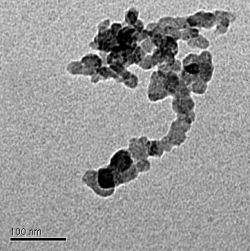
Traffic fumes from individual vehicles are decreasing every year as engines become cleaner, but there are more vehicles on the road and the number continues to grow. The long term effects of living in urban areas and breathing in traffic fumes is widely studied, particularly in cities such as Athens and Los Angeles, where there is a lot of sunlight and not much air movement, resulting in photochemical smog from traffic fumes and industrial gases hanging in the air.
Image: Transmission Electron Microscope image of a diesel particle courtesy of K. Park, F. Cao, D. Kittelson, and P. McMurry
In the 1970's the Harvard Six Cities Study looked at morbidity and mortality and the correlation with diesel and gasoline particle levels in the environment and found a correlation which subsequent studies have born out.
In an urban environment typically 60-70% of the particles that we breathe in are from diesel or gasoline engines. Millions of particles are taken into our lungs with every breath we take, most of these pass back out again when we breathe out. The particles that are not exhaled travel in the human body, passing from the "air side" to the "fluid side" very quickly. Research elsewhere is being carried out to find out more about the tiny diesel particles that are able to travel through the lung walls into the bloodstream, what the body does with them and what the long term damage might be.
Here in the Department Professor Nick Collings and his student Jason Olfert are working on a new method to measure extremely tiny particles in exhaust gas. Vehicle engines continue to be designed to be cleaner and the particles that need to be measured are extremely small. The old method of analysing vehicle exhaust fumes would be to pass exhaust gas through a filter, weighing it both before and after. This method is not relevant for tomorrow's cleaner engines since there is too little mass collected to be reliably measured.
The tiny particles are given an electrical charge and they are then passed through a centrifugal machine that Nick and Jason have designed and built, that will separate the particles depending on their mass and the amount of electrical charge that they are carrying. Particles of the same mass-to-charge ratio can be separated using the machine and the particles can then be counted with an optical detector. Being able to measure the number and mass across the particle size range (approximately 5nm - 200nm) will help to better characterise, and more reliably measure the quantity of, the particle emissions from engines. While the precise mechanisms by which particles damage health remain unclear, it is important to measure the differentiating characteristics, and thus help the epidemiologists to disentangle cause and effect, followed by more cost-effective legislative action.
Source: Cambridge University


