Nature gives a lesson in armor design
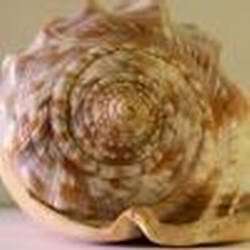
The ocean is a perilous environment for a soft-bodied creature like a sea snail, so nature gives it an advanced nanostructured armor system that is stiff and strong yet lightweight. It's called a shell. Now MIT scientists show that nature is indeed an expert nanoengineer.
Understanding the fundamental design principles of natural armor systems like shells may help engineers design improved body armor systems for humans in perilous situations, like soldiers and police officers. At MIT's Institute for Soldier Nanotechnologies, researchers are studying the structure and mechanics of the tough inner layer of mollusc shells, called "nacre" or mother-of-pearl, at extremely small, nanometer-length scales (a nanometer is a billionth of a meter).
In an upcoming issue of the Journal of Materials Research, Professor Christine Ortiz of the Department of Materials Science and Engineering, Professor Mary Boyce of the Department of Mechanical Engineering and doctoral student Benjamin Bruet of materials science report their results. They show that nature is indeed an expert nanoengineer.
"The complexity we have observed in nacre at the nanoscale is quite amazing and seems likely to be a critical determinant of the toughness of the material," said Ortiz.
Nacre is composed of two relatively weak materials: 95 percent calcium carbonate, a brittle ceramic, and 5 percent flexible biopolymer. These materials are organized into a "brick-and-mortar" structure with millions of ceramic plates, each a few thousand nanometers in size, that are stacked on top of each other like rolls of coins. Each layer of plates is glued together by thin layers of the biopolymer. The MIT team has focused its studies on small nanometer-sized regions of the individual tiny plates.
"Even though the calcium carbonate is very weak and brittle on its own, one can get enormous increases in toughness through design at multiple-length scales," said Ortiz. "Understanding how the material is designed and functions at the smallest-length scales will be critical to learning how to create tough biomimetic synthetic composites."
Replacing the weak building blocks of nacre with stronger materials -- in a similar design -- has the potential to yield much tougher composites for use in armor systems or structural applications like automobile panels or plane wings.
The MIT team began its experimental studies by imaging the tiny plates cut from the nacre of Trochus niloticus, a sea snail, using a powerful instrument called an atomic force microscope. They found that each individual plate also had its own complicated nanostructure and was divided like a pie into separate sectors, with cylindrical beams running through the thickness of the plates, a fine surface of nanosized bumps, called nanoasperities, which were further organized into groups, and biopolymer molecules, only about 1 nanometer in height, traversing over and bound to the mountainous array of nanobumps.
They then used a diamond-probe tip only a few hundred nanometers in size in the Department of Materials Science and Engineering's Nanomechanical Technology Laboratory to push into the surface of an individual plate (a technique called nanoindentation) while "feeling" the force that resulted. "I was surprised to find that the tablets were both extremely stiff and strong at these length scales and that they resisted brittle crack formation and propagation even at exceedingly high forces," said Bruet.
Although scientists have studied the properties of nacre at the macroscale and microscale, Ortiz says that very little is known about its behavior at the nanoscale, which is where structure and properties set the foundation for the material's overall behavior.
The team is currently studying the nanoscale adhesion forces that exist between the ceramic plates and flexible biopolymer in the nacre, as well as the single molecule nanomechanical properties of the biopolymer. This research may shed light on the longstanding question of how to create durable interfaces in synthetic composites that can withstand high forces in water environments. Ortiz's group is also studying the nanostructure and nanomechanical properties of other natural materials, such as bone and cartilage.
"Nature uses nanoscale structural design principles to produce materials with superior mechanical properties," said Ortiz. "In many aspects, human engineers have yet to achieve the same skill. However, as nanotechnology methods advance, the creation of artificial nacre -- and other kinds of high-performance armors -- is becoming a more and more realistic goal."
Source: MIT


