XMM-Newton reveals the origin of elements in galaxy clusters
May 10, 2006 XMM-Newton reveals the origin of elements in galaxy clusters

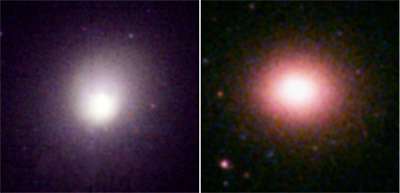
These X-ray images of the clusters of galaxies ‘Sersic 159-03’(right) and ‘2A 0335+096’ (left) were taken by the European Photon Imaging Camera (EPIC) on-board ESA’s XMM-Newton, in November 2002 and August 2003 respectively. Thanks to these observations, astronomers could determine the abundances of nine chemical elements in the clusters ‘plasma’ – a gas containing charged particles such as ions and electrons. These elements include oxygen, iron, neon, magnesium, silicon, argon, calcium, nickel, and - detected for the first time ever in a galaxy cluster - chromium. The distribution of silicon (produced by ‘type Ia’ and ‘core collapse’ supernova types) relative to iron (mainly produced by ‘type Ia’ supernovae) in these two clusters is very different, showing that they had a different evolution. Credits: ESA and the XMM-Newton EPIC consortium.

Deep observations of two X-ray bright clusters of galaxies with ESA’s XMM-Newton satellite allowed a group of international astronomers to measure their chemical composition with an unprecedented accuracy. Knowing the chemical composition of galaxy clusters is of crucial importance to understanding the origin of chemical elements in the Universe.

Clusters, or conglomerates, of galaxies are the largest objects in the Universe. By looking at them through optical telescopes it is possible to see hundreds or even thousands of galaxies occupying a volume a few million light years across. However, such telescopes only reveal the tip of the iceberg. In fact most of the atoms in galaxy clusters are in the form of hot gas emitting X-ray radiation, with the mass of the hot gas five times larger than the mass in the cluster’s galaxies themselves.

Most of the chemical elements produced in the stars of galaxy clusters - expelled into the surrounding space by supernova explosions and by stellar winds - become part of the hot X-ray emitting gas. Astronomers divide supernovae into two basic types: ‘core collapse’ and ‘Type Ia’ supernovae. The ‘core collapse’ supernovae originate when a star at the end of its life collapses into a neutron star or a black hole. These supernovae produce lots of oxygen, neon and magnesium. The Type Ia supernovae explode when a white dwarf star consuming matter from a companion star becomes too massive and completely disintegrates. This type produces lots of iron and nickel.

Respectively in November 2002 and August 2003, and for one and a half day each time, XMM-Newton’s made deep observations of the two galaxy clusters called ‘Sersic 159-03’ and ‘2A 0335+096’. Thanks to these data the astronomers could determine the abundances of nine chemical elements in the clusters ‘plasma’ – a gas containing charged particles such as ions and electrons.

These elements include oxygen, iron, neon, magnesium, silicon, argon, calcium, nickel, and - detected for the first time ever in a galaxy cluster - chromium. "Comparing the abundances of the detected elements to the yields of supernovae calculated theoretically, we found that about 30 percent of the supernovae in these clusters were exploding white dwarfs (‘Type Ia’) and the rest were collapsing stars at the end of their lives (‘core collapse’)," said Norbert Werner, from the SRON Netherlands Institute for Space Research (Utrecht, Netherlands) and one of the lead authors of these results.

"This number is in between the value found for our own Galaxy (where Type Ia supernovae represent about 13 percent of the supernovae ‘population’) and the current frequency of supernovae events as determined by the Lick Observatory Supernova Search project (according to which about 42 percent of all observed supernovae are Type Ia)," he continued.

The astronomers also found that all supernova models predict much less calcium than what is observed in clusters and that the observed nickel abundance cannot be reproduced by these models. These discrepancies indicate that that the details of supernova enrichment is not yet clearly understood. Since clusters of galaxies are believed to be fair samples of the Universe, their X-ray spectroscopy can help to improve the supernova models.

The spatial distribution of elements across a cluster also holds information about the history of clusters themselves. The distribution of elements in 2A 0335+096 indicates an ongoing merger. The distribution of oxygen and iron across Sersic 159-03 indicates that while most of the enrichment by the core collapse supernovae happened long time ago, Type Ia supernovae still continue to enrich the hot gas by heavy elements especially in the core of the cluster.

Source: ESA


print this article email this article download pdf blog this article bookmark this article     Stumble it Digg this share on Facebook retweet share on Reddit add to delicious
Rate this story - 5 /5 (1 vote)


May 10, 2006 all stories

Comments: 0

5 /5 (1 vote)
  • Stumble this up

  • Digg this

  • share this

  • hide
  • Related Stories

  • A Look into the Hellish Cradles of Suns and Solar Systems
    created Aug 19, 2009 | popularity not rated yet | comments 0
  • Stellar family in crowded, violent neighborhood proves to be surprisingly normal
    created Jun 04, 2009 | popularity not rated yet | comments 0
  • Hubble finds multiple stellar 'baby booms' in a globular cluster
    created May 02, 2007 | popularity not rated yet | comments 0
  • Universe contains more calcium than expected
    created Feb 06, 2007 | popularity not rated yet | comments 0
  • Brightest supernova in a decade captured by Hubble
    created Sep 03, 2004 | popularity not rated yet | comments 0


  • hide
  • Relevant PhysicsForums posts

  • The Big Bang!
    created 8 hours ago
  • Super-earth transiting nearby star
    created 13 hours ago
  • Is there cyclic motion of galaxies?
    created 14 hours ago
  • Solar Cycle 24
    created Dec 15, 2009
  • More from Physics Forums - General Astronomy

Other News

New Study of Meteorite Provides More Evidence for Ancient Life on Mars

New Study of Meteorite Provides More Evidence for Ancient Life on Mars

Space & Earth / Space Exploration

created 5 minutes ago | popularity not rated yet | comments 0

(PhysOrg.com) -- In 1996, when scientists examined a meteorite from Mars previously uncovered in Antarctica, they were intrigued by what looked like microscopic fossils of ancient Martian life forms. Now, ...


NASA, Google offer more precise emissions tracking (AP)

NASA, Google offer more precise emissions tracking

Space & Earth / Environment

created 1hour ago | popularity not rated yet | comments 0

(AP) -- The question is a potential deal-killer: If nations ever agree to slash greenhouse gas emissions, how will the world know if they live up to their pledges?


Astronomers find super-Earth using amateur, off-the-shelf technology

Astronomers Find Super-Earth Using Amateur, Off-the-Shelf Technology (w/ Video)

Space & Earth / Astronomy

created 19 hours ago | popularity 5 / 5 (17) | comments 8

(PhysOrg.com) -- Astronomers announced today that they have discovered a "super-Earth" orbiting a red dwarf star 40 light-years from Earth. They found the distant planet with a small fleet of ground-based ...


NASA aims to send astronauts back to the moon by 2020, and then perhaps to Mars and other destinations

Top US lawmaker skeptical of new space funding

Space & Earth / Space Exploration

created 2 hours ago | popularity 5 / 5 (1) | comments 0

Democratic House Speaker Nancy Pelosi said she was personally skeptical of manned space missions and warned that NASA's future funding could depend on whether it was likely to create jobs.


Hubble Finds Smallest Kuiper Belt Object Ever Seen

Hubble Finds Smallest Kuiper Belt Object Ever Seen

Space & Earth / Space Exploration

created 17 hours ago | popularity 5 / 5 (14) | comments 6

(PhysOrg.com) -- NASA's Hubble Space Telescope has discovered the smallest object ever seen in visible light in the Kuiper Belt, a vast ring of icy debris that is encircling the outer rim of the solar system ...