Pursuing the Invisible with Einstein's Lens
"I could not go abroad in snow, it would settle on me and expose me. Rain, too, would make me a watery outline, a glistening surface of a man -- a bubble."
- from "The Invisible Man" by H.G. Wells
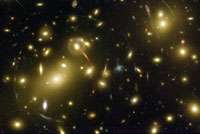
Though he couldn't be observed directly, the Invisible Man knew his presence could be betrayed by his effect on visible things. Employing a similar principle, a team led by Andrew Gould of Ohio State University will hunt for hard-to-see celestial objects, like black holes and dark matter, by observing how they affect light coming from stars behind them.
This "gravitational lens" effect, predicted by Albert Einstein, has been observed repeatedly from the ground. But NASA's SIM PlanetQuest space telescope will enable Gould's team to use Einstein's lens in ways never before possible. They hope to make the first real "sighting" of dark matter, the mysterious stuff thought to constitute 90 percent of the galaxy. They also will investigate how much of the galaxy is composed of ordinary stars and how much consists of more exotic objects that can't be directly imaged by current telescopes.
"We're able to measure objects based on their mass instead of their light, and so we're able to do a census of all objects independent of whether they're shining or not," Gould said. "The objects that are dark -- and those are black holes, neutron stars, white dwarfs and brown dwarfs -- that's the more interesting science driver because people really don't know how many of those there are."
Einstein's magic ring
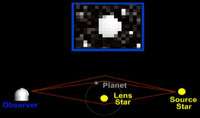
The analysis that Gould's team wants to do requires that they determine the distance and mass of cosmic objects they won't be able to see. The key to that seemingly impossible task lies in a phenomenon called an "Einstein ring."
Einstein predicted that the gravitational field of any massive object would act as a lens and bend light that passes by the object. If Earth, the lens and a distant background star or galaxy happen to move into exact alignment, astronomers on Earth -- with a sufficiently powerful telescope -- would see the luminous background source as a ring around the lensing object in the middle. (If slightly misaligned, they'd see twin images of the background object.) What's more, the image would brighten during the lensing event since light that normally would miss the Earth would be redirected toward it.
Ring size, amount of brightening, and duration of the event all provide clues to the distance and mass of a lensing object. But ground-based telescopes, limited by size constraints and our distorting atmosphere, can't resolve the ring unless the lensing object has the mass of a galaxy or group of galaxies. When a lens has only the mass of a star, the image of the background star is smeared by about one part in a million -- too little for our telescopes to resolve. Such unresolved gravitational lensing is called "microlensing."
Terrestrial telescopes can measure how much a background star appears to brighten and dim as a microlensing event builds to a peak and then dwindles away. But that and clocking the duration of the event are not enough to tease out the mass and distance of a microlensing object.
For the missing pieces of the puzzle, Gould's team will turn to SIM PlanetQuest.
A dime's worth of difference
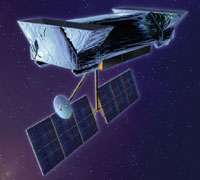
SIM will be able to make brightness measurements of a microlensing event at the same time as Earth-based telescopes but from a vantage point some 25 million miles away from Earth, giving astronomers a stereoscopic view of the lens. "It's as if you have two eyes looking at the same thing rather than one," explained Caltech's Andy Boden, one of the study's co-investigators, "and thereby you can get a depth perception to the problem."
Even SIM won't be able to resolve the Einstein ring or twin images when it encounters a microlens. But it will be able to pinpoint where the light on one side of the slightly smeared image balances the light on the other side, a position called the centroid. Measuring the tiny shift in the location of the centroid during and after the microlensing event will help scientists determine the size of the Einstein ring and deduce the object's mass.
"The centroid gets deflected by a few tens of micro-arcseconds," Gould said. "If you took a dime, turned it on edge, and put it on the moon, that's one micro-arcsecond."
There should be ample opportunity for SIM to use microlensing to categorize the constituents of the galactic bulge and disk. "There are about 50 million source stars out there and we're going to monitor all of them," Gould said. "Objects are going to go in front of some small fraction of these source stars close enough (to lining up with Earth) to be microlensed."
Tracking down dark matter in the galaxy's halo will require much more patience, since there are far fewer bright background stars to be eclipsed when looking away from the galactic plane.
"We'll be lucky to get five events in the entire SIM experiment that we can measure this way," Gould said. "But if we had five and we measured even three of them to be in the middle of nowhere, then it would be absolutely clear-cut that this was part of the dark matter."
Asked what he finds most exciting when he looks ahead to the experiment, Gould replied, "I guess it's basically just that we can look for things that we can't see. That seems really amazing to me." H.G. Wells would probably agree.
To find out more about the mission, visit the PlanetQuest Web site.
Source: NASA, Written by Bob Silberg / PlanetQuest


