Record air pollution above the Arctic
May 11th, 2006 Record air pollution above the Arctic

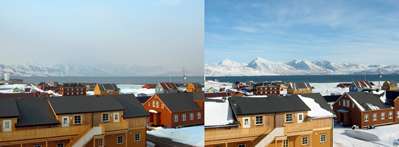
Arctic haze above Svalbard. On the left (May 2nd, 2006), orange brown dust is clearly visible. On the right (May, 8.), the dust has disappeared. Photo: Juergen Graeser, Alfred-Wegener-Institut.

Last week Scientists of the Alfred Wegener Institute for Polar and Marine Research observed the highest air pollution on record since measurements began in Ny-Ålesund on Svalbard. Monitoring instruments displayed significantly increased aerosol concentrations compared to those generally found. Aerosols from eastern Europe have been transported into the Arctic atmosphere due to a particular large-scale weather situation.

Usually the air is pure and clear above the French-German AWIPEV-Research base in Ny-Ålesund at the western coast of Svalbard. However, at the beginning of May it turned to a deep orange-brown. Confirming the observations of the German team, Swedish scientists of the Department of Applied Environmental Science at Stockholm University (ITM) measured up to fifty micrograms aerosol per cubic metre air in Ny-Ålesund. Such values are usually measured during rush hour in cities. In addition, the Norwegian Institute for Air Research (NILU) found extremely high concentrations of ozone above ground. With more than 160 micrograms ozone per cubic metre, these values are the highest measured since the foundation of the research base in 1989.

A specific weather condition has caused the record high air pollution. Large amounts of aerosols from eastern Europe were driven into the arctic atmosphere. Increased aerosol concentrations had already been measured at springtime of recent years. However, this "Arctic Haze" has never been as pronounced before.

Aerosols constitute small particles in the atmosphere. They can be liquid or solid and serve as condensation nuclei during cloud formation. It is these properties that lead to aerosols influencing the climate system. "The present air pollution is more than 2.5 fold higher than values measured in spring 2000. As a consequence, we expect significantly increase warming ", explains Dr. Andreas Herber of the Alfred Wegener Institute in Bremerhaven.

Scientists of the Alfred Wegener Institute have been measuring the aerosol content of the atmosphere above Svalbard since 1991. Measurements made via the institute’s aeroplanes serve the ongoing investigation of the impact of aerosols on the climate. “It is still difficult to estimate, whether this year’s data constitute the beginning of a common trend”, says Andreas Herber. “We need continued measurements in the course of subsequent years”. Moreover, the scientists expect the detailed examination of the origin and chemical composition of the aerosols to yield further understanding for the current observations.

The AWIPEV research base in Ny-Ålesund is a joint station of the German Alfred Wegener Institute and the French Institut Polaire Paul Emile Victor (IPEV). It comprises the German Koldewey and the French Rabot research stations.

Source: Alfred Wegener Institut fuer Polar und Meeresforschung


print this article email this article download pdf blog this article bookmark this article     Digg this Stumble it share on Facebook share on Reddit add to delicious save to Yahoo! bookmarks
4.5/5 after 2 votes


May 11th, 2006 all stories
Space & Earth / Environment

Comments: 0
Rank: 4.5/5 after 2 votes

  • Stumble this up

  • Digg this

  • Share it:
  • share on Facebook
  • share on MySpace
  • share on Slashdot
  • rss-newsfeed
  • share on Google
  • share on Reddit
  • add to delicious
  • save to Yahoo! bookmarks
  • share on Windows Live
  • Add to Mixx!
Rating: 4.5/5 after 2 votes

  • Related Stories

  • Aerosols May Drive a Significant Portion of Arctic Warming
    created Apr 08, 2009 | popularity not rated yet | comments 0
  • New Instrument Could Detect Hidden Aviation Hazards
    created Mar 03, 2009 | popularity not rated yet | comments 0
  • Discovery of a type of aerosols from Sahara which will be useful to study climate change
    created Oct 03, 2008 | popularity not rated yet | comments 0
  • Tracking down the menace in Mexico City smog
    created Sep 08, 2008 | popularity not rated yet | comments 0
  • Dirty air brings rain -- then again, maybe not
    created Sep 08, 2008 | popularity not rated yet | comments 0

Tags


  • Physicists Demonstrate Quantum Memory with Matter Qubits
    Physicists Demonstrate Quantum Memory with Matter Qubits
    Physics / General Physics
    created Jul 03, 2009 | popularity 4.4 / 5 (17) | comments 1
  • 'Holey' Nanosheets for Wastewater Dye Removal
    Nanotechnology / Nanomaterials
    created Jul 01, 2009 | popularity 5 / 5 (5) | comments 1
  • Jellyfish Robot Swims Like its Biological Counterpart
    Jellyfish Robot Swims Like its Biological Counterpart
    Electronics / Robotics
    created Jun 26, 2009 | popularity 4.4 / 5 (8) | comments 1
  • Could Maxwell's Demon Exist in Nanoscale Systems?
    Could Maxwell's Demon Exist in Nanoscale Systems?
    Physics / General Physics
    created Jun 24, 2009 | popularity 4.4 / 5 (18) | comments 29
  • Living Safely with Robots, Beyond Asimov's Laws
    Living Safely with Robots, Beyond Asimov's Laws
    Electronics / Robotics
    created Jun 22, 2009 | popularity 4.6 / 5 (52) | comments 40
  • Other News

    Forty years ago man first walked on the moon

    Space & Earth / Space Exploration

    created 17 hours ago | popularity 4.3 / 5 (4) | comments 2

    Forty years ago on July 20, 1969, American astronaut Neil Armstrong realized the oldest dream of human civilizations when he became the first man to walk on the moon.


    The least sea ice in 800 years

    The least sea ice in 800 years

    Space & Earth / Earth Sciences

    created Jul 01, 2009 | popularity 4.2 / 5 (62) | comments 59

    New research, which reconstructs the extent of ice in the sea between Greenland and Svalbard from the 13th century to the present indicates that there has never been so little sea ice as there is now. The ...


    Gas around young galaxy

    Intense heat killed the Universe's would-be galaxies, researchers say

    Space & Earth / Astronomy

    created Jul 01, 2009 | popularity 3.4 / 5 (21) | comments 27

    (PhysOrg.com) -- Our Milky Way galaxy only survived because it was already immersed in a large clump of dark matter which trapped gases inside it, scientists led by Durham University's Institute for Computational ...


    Scientists' Drill Hits Magma: Only Third Time on Record

    Scientists' Drill Hits Magma: Only Third Time on Record

    Space & Earth / Earth Sciences

    created Jun 29, 2009 | popularity 4.7 / 5 (22) | comments 19

    (PhysOrg.com) -- Scientists drilling a borehole deep into Iceland’s rocky crust to explore new methods of using geothermal energy hit a major roadblock on Thursday: Their drill ran into molten rock at a depth ...


    NASA manager pitches a cheaper return-to-moon plan

    Space & Earth / Space Exploration

    created Jun 30, 2009 | popularity 4 / 5 (7) | comments 18

    (AP) -- Like a car salesman pushing a luxury vehicle that the customer no longer can afford, NASA has pulled out of its back pocket a deal for a cheaper ride to the moon.