Biological motors sort molecules one by one on a chip
May 11th, 2006 Biological motors sort molecules one by one on a chip

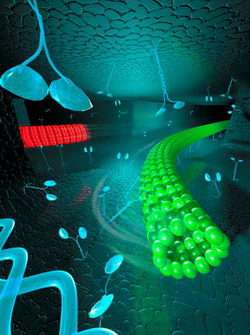
Artist impression of the sorting of green and red microtubules in nanochannels. Kinesin motors on the walls push the microtubule forward while an external experimentalist can steer the direction by exerting an electrical force on the tube (Image TU Delft/Tremani)

Researchers from Delft University of Technology’s Kavli Institute of Nanoscience have discovered how to use the motors of biological cells in extremely small channels on a chip. Based on this, they built a transport system that uses electrical charges to direct the molecules individually.

To demonstrate this, the Delft researchers sorted the individual molecules according to their color. Professor Hess of the University of Florida has called the Delft discovery "the first traffic control system in biomolecular motor nanotechnology". The research findings will be published in Science on May 12.

The biological cell is a complex of many different small protein factories. The necessary transportation of materials within the cell occurs across a network of microtubules: long, tubular-shaped proteins that extend in a star-shaped formation from the nucleus of the cell to the walls of the cell. Molecular bio-motors, such as the enzyme kinesin, can walk in small steps (of 8 nanometers) with a load of material along these microtubule-networks and thus provide transport within the cell.

Fascinated by these biological motors, the researchers at Delft University of Technology’s Kavli Institute of Nanoscience are currently exploring the possibility of inserting these kinesin-motors and microtubules in an electrically directed transport system that is made by the researchers using nano-fabrication techniques.

The researchers turned the system around: the kinesin-motors are fastened in large quantities on a surface with their 'feet' up; the microtubules (measuring approximately 1 to 15 micrometers in length) were then transported over the 'carpet' of motors. The microtubules are, as it were, 'crowd surfing' over the sea of small kinesin motors. A particular challenge of the research was to ensure beforehand that the microtubule tubes could be transported in a determined direction and were not dislodged by collisions of the motor carpet.

PhD student Martin van den Heuvel, master student Martijn de Graaff and groupleader Professor Cees Dekker have for the first time achieved to control and address individual microtubules. An important step in this was to allow microtubule-transport to occur in small closed liquid channels. This made it possible to apply a strong electrical field locally at the Y-junction in the channels. Because of this, the electrical force could be exerted on the individual microtubules. The researchers discovered that by using this electrical force they could push the front of the microtubule into the determined direction.

To demonstrate this, the researchers allowed a mixture of green and red fluorescent microtubules to arrive at a Y-junction. By changing the direction of the electrical force, depending on the color of the microtubule, the Delft researchers were able to collect the green and red microtubules in different reservoirs.

With their approach to the nano-channels, the researchers killed two birds with one stone. In addition to the possibility of steering individual microtubules, they were able to prevent the microtubules from derailing from their tracks. Incidentally, the Delft researchers discovered that their work contained a third interesting aspect. The closed channels offered the possibility to observe the electrical transport of freely suspended microtubules, thus proving that the speed of the microtubules under an external electrical field is largely dependent on the orientation of the cylinder-shaped molecules. This was the first time that this orientation-dependency of the electrophoretic mobility was observed.

In an accompanying Perspective article in Science, Professor Hess of the University of Florida wrote that the Delft researchers had developed the first traffic control system in biomolecular motor nanotechnology.

Source: Delft University of Technology


print this article email this article download pdf blog this article bookmark this article     Digg this Stumble it share on Facebook share on Reddit add to delicious save to Yahoo! bookmarks
4.2/5 after 17 votes


May 11th, 2006 all stories
Nanotechnology / Nanophysics

Comments: 0
Rank: 4.2/5 after 17 votes

  • Stumble this up

  • Digg this

  • Share it:
  • share on Facebook
  • share on MySpace
  • share on Slashdot
  • rss-newsfeed
  • share on Google
  • share on Reddit
  • add to delicious
  • save to Yahoo! bookmarks
  • share on Windows Live
  • Add to Mixx!
Rating: 4.2/5 after 17 votes

  • Related Stories

  • The downside of microtubule stability
    created Jun 15, 2009 | popularity not rated yet | comments 0
  • Advance in understanding cellulose synthesis
    created Jun 14, 2009 | popularity not rated yet | comments 0
  • Chameleon-like camouflage: 'Nano-camo' for fashionistas and environmentalists
    created Apr 17, 2009 | popularity not rated yet | comments 0
  • Motor proteins may be vehicles for drug delivery
    created Mar 20, 2009 | popularity not rated yet | comments 0
  • Mechanism of Alzheimer's suggests combination therapy needed
    created Mar 17, 2009 | popularity not rated yet | comments 0

Tags


  • Physicists Demonstrate Quantum Memory with Matter Qubits
    Physicists Demonstrate Quantum Memory with Matter Qubits
    Physics / General Physics
    created Jul 03, 2009 | popularity 4.4 / 5 (17) | comments 1
  • 'Holey' Nanosheets for Wastewater Dye Removal
    Nanotechnology / Nanomaterials
    created Jul 01, 2009 | popularity 5 / 5 (5) | comments 1
  • Jellyfish Robot Swims Like its Biological Counterpart
    Jellyfish Robot Swims Like its Biological Counterpart
    Electronics / Robotics
    created Jun 26, 2009 | popularity 4.4 / 5 (8) | comments 1
  • Could Maxwell's Demon Exist in Nanoscale Systems?
    Could Maxwell's Demon Exist in Nanoscale Systems?
    Physics / General Physics
    created Jun 24, 2009 | popularity 4.4 / 5 (18) | comments 29
  • Living Safely with Robots, Beyond Asimov's Laws
    Living Safely with Robots, Beyond Asimov's Laws
    Electronics / Robotics
    created Jun 22, 2009 | popularity 4.6 / 5 (54) | comments 40
  • Other News

    Physics research with atomic force microscope could lead to better health care

    Atomic force microscope research could lead to better health care

    Nanotechnology / Nanophysics

    created 59 minutes ago | popularity 5 / 5 (1) | comments 0

    Where biology, chemistry and physics intersect, a Kansas State University professor expects to find applications to improve human health.


    Canadian researchers set to study impact of nanomaterials on aquatic ecosystems

    Nanotechnology / Bio & Medicine

    created 2 hours ago | popularity 5 / 5 (1) | comments 0

    A team of Canadian scientists and engineers, led by the University of Alberta and the National Research Council of Canada, will collaborate on a $3.39 million, three-year study to assess the potential effects of nanoparticles ...


    Nano Measurement in the 3rd Dimension

    Nano Measurement in the 3rd Dimension

    Nanotechnology / Nanophysics

    created 4 hours ago | popularity 3 / 5 (1) | comments 0

    From the motion sensor to the computer chip - in many products of daily life components are used whose functioning is based on smallest structures of the size of thousandths - or even millionths - of millimetres. ...


    A 'quantum of sol' -- how nanotechnology could hold the key to a solar-powered future

    A 'quantum of sol' -- how nanotechnology could hold the key to a solar-powered future

    Nanotechnology / Nanomaterials

    created Jun 30, 2009 | popularity 3.9 / 5 (16) | comments 17

    (PhysOrg.com) -- A new generation of 'nano-structured' millimetre-sized solar cells that could convert the sun's energy to electricity more than twice as efficiently as current technology, is the subject of ...


    Australian researchers are set to begin human trials of a tiny nano-cell that acts as a "Trojan horse" against cancer

    Hi-tech 'Trojan horse' can kill cancer cells: researchers

    Nanotechnology / Bio & Medicine

    created Jun 29, 2009 | popularity 4.7 / 5 (12) | comments 7

    Australian researchers are set to begin human trials of a tiny nano-cell that acts as a "Trojan horse" against cancer cells, a breakthrough they say may curb the need for debilitating chemotherapy.