Scientists create the first synthetic nanoscale fractal molecule
From snowflakes to the leaves on a tree, objects in nature are made of irregular molecules called fractals. Scientists now have created and captured an image of the largest man-made fractal molecule at the nanoscale.
The molecule, developed by researchers at the University of Akron, Ohio University and Clemson University, eventually could lead to new types of photoelectric cells, molecular batteries and energy storage, according to the scientists, whose study was published online today by the journal Science.
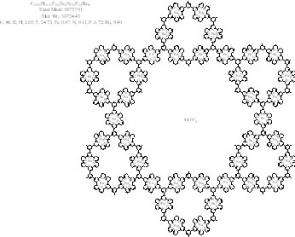
A University of Akron research team led by Vice President for Research George Newkome used molecular self-assembly techniques to synthesize the molecule in the laboratory. The molecule, bound with ions of iron and ruthenium, forms a hexagonal gasket.
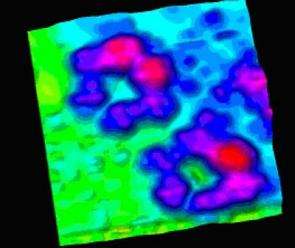
Ohio University physicists Saw-Wai Hla and Violeta Iancu, who specialize in imaging objects at the nanoscale, confirmed the creation of the man-made fractal. To capture the image, the physicists sprayed the molecules onto a piece of gold, chilled them to minus 449 degrees Fahrenheit to keep them stable, and then viewed them with a scanning tunneling microscope.
Though invisible to the naked eye – the molecules are about one million times smaller than the colorful hexagons shown in the Science image – the objects are 12 nanometers wide. "That's big for a nanoscale molecule. It's huge," said Hla, an associate professor of physics and astronomy.
"This man-made structure is one of the first nanoscale, non-branched fractal molecules ever produced," said Newkome, who is lead author on the Science paper and also serves as dean of the Graduate School and the James and Vanita Oelschlager Professor of Science and Technology at the University of Akron. "Blending mathematics, art and science, these nanoscopic hexagonal-shaped materials can be self-assembled and resemble a fine bead necklace. These precise polymers -- the first example of a molecule possessing a 'Star of David' motif -- may provide an entrée into novel new types of photoelectric cells, molecular batteries and energy storage."
Fractals are irregular curves or shapes that retain the same pattern when reduced or magnified. The molecule in the study, for example, is composed of six rings, which are made up of six smaller rings, and so on, Hla explained. Snowflakes, broccoli florets or tree bark would be just a few examples from nature.
Hla and Iancu, a graduate student, also were able to measure the electronic structure of the molecule, which is useful to know for possible electronic applications. "(The molecules) are unique in their own way, so you have to find out what kind of properties they have so we can initiate possible applications," he said.
The study authors were George R. Newkome, Pingshan Wang, Charles N. Moorefield, Tae Joon Cho, Prabhu Mohapatra, Sinan Li, Seok-Ho Hwang and Judith A. Palagallo, all from the University of Akron; Violeta Iancu and Saw-Wai Hla of Ohio University; and Olena Lukoyanova and Luis Echegoyen of Clemson University.
Source: Ohio University


