Mother's Day roses could soon smell sweeter, thanks to new research
May 12, 2006
Mother’s Day roses could soon smell sweeter, thanks to new research

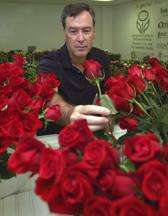
Harry Klee, a professor with the University of Florida’s Institute of Food and Agricultural Sciences, inspects roses in a biotechnology laboratory in Gainesville. Klee and other UF researchers believe they can improve the scent of many rose varieties using a gene discovered in tomato plants. The gene controls production of a chemical that enhances the aroma of flowers.

University of Florida researchers may have good news for disappointed consumers who want to know why their Mother’s Day roses just don’t smell as good as they used to.

Harry Klee, a professor with UF’s Institute of Food and Agricultural Sciences, says a breakthrough discovery in tomatoes could lead to better-smelling roses. The genetically improved flowers could be on the market in just a few years.

Klee and several UF researchers, including Andrew Hanson – like Klee, an eminent scholar with UF’s horticultural sciences department – have identified a gene in tomatoes that contributes to the fruit’s flavor.

That same gene is responsible for helping create desirable fragrances in roses and other flowers, and is thought to be involved in attracting insects that pollinate flowers, Klee said.

Although the research began with tomatoes and may eventually be used to improve their flavor, UF researchers first want to enhance the scent of roses, because many varieties sold by florists have little or no fragrance.

It took researchers several years to pin down the gene responsible for making the compound, 2-phenylethanol, commonly known as rose oil.

“We’re excited about doing it, and feel very optimistic that this is the missing link,” Klee said.

Flower breeders have put so much emphasis on creating varieties of eye-popping blooms that scent just “got lost along the way,” Klee said.

“It takes energy to make a bigger rose, and that has to come from somewhere - probably from scent,” he said.

The research team published its findings this month in the Proceedings of the National Academy of Sciences. UF is exploring the commercial potential for the technology, which was developed with assistance from two researchers from Germany’s Max Planck Institute.

The 2-phenylethanol finding could one day have an even bigger impact, Klee says, because the compound is important to the taste of many foods and beverages, including beer, wine and grapes.

“Anybody who’s interested in flavor will eventually be interested in this,” he said.

The compound can be used to make fragrances for perfumes as well, he said. Right now, it can be made synthetically but that method makes what Klee calls “side product” odors that fragrance purists frown upon.

“The best analogy I can come up with is that it’s like pure vanilla extract versus imitation vanilla,” he said. “People who make perfumes are very sensitive to those types of differences.”

And naturally produced rose oil is expensive, requiring large quantities of roses to make a small amount of oil. So engineering roses that produce more rose oil could have far-reaching implications, said UF associate professor David Clark, who is working to grow enhanced-fragrance roses using the newly discovered gene.

“I think a lot of people are going to jump on Harry’s discovery,” Clark said. “It’s important because this work provides a basis for answering biochemical questions that have been around a long time, like, ‘What makes a vegetable or fruit taste better?’ Or ‘What makes a flower smell better?’”

For Walter Metz, a former florist and now a florist trainer who works for the Florida State Florists’ Association in Lake Worth, the possibility of making roses more fragrant is cause for celebration.

“With so much hybridization, we’ve got stronger colors, straighter stems, bigger blooms – and less smell,” he said. “There are so many, especially the red ones, that just aren’t fragrant anymore.”

Source: University of Florida

4.6 /5 (7 votes)  

Rank 4.6 /5 (7 votes)
Tags

Relevant PhysicsForums posts

More news stories

Entire genome of extinct human decoded from fossil

(PhysOrg.com) -- In 2010, Svante Pääbo and his colleagues presented a draft version of the genome from a small fragment of a human finger bone discovered in Denisova Cave in southern Siberia. The ...

Biology / Biotechnology

created Feb 07, 2012 | popularity 4.7 / 5 (58) | comments 44 | with audio podcast

Why are there so few fish in the Earth's oceans?

(PhysOrg.com) -- A Stony Brook University researcher has found that, contrary to popular belief, there are not plenty of fish in the sea.

Biology / Plants & Animals

created Feb 08, 2012 | popularity 4.3 / 5 (17) | comments 25 | with audio podcast

Miami battling invasion of giant African snails

No one knows how they got there. But an invasion of African giant snails has southern Florida in a panic over potential crop damage, disease and general yuckiness surrounding the slimy gastropods.

Biology / Ecology

created Feb 10, 2012 | popularity 4.5 / 5 (2) | comments 5

The power of estrogen -- male snakes attract other males

A new study has shown that boosting the estrogen levels of male garter snakes causes them to secrete the same pheromones that females use to attract suitors, and turned the males into just about the sexiest ...

Biology / Plants & Animals

created Feb 10, 2012 | popularity 4.8 / 5 (6) | comments 2 | with audio podcast

Deciding to go left or right: Researchers use device to determine that lower animals can navigate too

For decades, scientists have associated binary decision making — opting to go left or right — with higher-ranking animals, including humans. A team of Harvard researchers, however, is rewriting that ...

Biology / Plants & Animals

created Feb 09, 2012 | popularity 4 / 5 (1) | comments 4 | with audio podcast


Walney offshore wind farm is world's biggest (for now)

(PhysOrg.com) -- The Walney wind farm on the Irish Sea--characterized by high tides, waves and windy weather--officially opened this week. The farm is treated in the press as a very big deal as the Walney ...

GPS court ruling leaves US phone tracking unclear

A US Supreme Court decision requiring a warrant to place a GPS device on the car of a criminal suspect leaves unresolved the bigger issue of police tracking using mobile phones, legal experts say.

Europeans protest controversial Internet pact

Tens of thousands of people marched in protests in more than a dozen European cities Saturday against a controversial anti-online piracy pact that critics say could curtail Internet freedom.

Europe stakes billion-dollar bet on new rocket

A pencil-slim rocket is scheduled to lift into space from South America on Monday, carrying a billion-dollar bet that Europe can grab a juicy slice of the market to place satellites in low orbit.

Study finds that anti-diabetic medication can prevent the long-term effects of maternal obesity

In a study to be presented today at the Society for Maternal-Fetal Medicine's annual meeting, The Pregnancy Meeting, in Dallas, Texas, researchers will report findings that show that short therapy with the anti-diabetic medication ...

Netflix settlement trims 14 pct off 4Q earnings

(AP) -- Netflix pressed the rewind button on its fourth-quarter earnings after settling allegations that the video subscription service violated a consumer-privacy law.