Ferreting Out The First Stars
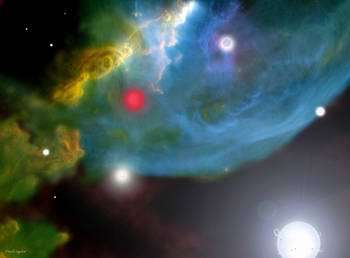
What did the very first stars look like? How did they live and die? Astronomers have ideas, but no proof. The first stars are so distant and formed so long ago that they are invisible to our best telescopes.
Until they explode. Hypernovas (more powerful cousins of supernovas) and their associated gamma-ray bursts offer astronomers the possibility of detecting light from the first generations of stars.
Image: Shown in this artist's conception, the universe's first stars were behemoths that guzzled fuel faster than an SUV, dying quickly and explosively. NASA's Swift satellite may detect the resulting gamma-ray bursts, opening a new window onto the early history of the cosmos. Credit: David A. Aguilar (CfA)
NASA's Swift satellite already has seen a gamma-ray burst (GRB) with a redshift of 6.29, meaning that the progenitor star exploded about 13 billion years ago, when the universe was less than a billion years old. Theorists Volker Bromm (University of Texas at Austin) and Avi Loeb (Harvard-Smithsonian Center for Astrophysics) predict that one-tenth of the blasts Swift will spot during its operational lifetime will come from stars at a redshift of 5 or greater, that lived and died during the first billion years of the universe.
"Most of those GRBs will come from second generation or later stars," said Loeb. "But if we get lucky, Swift may even detect a burst from one of the very first stars that formed -- a star made of only hydrogen and helium."
Calculations suggest that such stars, which are called Population III for historical reasons, would have been behemoths weighing 50-500 times as much as the Sun. A Population III star would have gulped its nuclear fuel faster than an SUV, dying quickly and explosively.
"Our best guess right now is that the recent GRB was not from a Pop III star. However, its redshift is high enough to make it very interesting," said Bromm.
One key question examined by Bromm and Loeb is whether a Pop III star could have generated a GRB -- a blast powerful enough to be seen from a distance of more than 13 billion light-years.
The answer they derived is a qualified yes. Pop III stars were massive enough to explode violently, leaving behind a black hole in most cases. However, a Pop III star likely would have to be part of a tight binary system to generate a GRB.
A close binary companion could strip the outer layers of a dying Pop III star, leaving less material to block the star's explosive death throes. Jets of material generated from the newborn black hole therefore could punch their way out more easily, creating a burst of gamma-ray energy detectable across the universe.
About half of all nearby stars are members of binary or multiple star systems. The frequency of binaries, particularly close binaries, among Pop III stars remains unknown.
"Astronomers will address this question of the Pop III binary frequency using a dual approach, both observational and theoretical," said Bromm. "By searching for high-redshift GRBs, we can constrain that number empirically. We also will try to improve simulations and make them detailed enough to model those details of star formation."
If binary star systems are common among Pop III stars, then high-redshift GRBs could offer astronomers an ideal opportunity to study the first generation of stars.
"If Pop III binaries are common, Swift will be the first observatory to probe Population III star formation at high redshifts," said Loeb.
This research has been submitted for publication to The Astrophysical Journal and is available online at arxiv.org/abs/astro-ph/0509303
Source: Harvard-Smithsonian Center for Astrophysics


