Smell of success for nanobiosensors
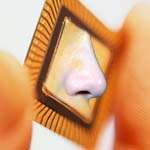
Modern-day doctors may soon start using smell to detect the early warning signs of different illnesses thanks to technology that replicates - and improves upon - the human olfactory system thanks to tiny bioelectronic sensors.
The new interdisciplinary technology approach, developed and tested by researchers in Spain, France and Italy with funding from the European Commission’s FET (Future and Emerging Technologies) initiative of the IST programme, will ultimately lead to electronic noses based on natural olfactory receptors that could be used not only in healthcare but also in agriculture, industry, environmental protection or security.
“The potential uses of smell technology are endless,” notes Josep Samitier, the coordinator of the SPOT-NOSED project that developed nanobiosensors to mimic the way human and animal noses respond to different odours.
This new nose biosensor is unusual in how it’s made. By placing a layer of proteins that constitute the olfactory receptors in animal noses on a microelectrode and measuring the reaction when the proteins come into contact with different odorants, the system is capable of detecting odorants at concentrations that would be imperceptible to humans.
“Our tests showed that the nanobiosensors will react to a few molecules of odorant with a very high degree of accuracy. Some of the results of the trials surpassed even our expectations,” Samitier says. These tiny bioelectronic sensors, he says, represent a ‘major leap forward’ in smell technology and a clear example of a biomimetic devices obtained by converging Nano-Bio-Info technologies.
Several hundred different proteins, which the SPOT-NOSED researchers genetically copied from rats and grew in yeast, would be needed for an electronic nose to detect almost any smell because different proteins react to different odorants and it is the resultant combination of reactions that identifies a certain smell. Nanotechnology makes such an electronic nose feasible, the coordinator notes, even though the human nose uses 1,000 different proteins to allow the brain to recognise 10,000 different smells.
While the SPOT-NOSED project focused on replicating the physical reaction that takes place in animal noses, the project partners are now planning to continue their research and develop the instrumentation and software tools necessary for an electronic nose to recognise smells – the role played by the brain in the olfactory system. In this sense, new high accuracy electronic instrumentation capable of performing electrical measurements at the nanoscale level has been developed and adapted to an atomic force microscope with atofarad precision (10-15).
This, Samitier says, could lead to medical applications to diagnose organ failure, bacterial infections or diseases such as cancer being made commercially available within a few years, as well as devices that would have a major impact on other sectors. A major challenge of these new diagnostic tools lies in the establishment of a precise odorant disease signature, understood as the mix of volatile compounds whose concentration in a body fluid (i.e. urine, blood, pus, etc) or in the breath varies in patients with the malignancy with respect to healthy individuals. Moreover, smell technology could, for example, be used to detect rotten food, test cosmetics and pharmaceuticals, identify pollutants or scan for drugs and bombs at airports, replacing chemical sensors that are only able to detect a single substance.
Source: IST Results


