May 15, 2006 feature
Super-Kamiokande Finds Structure in the Cosmic Ray Sky

Cosmic rays, which are high-energy atomic nuclei driven by spectacular cosmic events, come to us from every direction on the sky. Most of them are destroyed high in the atmosphere, creating a shower of high-speed particles that penetrate sky and earth with ease. Surprising results from Japan's Super-Kamiokande underground observatory have recently shown that the distribution of cosmic rays on the sky is not uniform, a useful clue to the nature of these cosmic voyagers.
Supernovae and similar high-energy events can accelerate protons and heavier atomic nuclei to enormous speeds, imparting a kinetic energy thousands of times greater than the mass of the particle itself. Many are much more powerful than anything our best particle accelerators can produce, so cosmic rays are of great interest to particle physicists as well as astronomers. The strongest (and rarest) cosmic rays can pack as much kinetic energy as a good punch in the jaw -- no mean feat for a subatomic particle weighing 1027 times less than your fist!
For all their scientific potential, cosmic rays cannot be identified with any specific source. Because atomic nuclei are charged particles, they can be deflected by the Milky Way's magnetic field. While scientists have many ideas concerning the astronomical processes that can create cosmic rays, it has proven difficult to test these ideas.
What's more, most of the cosmic rays that meet the Earth never make it to the ground. Their annihilation in the atmosphere produces an “shower” of muons (heavy electrons, essentially), neutrinos, and other simple subatomic particles. Some of the byproducts can produce showers of their own, eventually dissipating most of the cosmic ray's energy into the atmosphere. (The photograph shown here was taken from a baloon high in the atmosphere.) The high-energy muons, however, interact only rarely with matter and can slide through miles of atmosphere and bedrock before coming to a halt.
Building a better μ-trap
Cosmic ray muons are elusive targets, and can't be counted by watching the sky. Instead researchers must surround an enormous volume of transparent material with detectors, and hope to catch a small fraction of the passing particles inside. The Super-Kamiokande experiment, for example, is an underground tank containing 50,000 tons of water.
Lining the walls of this tank are 11,200 photomultiplier tubes, sensitive instruments that amplify the faintest glimmer of light into a strong electrical current. If an interesting event occurs anywhere in the tank's volume, the nature of the interaction can be reconstructed from the pattern of captured light on the walls. When supernova 1987a exploded in the Large Magellanic Cloud, for example, Super-Kamiokande captured a dozen neutrinos in two separate pulses from the dying star.
Cosmic muons in particular have a distinctive signature. While they travel at speeds close to that of light, light is about 75% slower in water than in air. The muons therefore move faster than the light they emit, so the leading edges of the emitted waves pile up into a bright, cone-shaped pulse. The same phenomenon can be seen in the powerful crest that defines the wake of a speedboat, or heard in the boom of a supersonic jet or rocket. When a cosmic muon passes through, the photomultipliers trace out a perfect ellipse or hyperbola (a conic section) on the wall.
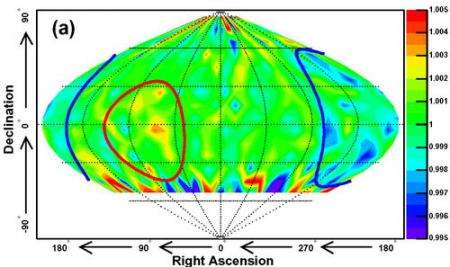
Collecting over 200 million cosmic ray muons from five years of Super-Kamiokande data, researchers Gene Guillian, Yuichi Oyama, and other collaborators were able to reconstruct a full-sky map of the cosmic ray flux. Two features are readily apparent: an excess of cosmic rays in the direction of the constellation Taurus, and a deficit in the direction of Virgo. (The scale on the right is the ratio of local flux to average flux.)
The excess and deficit are both detected with a very high confidence; the probability for each to have been produced by random fluctuations is less than one in a million. Their amplitudes are also roughly the same, and they are separated by an angle of about 130° on the sky. This odd angle seems to preclude the most obvious explanation, that Super-K is seeing the effect of the Earth's motion with respect to an isotropic cosmic ray background. If such were the case, then the separation between the two features should be exactly 180°.
Oyama and Guillian offer another possible explanation. The cosmic ray excess points into the denser regions of our spiral arm of the Milky Way galaxy, and the deficit is pointing roughly out of the galactic plane. Does this result prove that some of the cosmic rays come from nearby sources? “We have no idea about this,” responds Oyama, who goes on to explain that the entire theoretical community will want to debate the matter. Guillian's paper, for example, mentions a competing hypothesis: that local structure in the galactic magnetic field may focus or defocus the cosmic ray flux in certain directions.
These results provide an important clue to the origin of cosmic rays, and will certainly shed light on the question of how the galactic magnetic field influences their journey. “In 1987, Kamiokande started an astronomy beyond light.” Dr. Oyama explains, referring to the detection of supernova neutrinos mentioned above. “In 2005, Super-Kamiokande started an astronomy beyond neutral particles.”
References:
Yuichi Oyama, 2006, “Anisotropy of the Primary Cosmic Ray Flux in Super-Kamiokande” http://xxx.lanl.gov/astro-ph/0605020
Gene Guillian et al., 2005, “Observation of the Anisotropy of 10 TeV Primary Cosmic Ray Nuclei Flux with the Super-Kamiokande-I Detector” http://xxx.lanl.gov/astro-ph/0508468
The cosmic ray photograph was taken from the website “The Exploration of the Earth's Magnetosphere” at URL http://www-spof.gsfc.nasa.gov/Education/index.html
By Ben Mathiesen, Copyright 2006 PhysOrg.com


