Taking on a New Shape
May 15, 2006
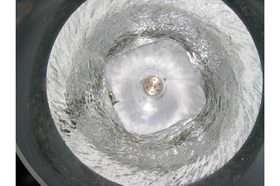
Rotating Polygons. Credit: Thomas Jansson.
“It is seldom that you see a new stable structure appearing spontaneously in a completely symmetric environment,” explains Tomas Bohr, a physicist at the Technical University of Denmark. “Usually you have to do something to break the symmetry. But we’re not doing anything to break the symmetry. The system does it all by itself.”
The unusual phenomenon in question involves rotating a bottom plate under a liquid in a circular (cylindrical) container. Bohr and his team of students at the Technical University and at the Niels Bohr Institute set up an experiment to find out whether or not such conditions would lead to stable deformations of a water surface into polygon shapes. The findings from their experiment were published May 3rd in Physical Review Letters.
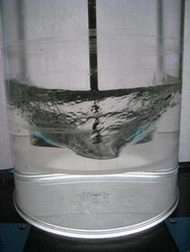
Rotating Polygons. Credit: Thomas Jansson.
Bohr tells PhysOrg.com that a somewhat similar experiment took place eight years ago with a different team (including Clive Ellegaard and others). “We had fluid falling on a plane, like water from a faucet. We found that even if the rim of the plate is completely circular, the fluid surface can be shaped like a polygon.”While the first polygon experiment Bohr did involved stationary polygons, the most recent effort shows rotating polygons. “Not only are these shapes rotating,” says Bohr, “but they are rotating at a different speed than the plate beneath them.”
“Nobody predicted that it should behave like this,” Bohr continues. “You start with something that is completely circular, basically like a hand without fingers, and, suddenly, out of nowhere, fingers develop. The fluid is pressed against a round wall, at first in a circular shape, but it wants to become something else, to develop a corner.”
Bohr finds the mystery fascinating. The circle shape demonstrates instability, but when it develops into a polygon (and Bohr’s team has found that the polygon can have anywhere from two to six sides), it becomes quite stable and can remain the same for hours. In some cases there can also be slow transitions from one polygon to another.
The findings are related to geophysical phenomena around us. Bohr explains that similar forces are at work on our own planet: “We live on a rotating sphere, and fluids abound in the oceans and in the atmosphere,” he explains. “Our experiment might help us know the basic instabilities and properties of systems like that.”
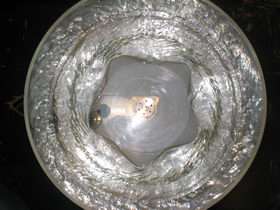
Rotating Polygons. Credit: Thomas Jansson.
Right now, admits Bohr, there is little known of these rotating polygons beyond the fact that they exist, and that they behave in ways nobody expected. “We think this is a spectacular phenomenon” he says, “but we don’t know why it works. Maybe someone will get a bright idea when they read our paper.”Bohr has plans to continuing examining this phenomenon. “We want to build new containers with different sizes, et cetera, and find ways to probe this more accurately, so we can be sure exactly which conditions are necessary to see the polygons.”
You can see pictures of the experiment, and watch a video, by visiting the Technical University of Denmark’s Rotating Polygons site.
By Miranda Marquit, Copyright 2006 PhysOrg.com
-
Rice lab mimics Jupiter's Trojan asteroids inside a single atom
Jan 24, 2012 |
4.5 / 5 (13) |
6
-
JQI cool nano loudspeakers could makes for better MRIs, quantum computers
Jan 25, 2012 |
4.8 / 5 (4) |
0
-
Physicists cool semiconductor by laser light
Jan 22, 2012 |
4.5 / 5 (11) |
2
-
Physicist creates scale model of LHC ATLAS experiment of out LEGO blocks
Dec 30, 2011 |
3.6 / 5 (17) |
19
-
U of Toronto experiment named top breakthrough of 2011 by Physics World
Dec 16, 2011 |
5 / 5 (6) |
19
-
Engineers build first sub-10-nm carbon nanotube transistor
Feb 01, 2012 |
4.9 / 5 (30) |
30
-
Something old, something new: Evolution and the structural divergence of duplicate genes
Jan 31, 2012 |
4.6 / 5 (7) |
1
-
The hidden nanoworld of ice crystals: Revealing the dynamic behavior of quasi-liquid layers
Jan 30, 2012 |
5 / 5 (3) |
1
-
Stock market network reveals investor clustering
Jan 27, 2012 |
3.9 / 5 (23) |
8
-
Of microchemistry and molecules: Electronic microfluidic device synthesizes biocompatible probes
Jan 26, 2012 |
5 / 5 (1) |
0
-
Steam Table issues
49 minutes ago
-
Problem with the curl of electric field
56 minutes ago
-
electrostatic induction in a conductor should be immpossible
4 hours ago
-
Help! Physics Momentum/Impulse problem!
7 hours ago
-
Gauss' law cubes, how to prove
8 hours ago
-
what is significance of torque
10 hours ago
- More from Physics Forums - General Physics
More news stories
Physics research suggests new pathways for cancer progression
Observing that certain cancer cells may exhibit greater flexibility than normal cells, some scientists believe that this capability promotes rapid tumor growth. Now computer simulations developed by Boston University Biomedical ...
21 hours ago |
5 / 5 (1) |
0
Quantum physicist explains $100K offer for proof scaled-up quantum computing is impossible
(PhysOrg.com) -- MIT researcher Scott Aaronson has certainly riled the physics community with his offer this past Friday, of $100,000 to anyone who can prove that scaled-up quantum computing is impossible. ...
Explained: Sigma
It's a question that arises with virtually every major new finding in science or medicine: What makes a result reliable enough to be taken seriously? The answer has to do with statistical significance -- but ...
Feb 09, 2012 |
5 / 5 (13) |
32
Physicists 'record' magnetic breakthrough
An international team of scientists has demonstrated a revolutionary new way of magnetic recording which will allow information to be processed hundreds of times faster than by current hard drive technology.
Feb 07, 2012 |
4.5 / 5 (39) |
14
|
Diamond light, brighter than the sun
Its the size of five football pitches and generates light 10 billion times brighter than the sun. As the Diamond Light Source celebrates its tenth anniversary this year, Penny Bailey visits one of the ...
Feb 07, 2012 |
4.3 / 5 (7) |
15
|
New error-correcting codes guarantee the fastest possible rate of data transmission
Error-correcting codes are one of the triumphs of the digital age. Theyre a way of encoding information so that it can be transmitted across a communication channel such as an optical fiber o ...
Humans may have helped the decline of African rainforests 3000 years ago
(PhysOrg.com) -- Large areas of rainforests in Central Africa mysteriously disappeared over three thousand years ago, to be replaced by savannas. The prevailing theory has been that the cause was a change ...
Japan scientist makes 'Avatar' robot
A Japanese-developed robot that mimics the movements of its human controller is bringing the Hollywood blockbuster "Avatar" one step closer to reality.
Protein libraries in a snap
(PhysOrg.com) -- A Rice University undergraduate will depart with not only a degree but also a possible patent for his invention of an efficient way to create protein libraries, an important component of biomolecular ...
Miami battling invasion of giant African snails
No one knows how they got there. But an invasion of African giant snails has southern Florida in a panic over potential crop damage, disease and general yuckiness surrounding the slimy gastropods.
Sleep breathing machine shows clear benefits in children with sleep apnea
Children and adolescents with obstructive sleep apnea had substantial improvements in attention, anxiety and quality of life after treatment with positive airway pressure (PAP)a nighttime therapy in which a machine ...
Jul 05, 2008
Rank: not rated yet
Oct 14, 2008
Rank: 5 / 5 (1)
http://www.jpl.na...2007-034
I would imagine that finding a relationship between the fluid rotation speed and the bottom plate's rotation speed would then help in calculating the true rotation speed of Saturn underneath its atmosphere...