Carbon fullerenes now have metallic cousins, 'hollow golden cages'
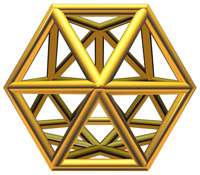
May 15, 2006 Au16, the smallest hollow gold cluster.

Au16, the smallest hollow gold cluster.

Scientists have uncovered a class of gold atom clusters that are the first known metallic hollow equivalents of the famous hollow carbon fullerenes known as buckyballs. The evidence for what their discoverers call "hollow golden cages" appeared today in the online early edition of the Proceedings of the National Academy of Sciences.

The fullerene is made up of a sphere of 60 carbon (C) atoms; gold (Au) requires many fewer -- 16, 17 and 18 atoms, in triangular configurations more gem-like than soccer ball. At more than 6 angstroms across, or roughly a ten-millionth the size of this comma, they are nonetheless roomy enough to cage a smaller atom.

"This is the first time that a hollow cage made of metal has been experimentally proved," said Lai-Sheng Wang, the paper's lead corresponding author.

Wang is an affiliate senior chief scientist at the Department of Energy's Pacific Northwest National Laboratory and professor of physics at Washington State University. The experiments were buttressed and the clusters' geometry deciphered from theoretical calculations led by Professor Xiao Cheng Zeng of the University of Nebraska and co-corresponding author.

Wang, who worked in the Richard Smalley lab that gave the world buckyballs, is part of a large cluster of researchers who have spent much of the past decade attempting to find the fullerene's kin in metal. But their search has proved difficult because of metal clusters' tendency to compact or flatten.

Experiments at the PNNL-based W.R. Wiley Environmental Molecular Sciences Laboratory elicited the photoelectron spectra of clusters smaller than Au32, which had been theorized as the gold-cage analog to C60 but ruled out by Wang's group in an experiment that showed it as being a compact clump.

They instead turned their attention to clusters smaller than 20 atoms, which earlier work by Wang's group showed were 3-D-- a golden pyramid, no less--but larger than 13 atoms, known to be flat. The spectra and calculations showed that clusters of 15 atoms or fewer remained flat but that all but one possible configuration of 16, 17 and 18 atoms open in the middle. At 19 atoms, the spaces fill in again to form a near-pyramid.

"Au-16 is beautiful and can be viewed as the smallest golden cage," Wang said. He pictures it as having "removed the four corner atoms from our Au20 pyramid and then letting the remaining atoms relax a little," and thus opening up space in its center.

It and its larger neighbors are stable at room temperature and are known as "free-standing" cages--unattached to a surface or any other body, in a vacuum. "When deposited on a surface, the cluster may interact with the surface and the structure may change."

Wang and his co-workers suspect "that many different kinds of atoms can be trapped inside" these hollow clusters, a process called "doping." "These doped cages may very well survive on surfaces," suggesting a method for influencing physical and chemical properties at smaller-than-nano scales, "depending on the dopants."

Wang's group has not yet attempted to imprison a foreign atom in the hollow Au cages, but they plan to try.

Source: Pacific Northwest National Laboratory


print this article email this article download pdf blog this article bookmark this article     Stumble it Digg this share on Facebook retweet share on Reddit add to delicious
Rate this story - 4.2 /5 (51 votes)


May 15, 2006 all stories

Comments: 0

4.2 /5 (51 votes)
  • Stumble this up

  • Digg this

  • share this

  • hide
  • Related Stories

  • Bucky's brother -- The boron buckyball makes its debut
    created Apr 23, 2007 | popularity not rated yet | comments 0
  • Physicists discover structures of gold nanoclusters
    created Jan 16, 2007 | popularity not rated yet | comments 0
  • Clemson researchers develop nanotechnology
    created Oct 03, 2006 | popularity not rated yet | comments 0
  • 'Gadonanotubes' greatly outperform existing MRI contrast agents
    created Aug 11, 2005 | popularity not rated yet | comments 0
  • Rice finds 'on-off switch' for buckyball toxicity
    created Sep 24, 2004 | popularity not rated yet | comments 0


  • hide
  • Relevant PhysicsForums posts

  • Bodies in motionÂ…..
    created 2 hours ago
  • Refraction optics help
    created 2 hours ago
  • A basketball Jump Shot
    created 3 hours ago
  • help with accelerometer
    created 4 hours ago
  • More from Physics Forums - General Physics

Other News

Engineers image nanostructure of a solid acid catalyst and boost its catalytic activity

Nanotechnology / Nanomaterials

created 1hour ago | popularity 5 / 5 (1) | comments 1

The catalytic processes that facilitate the production of many chemicals and fuels could become much more environmentally friendly thanks to a breakthrough achieved by researchers from Lehigh and Rice Universities.


New transparent insulating film could enable energy-efficient displays

New transparent insulating film could enable energy-efficient displays

Nanotechnology / Nanomaterials

created 5 hours ago | popularity 4.8 / 5 (6) | comments 0

Johns Hopkins materials scientists have found a new use for a chemical compound that has traditionally been viewed as an electrical conductor, a substance that allows electricity to flow through it. By orienting ...


Ideal nanoparticle cancer therapies surf the bloodstream

Nanotechnology / Bio & Medicine

created 6 hours ago | popularity 5 / 5 (1) | comments 0

Eric Shaqfeh studies blood at Stanford University, using computer models that simulate how the fluid and the cells it contains move around. On November 11 at a meeting of the scientific society AVS, he will present his latest ...


New Digital 'Electronics' Concept May Continue Moore's Law

New Digital 'Electronics' Concept May Continue Moore's Law

Nanotechnology / Nanophysics

created Nov 05, 2009 | popularity 4.6 / 5 (56) | comments 9

(PhysOrg.com) -- Computers of the future could be operating not on electrons, but on tiny waves traveling through an electron "fluid," if a new proposal is successful. The new circuit design, recently introduced ...


Findings show nanomedicine promising for treating spinal cord injuries

Findings show nanomedicine promising for treating spinal cord injuries

Nanotechnology / Bio & Medicine

created Nov 08, 2009 | popularity 4.5 / 5 (4) | comments 0

(PhysOrg.com) -- Researchers at Purdue University have discovered a new approach for repairing damaged nerve fibers in spinal cord injuries using nano-spheres that could be injected into the blood shortly ...