NASA Looks at Hurricane Cloud Tops for Windy Clues
May 16, 2006 NASA Looks at Hurricane Cloud Tops for Windy Clues

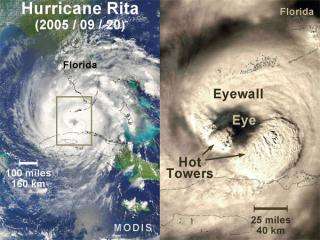
On September 20, 2005, Hurricane Rita rapidly intensified after entering the warm waters of the Gulf of Mexico. During that intensification, the MODIS instrument on the Aqua satellite captured this image of the cloud tops of Hurricane Rita, clearly showing two hot towers in the hurricane's eyewall. Credit: NASA

Scientists at NASA are finding that with hurricanes, they can look at the cloud tops for clues about the behavior of winds below the hurricane on the Earth's surface.

By looking at how high up the rain is forming within clouds, scientists can estimate whether the hurricane's surface winds will strengthen or weaken. They have found that if rain is falling from clouds that extend up to 9 miles high, and that rain continues for at least one out of three hours, a hurricane's surface winds are likely going to get stronger.

To see into the cloud tops, NASA scientists developed a precise mathematical method or a technique with the very precise rain measurements from the radar onboard the Tropical Rainfall Measuring Mission (TRMM) satellite. Once this technique was developed it was applied to data collected by National Weather Service radars on the ground.

"Thanks to the precise measurements from TRMM, we've found a new way to use data that's collected all the time by weather radars on the ground," said Owen Kelley, scientist at NASA's Goddard Space Flight Center, Greenbelt, Md.
NASA Looks at Hurricane Cloud Tops for Windy Clues

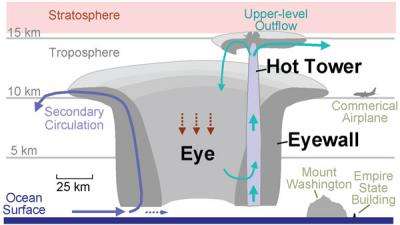
At the center of a hurricane is a relatively cloud-free eye. Surrounding the eye, there is often a ring of clouds called the "eyewall," which occurs directly over the strongest and most destructive surface winds of the hurricane. Scientists are still trying to determine why hot towers sometimes rise up from the eyewall, as shown in this schematic diagram. Only during the past ten years, routinely used radars have been precise enough to reveal the structure of these tall towers inside of hurricanes. Credit: NASA

Kelley and scientists John Stout of NASA Goddard and Jeff Halverson of the University of Maryland Baltimore County calculated statistics that suggest forecasters could use TRMM's rain-height observations to improve existing observations and computer model forecasts of hurricane winds. "The trick is to keep an eye on the height of rain that radars see when a hurricane approaches within 200 miles of the coast," Kelley said.

The TRMM satellite and the ground radar work well together, especially during hurricanes because they each have an advantage. National Weather Service radars on the ground give less precise height measurements of rainfall than the TRMM satellite's radar, but ground radars can continuously observe a nearby hurricane for hours at a time, whereas TRMM's orbit prevents it from hovering over one spot.

For several years, Kelley and his colleagues have been studying "hot towers," the towering high clouds in a hurricane's eyewall. The eyewall is the area of strong storms that surround a hurricane's mostly cloud-free eye. Hot towers can generate very heavy rainfall and reach the top of the troposphere, which extends 9 miles (14.5 km) above the Earth's surface in the tropics. These towers are called “hot” because a lot of heat is released inside them by water vapor condensing to form rain.

Hot towers are one window into the mystery of how hurricanes grow stronger. A single hot tower does not tell you much about a hurricane, but a rapid sequence of towers suggests that something unusual is going on deep inside the hurricane.

By combining measurements from many hurricanes, statistics show that if hot towers exist in the eyewall at least 33% of the time during a three-hour period, a hurricane's destructive surface winds have an 82% chance of intensifying. Otherwise, the chance of wind intensification drops to only 17%. The bottom line is that if several hot towers are present in a hurricane over a period of time, there's a higher probability of a storm intensifying.

Kelley is still searching for a more complete explanation of what causes these bursts of hot towers. Radar observations have shown conclusively that these bursts happen, but further research is needed to explain why and how.

TRMM, which was built by NASA and the Japan Aerospace Exploration Agency, and launched in 1997, has been orbiting the Earth watching rainfall from space.

This study appeared in an issue of Geophysical Research Letters in the fall of 2005. During the 2006 hurricane season, researchers both inside and outside NASA will continue to use TRMM to shed light on how hurricanes work.

Source: NASA/Goddard Space Flight Center, by Rob Gutro


print this article email this article download pdf blog this article bookmark this article     Stumble it Digg this share on Facebook retweet share on Reddit add to delicious
Rate this story - 4.9 /5 (7 votes)


May 16, 2006 all stories

Comments: 0

4.9 /5 (7 votes)
  • Stumble this up

  • Digg this

  • share this

  • hide
  • Related Stories


  • hide
  • Relevant PhysicsForums posts

  • cycles
    created Nov 08, 2009
  • The Origin of the term 'fossil' fuels
    created Nov 05, 2009
  • co2
    created Nov 03, 2009
  • Early Earths Sulfidic Ocean Conditions
    created Oct 30, 2009
  • vegetation
    created Oct 29, 2009
  • climate change
    created Oct 29, 2009
  • More from Physics Forums - Earth

Other News

NASA satellites make a movie and get rainfall, wind info on Ida

NASA satellites make a movie and get rainfall, wind info on Ida (w/ Video)

Space & Earth / Earth Sciences

created 1hour ago | popularity not rated yet | comments 0

NASA satellites are amazing examples of technology. The TRMM satellite peers into tropical cyclones and can tell how much rain is falling per hour and where. QuikScat uses microwave technology to measure Ida's ...


L-R: Chiwetel Ejiofor, Amanda Peet and John Cusack at the premiere of "2012"

NASA on crusade to debunk 2012 apocalypse myths

Space & Earth / Space Exploration

created 54 minutes ago | popularity not rated yet | comments 0

The world is not coming to an end on December 21, 2012, the US space agency insisted Monday in a rare campaign to dispel widespread rumors fueled by the Internet and a new Hollywood movie.


NASA's GOES Project offers real-time hurricane alley movies

NASA's GOES Project offers real-time hurricane alley movies

Space & Earth / Earth Sciences

created 44 minutes ago | popularity not rated yet | comments 0

People love to get the big picture of hurricane alleys, and thanks to the GOES Project at NASA's Goddard Space Flight Center in Greenbelt, Md., they can now get real-time satellite animations of the eastern ...


Antarctica glacier retreat creates new carbon dioxide store

Antarctica glacier retreat creates new carbon dioxide store

Space & Earth / Earth Sciences

created 5 hours ago | popularity 5 / 5 (2) | comments 0

Large blooms of tiny marine plants called phytoplankton are flourishing in areas of open water left exposed by the recent and rapid melting of ice shelves and glaciers around the Antarctic Peninsula. This ...


NASA's TRMM Satellite sees most of Ida's heaviest rain stayed off coasts

NASA's TRMM Satellite sees most of Ida's heaviest rain stayed off coasts

Space & Earth / Earth Sciences

created 1hour ago | popularity not rated yet | comments 0

NASA and the Japanese Space Agency's Tropical Rainfall Measuring Mission (TRMM) satellite flew over Ida and captured her rainfall when she passed by Nicaragua, Honduras and Belize this weekend. TRMM data revealed ...