Nanotube bundles could be used as motors for nanodevices
May 16th, 2006 Nano-oscillators

Nano-oscillators

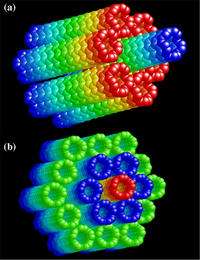
Even the smallest devices, assembled at the molecular level, need motors and oscillators. UC Riverside Mechanical Engineering Professor Qing Jiang thinks bundling groups of carbon nanotubes together could make an ultra-efficient and accurate nano-oscillator.

His findings were published in the in the May 14 issue of the Institute of Physics journal, Nanotechnology, in a paper titled Nanotube Oscillator Based on a Short Single-Walled Carbon Nanotube Bundle, co-authored with colleagues Jeon Won Kang, Ki Oh Song and Ho Jun Hwang from Chung-Ang University, Seoul, South Korea.

In the rapidly developing field of nanotechnology – doing things at a scale 100,000 times narrower than a human hair – nanodevices are becoming an increasingly key component in everything from drug delivery to improving or even replacing the microprocessors in computers or optical switches in telecommunications networks.

“We’re looking at the very fundamentals of machinery in the nanoscopic world and what it takes to move the components of these machines, ultra-fast, super-efficient and with extreme precision” Jiang said. “A nano-motor generating rotational motion, a nano-oscillator (like a piston) generating linear motion forward and backward. We’re looking at how best to generate these motions in a nano-environment.”

Jiang’s earlier work, done mostly with multi-walled carbon nanotube oscillators, in which a narrow nanotube is encased in a larger nanotube, encountered two limitations – frequency and friction. With increased frequency, beyond the benchmark one gigahertz (a billion cycles per second), increased energy dissipation creates a lot of heat, which reduces the efficiency of the tiny pistons.

His current work, with bundles of single-walled carbon nanotubes encased in an additional layer of single-walled carbon nanotubes outperformed their multi-walled counterparts and generated less heat and friction problems.

“We were very encouraged by the findings of this paper and think we may be on our way to developing efficient oscillators,” Jiang said.

However, Jiang and his colleagues plan on exploring new substances that could better address the friction and heat limitations that carbon nanotubes encounter.

Source: University of California, Riverside


print this article email this article download pdf blog this article bookmark this article     Digg this Stumble it share on Facebook share on Reddit add to delicious save to Yahoo! bookmarks
3.8/5 after 27 votes


May 16th, 2006 all stories
Nanotechnology / Nanophysics

Comments: 0
Rank: 3.8/5 after 27 votes

  • Stumble this up

  • Digg this

  • Share it:
  • share on Facebook
  • share on MySpace
  • share on Slashdot
  • rss-newsfeed
  • share on Google
  • share on Reddit
  • add to delicious
  • save to Yahoo! bookmarks
  • share on Windows Live
  • Add to Mixx!
Rating: 3.8/5 after 27 votes

  • Related Stories

  • Toward a new generation of paper-thin loudspeakers
    created Nov 17, 2008 | popularity not rated yet | comments 0
  • Tiny solar cells built to power microscopic machines
    created Nov 06, 2008 | popularity not rated yet | comments 0
  • New Nanomaterial, 'NanoBuds,' Combines Fullerenes and Nanotubes
    created Mar 30, 2007 | popularity not rated yet | comments 0
  • Telescoping nanotubes offer new option for nonvolatile memory
    created Feb 06, 2007 | popularity not rated yet | comments 0
  • Carbon Nanotubes Continue To Show Promise in Battle Against Cancer
    created Jun 30, 2009 | popularity not rated yet | comments 0

Tags


  • Physicists Demonstrate Quantum Memory with Matter Qubits
    Physicists Demonstrate Quantum Memory with Matter Qubits
    Physics / General Physics
    created Jul 03, 2009 | popularity 4.4 / 5 (17) | comments 1
  • 'Holey' Nanosheets for Wastewater Dye Removal
    Nanotechnology / Nanomaterials
    created Jul 01, 2009 | popularity 5 / 5 (5) | comments 1
  • Jellyfish Robot Swims Like its Biological Counterpart
    Jellyfish Robot Swims Like its Biological Counterpart
    Electronics / Robotics
    created Jun 26, 2009 | popularity 4.4 / 5 (8) | comments 1
  • Could Maxwell's Demon Exist in Nanoscale Systems?
    Could Maxwell's Demon Exist in Nanoscale Systems?
    Physics / General Physics
    created Jun 24, 2009 | popularity 4.4 / 5 (18) | comments 29
  • Living Safely with Robots, Beyond Asimov's Laws
    Living Safely with Robots, Beyond Asimov's Laws
    Electronics / Robotics
    created Jun 22, 2009 | popularity 4.6 / 5 (52) | comments 40
  • Other News

    A 'quantum of sol' -- how nanotechnology could hold the key to a solar-powered future

    A 'quantum of sol' -- how nanotechnology could hold the key to a solar-powered future

    Nanotechnology / Nanomaterials

    created Jun 30, 2009 | popularity 3.9 / 5 (14) | comments 16

    (PhysOrg.com) -- A new generation of 'nano-structured' millimetre-sized solar cells that could convert the sun's energy to electricity more than twice as efficiently as current technology, is the subject of ...


    Australian researchers are set to begin human trials of a tiny nano-cell that acts as a "Trojan horse" against cancer

    Hi-tech 'Trojan horse' can kill cancer cells: researchers

    Nanotechnology / Bio & Medicine

    created Jun 29, 2009 | popularity 4.6 / 5 (11) | comments 7

    Australian researchers are set to begin human trials of a tiny nano-cell that acts as a "Trojan horse" against cancer cells, a breakthrough they say may curb the need for debilitating chemotherapy.


    Harnessing Nanoparticles To Track Cancer Cell Changes

    Nanotechnology / Bio & Medicine

    created Jul 03, 2009 | popularity not rated yet | comments 1

    The more dots there are, the more accurate a picture you get when you connect them. Cancer researchers adopting that philosophy have developed a new imaging technology that could give scientists the ability to simultaneously ...


    'Holey' Nanosheets for Wastewater Dye Removal

    Nanotechnology / Nanomaterials

    created Jul 01, 2009 | popularity 5 / 5 (5) | comments 1

    (PhysOrg.com) -- Researchers have discovered that extremely thin sheets of nickel oxide with hexagonally shaped holes can absorb hazardous dyes from wastewater nearly as well as the best traditional methods, but are recyclable. ...


    Computer-Guided Nanoparticle Therapy Destroys Tumors

    Nanotechnology / Bio & Medicine

    created Jun 29, 2009 | popularity 5 / 5 (11) | comments 0

    Gold nanoshells are among the most promising new nanoscale therapeutics being developed to kill tumors, acting as antennas that turn light energy into heat that cooks cancer to death. Now, a multi-institutional research team ...